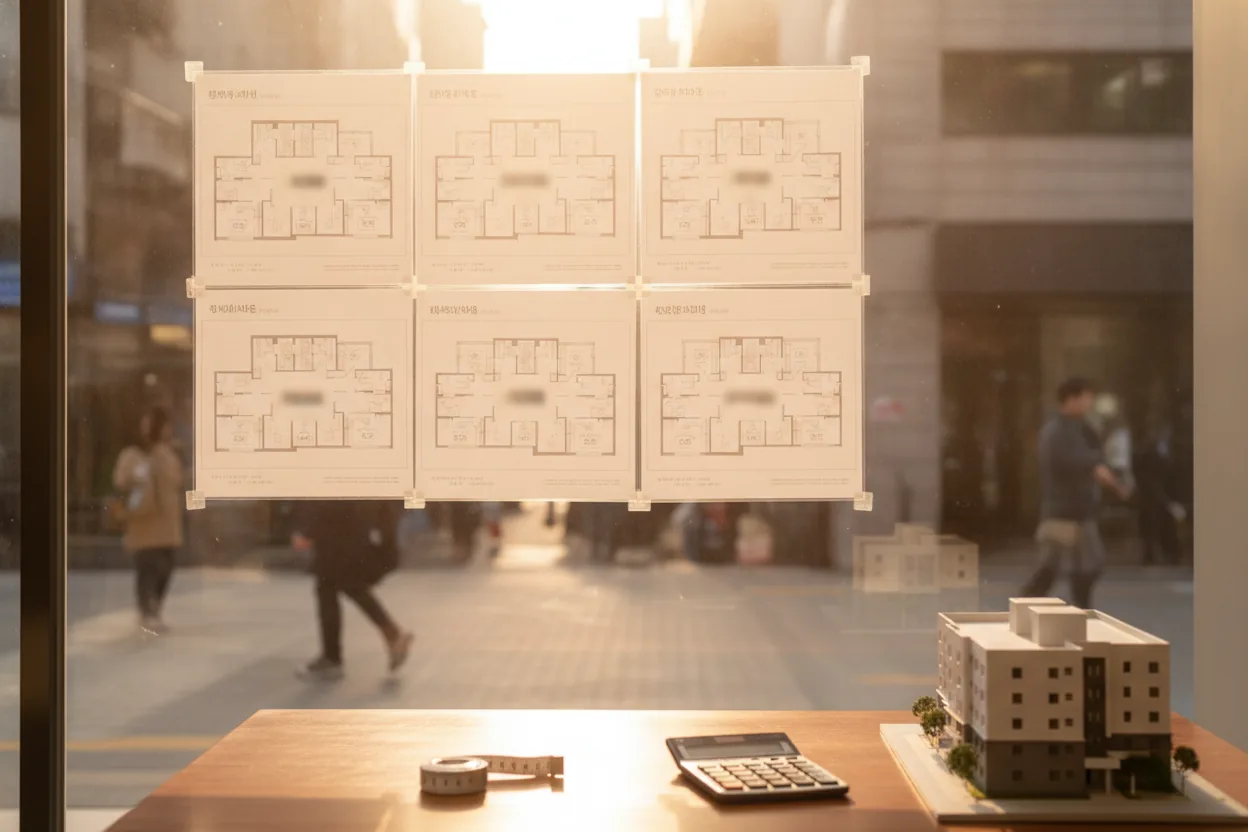
Understand what pyeong means and where it came from
South Korea started fining businesses for using pyeong instead of square meters back in 2007. A 2006 survey found that 88% of real estate brokerages kept using pyeong anyway. So if the law won on paper, why does almost every Korean still picture an apartment's size in pyeong rather than square meters?
The unit didn't even originate in Korea. It traces back to China and was widely adopted in Japan, where the equivalent unit is called tsubo. Japan brought pyeong to Korea during its occupation of the peninsula, using it to measure and record land area under Japanese administration. That history gives pyeong a colonial-era stain, but it hasn't stopped the unit from working its way into ordinary Korean life: apartment contracts, furniture sizing, even gold and silver sales, where people still use the traditional weight unit don instead of grams.
A 24-pyeong apartment converts to about 79.3 square meters. That specific size became culturally familiar enough in Korea to serve as shorthand for a certain kind of modest, standard household unit. The government's metric system expresses the same unit in square meters, the legally mandated standard today, but it still feels less familiar to many Korean apartment buyers than the pyeong figure they grew up hearing.
So if square meters became the law, why does pyeong keep showing up in listings, conversations, and casual real estate chatter? The next section looks at how the ban was actually enforced, and where that enforcement stopped short.
See how the law tried to ban pyeong and partly failed
South Korea's push to eliminate pyeong was a formal regulatory campaign, not some gradual cultural drift. Starting in 2007, the Technical Standards Agency under the Ministry of Trade, Industry and Resources (now reorganized as the Korean Agency for Technology and Standards) began fining businesses 500,000 won for using pyeong instead of square meters in official documents like dwelling sales contracts and apartment pre-sale notices. Then the rule expanded: from June 2010, fines applied to newspaper ads listing pyeong, and from January 2013, enforcement widened again to cover internet listings and real estate advertising platforms. Regulators pushed this hard because pyeong isn't an officially sanctioned unit under Korea's metric-only measurement law, and the government wanted one consistent standard across contracts and advertising. But the 2006 survey mentioned above, conducted jointly by the Ministry of Trade, Industry and Resources, the Korea Consumer Agency, and the Korea Association of Standards and Testing Organizations across 374 companies nationwide, found that 88% of real estate brokerages still customarily used pyeong instead of square meters. The same survey found 71% of precious metal sellers using don instead of grams. Pyeong wasn't an isolated holdout. It was part of a much broader pattern of traditional units refusing to die out across Korean commerce. If enforcement reached that far and compliance still stalled at those numbers, what actually kept the old unit alive?
The fines targeted formal documents and advertising channels, not everyday speech. Nobody got punished for saying pyeong in conversation, at a real estate office, or describing their own home to a friend. That gap between legal paperwork and daily language is exactly why pyeong survived: contracts list square meters to satisfy the law, while agents, buyers, and sellers keep thinking and talking in pyeong because it's still the more culturally legible number. Major Korean platforms like Daum have adapted to this split by showing both figures on listings, the square meter measurement as the compliant headline number, with the pyeong equivalent sitting right beside it so buyers can still judge size the way they're used to. But with two numbers now sitting side by side on every listing, how is a buyer supposed to know which one actually reflects the space they'd live in?
This dual listing also exposes a detail that trips up a lot of buyers, including international ones trying to make sense of Korean apartment listings: a single Korean apartment effectively has two different sizes depending on which area you're measuring. Korean real estate distinguishes between exclusive area, the private interior space a resident actually uses, and supply area, which tacks on shared spaces like stairwells, hallways, and sometimes parking facilities. A unit advertised as 24 pyeong in supply area terms will show a noticeably smaller exclusive area once converted. That's part of why the same apartment can carry two seemingly conflicting pyeong or square meter figures depending on the source.
For anyone comparing listings, check which area type a given pyeong or square meter figure refers to before comparing two apartments. Don't assume the headline number alone tells the full story. The law made square meters mandatory on paper, but it never reached the one place pyeong actually lives: the conversation between a buyer, a seller, and an agent standing in an apartment, deciding whether the space feels right. The fines couldn't close that gap, which is why a Korean apartment listing will keep showing both numbers for the foreseeable future.