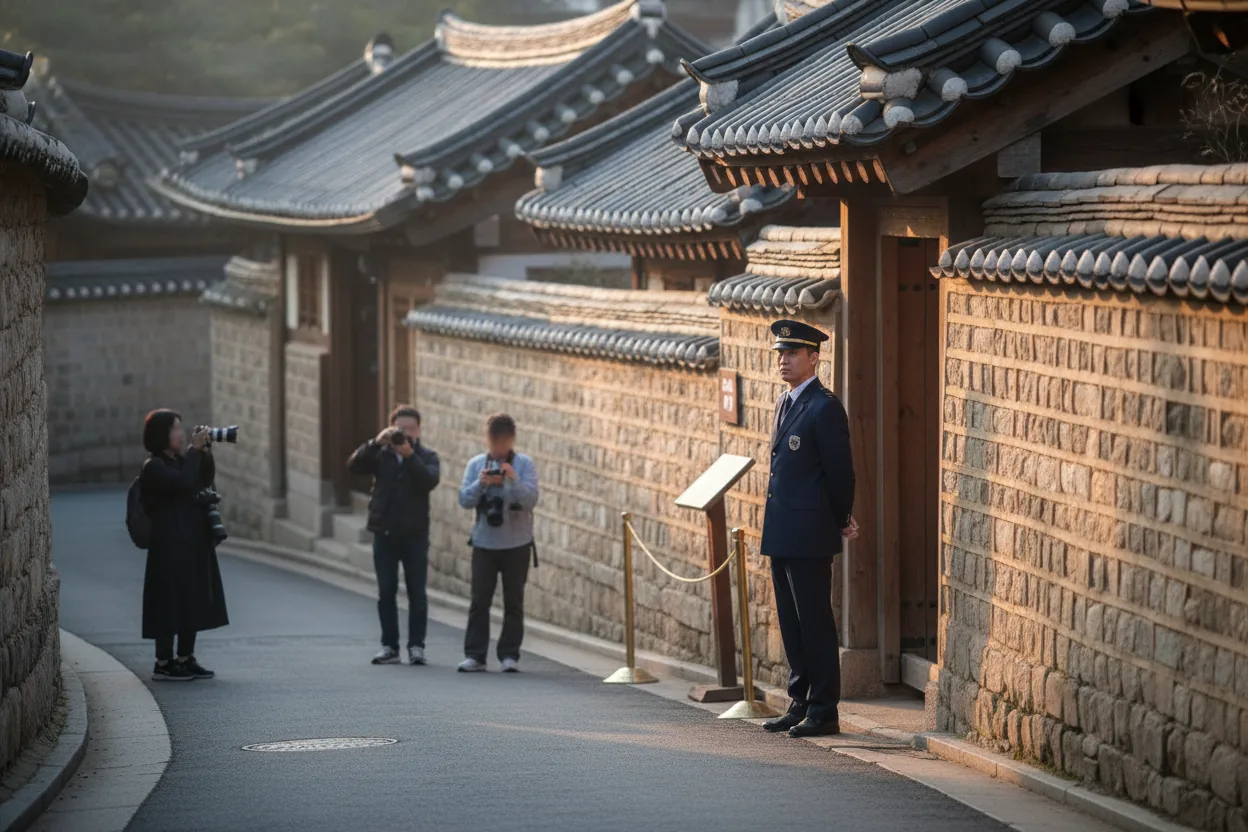
Six thousand people live in Bukchon Hanok Village. Six point four million visitors show up there every year. That mismatch is why a neighborhood famous for photogenic alleys now posts guards at checkpoints and fines people for touching the wrong gate. Most visitors still plan a Bukchon trip the way they would have in 2015: show up whenever, wander wherever, snap whatever looks good through a window. The rules written for 2026 don't work that way anymore, and knowing them before you arrive is the difference between a quiet morning walk and getting turned back in front of a tour group.
A decade ago you could wander Bukchon ro 11 gil at 7am with a camera and nobody blinked. In 2026, certain stretches are closed to tourists before 10am and after 5pm, and walking into a resident's courtyard to peek through a window can now cost money, not just a dirty look. Seoul didn't suddenly turn against tourists. The ratio of visitors to residents crossed a threshold no neighborhood could absorb, and this post lays out why that threshold got crossed, what the resulting rules actually say, and how to plan around them without ending up at a checkpoint.
Why Bukchon Reached Its Breaking Point
Bukchon's Impossible Ratio
Source: Article estimates based on reported local figures, 2026
The numbers tell the story better than any anecdote about a slammed gate or a drone buzzing a second story window. Between 2014 and 2024, Bukchon lost more than 27 percent of its resident population, according to reported figures that have circulated widely enough to be treated as the accepted baseline. That's not a slow demographic drift, that's families and elderly homeowners packing up and leaving ancestral houses because the street outside their door never went quiet. Social media turned Bukchon's tiled roofs and narrow alleys into a backdrop, and the backdrop started outnumbering the people who actually lived behind it.
- 6,000 permanent residents, give or take, as of recent counts
- 6.4 million annual visitors at peak, concentrated heavily on weekends
- 27 percent population decline documented between 2014 and 2024
- Bukchon ro 11 gil, the single most photographed alley and the site of the worst crowding
- Samcheong dong's connecting roads, regularly jammed by tour buses before restrictions tightened
What stands out, after watching this unfold over several years of filing stories from Seoul, is how long the informal phase lasted before anyone reached for a fine. Signs asked for quiet. Volunteer monitors wore vests. Pamphlets sat at the entrance. None of it worked, because a request without a consequence is just scenery to someone on a two day Seoul itinerary who flew in from Osaka or Chicago with one shot at the photo. The informal phase bought time, but not compliance. That gap produced the checkpoints standing there now, and it also shaped the two part rule structure covered next.
Reading The Current Rules Correctly
Resident Population Decline in Bukchon, 2014 to 2024
Source: Reported figures cited in article, treated as accepted baseline
Bukchon's regulations now operate on two tracks: time restrictions and conduct restrictions. Conflating the two is the most common mistake visitors make when reading about this neighborhood online. Time restrictions limit when visitors can be on certain residential lanes at all. Conduct restrictions apply everywhere, at any hour, and carry the fines people actually talk about afterward.
- 10am to 5pm, the window during which tourists are permitted on the most sensitive residential lanes
- Fines reported in the range of 100,000 won for noise violations and trespassing attempts, treated here as an observed pattern rather than a fixed tariff since enforcement amounts vary by case
- Checkpoint staff positioned at key alley entrances, including approaches to Bukchon ro 11 gil, checking for compliance during restricted hours
- Drone flights prohibited outright near residential structures regardless of time of day
- Private gates and windows off limits to touching, opening, or photographing from close range
Here's the part most travel blogs skip: the fine structure isn't primarily designed to generate revenue, it's designed to be high enough that word spreads. A single viral story about a tourist getting fined for yanking open a gate does more to change group tour behavior than a thousand polite signs ever did. Seoul has used this pattern before in other saturated neighborhoods, and it tends to work faster than voluntary codes of conduct, because tour guides update their briefings the moment a fine becomes a known risk rather than a theoretical one.
Of everything on that list, the 10am to 5pm window is the detail worth building a visit around. That's where planning comes in next.
Timing And Tools For A Fine Free Visit
Bukchon's Shift from Requests to Enforcement
Source: Article narrative of regulatory escalation
None of this makes Bukchon unvisitable. It makes Bukchon a neighborhood that rewards planning, the way Seongsu dong rewards knowing which converted warehouse cafes are worth the wait and which are just Instagram bait. The gap between a visitor who reads the rules first and one who doesn't is the gap between a thirty minute walk through quiet hanok lanes and a confrontation with a staff member holding a clipboard.
Arrive right at opening, around 10am, before tour buses from Myeongdong and Dongdaemun hotels have fully unloaded. That remains the single best lever a visitor has. Weekday mornings specifically, Tuesday through Thursday, see a fraction of the weekend crowd. Locals who still live in Bukchon will say, if asked directly, that weekday mornings are the only time the neighborhood still feels like somewhere people actually sleep.
- 10am arrival, timed to the opening of restricted hours, as the lowest crowd window
- Tuesday to Thursday, consistently quieter than Friday through Sunday
- Bukchon Hanok Village Information Center, near Jeongdok Public Library, a good first stop for an updated map of currently restricted lanes
- Gahoe Museum and nearby craft studios, offering an indoor alternative when outdoor lane access is time limited
- Jongno district office signage, posted at major entrances, listing current fine amounts and hours in both Korean and English
None of these workarounds cost anything beyond adjusting a schedule, which answers the mismatch this post opened with. Six thousand residents and 6.4 million annual visitors can't share the same narrow lanes on the visitors' terms, so the terms shifted: a fixed window, a conduct code, and a fine high enough to be remembered. The neighborhood never needed to charge an entrance fee, the way some overtouristed sites elsewhere in Asia eventually did, because time restrictions and a credible fine accomplished the same filtering effect without a ticket booth in front of a residential street. Whether that holds as a long term model, or whether Seoul eventually moves toward timed entry tickets the way certain European old towns have, is a separate question. For now, a visitor who shows up at 10am on a Tuesday with the current rules already in hand gets the Bukchon that used to be available at any hour: quiet lanes, no clipboard, no checkpoint standoff.