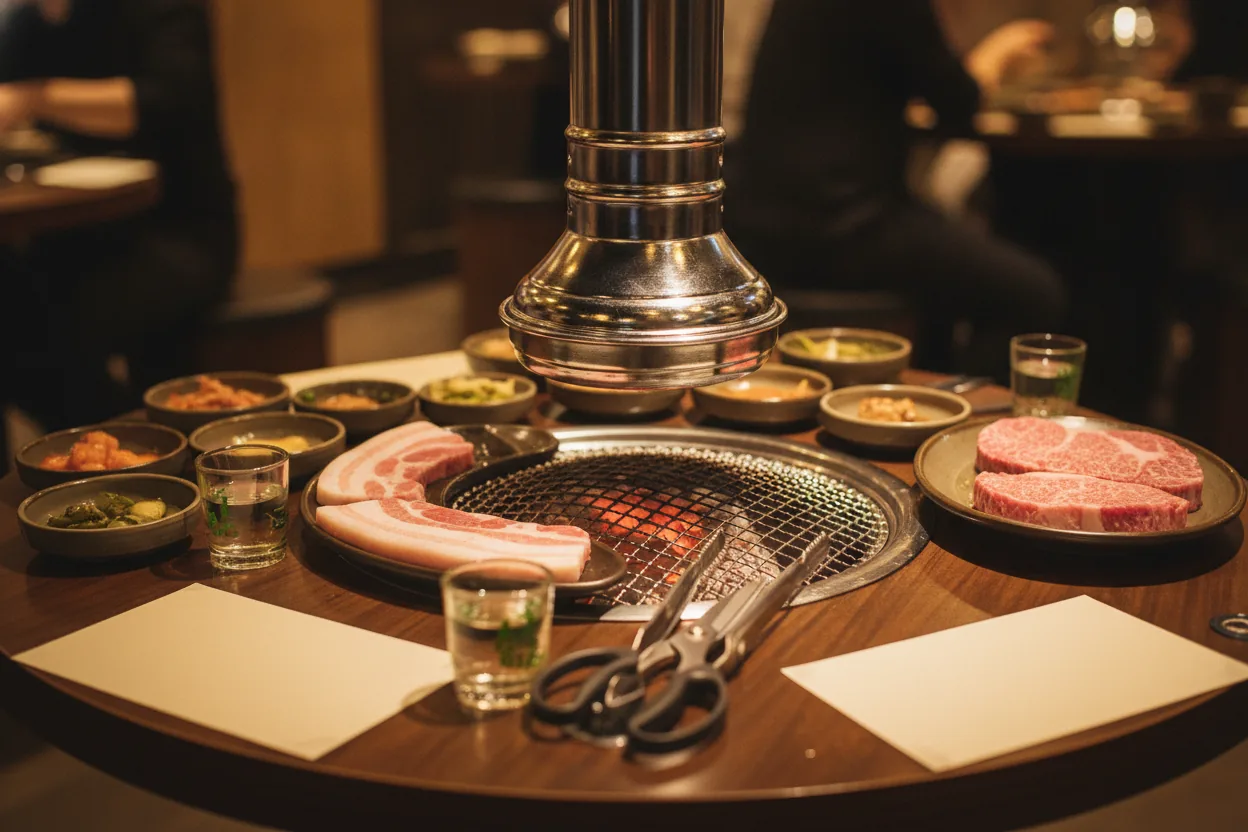
Order samgyeopsal at a Seoul BBQ joint and the bill lands around 15,000 to 18,000 won. Order hanwoo galbi at the same table, same portion size, and that number can triple or more, yet the menu lists both in identical Korean script at identical heights, so most visitors never see the gap coming. Locals read that menu as two separate economies, pork and beef, that happen to share a grill. The question is which cuts belong to which economy, and getting that wrong is how a traveler pays double for what should have been a routine dinner.
Korean BBQ isn't one food category with one price. It's two separate economies sitting on the same table, pork and beef, and they don't behave the same way at all. Knowing which cut belongs to which economy is probably the single most useful piece of ordering knowledge a traveler can carry into any Korean BBQ restaurant. Pork is the simpler side, so start there.
What Drives Samgyeopsal Pricing
Korean BBQ Cuts: Price Position by Category
| Cut | Type | Price vs Samgyeopsal | Price Tier |
|---|---|---|---|
| Samgyeopsal (pork belly) | Pork | Baseline | Low |
| Moksal (pork collar) | Pork | Same or slightly less | Low |
| Hangjeongsal (pork jowl) | Pork | +2,000 to 5,000 won | Low to Mid |
| Beef Galbi (imported) | Beef | Noticeably higher | Mid |
| Hanwoo Galbi/Course | Beef | Triple or more | High |
Source: Based on figures cited in article
Most guidebooks call samgyeopsal, or pork belly, the national dish of Korean barbecue, and fair enough, that's accurate. It shows up on nearly every BBQ menu in the country, from Seongsu dong gastropubs doing a modern spin to plastic stool joints near Dongdaemun that haven't touched their interior since the 1990s. What the guidebooks skip is the actual math behind the price tag.
Domestic pork, labeled guknae san on the menu, costs more than imported pork, usually from the United States or Canada. The gap isn't huge, maybe 2,000 to 4,000 won per order, but it shows up on nearly every menu that offers both. A plate of domestic samgyeopsal at a standard neighborhood restaurant sits in a mid range bracket for a typical portion. Hongdae or Gangnam will run you more, because rent gets baked into every gram of meat served there.
Moksal, the pork collar cut, sits right next to samgyeopsal on most menus and usually costs about the same or a touch less. It's leaner, grills a bit faster, and locals who find samgyeopsal too fatty order this instead without a second thought. Hangjeongsal, pork jowl, costs more than both, often 2,000 to 5,000 won above samgyeopsal, because the cut yields less meat per animal and has only caught on widely over the last decade.
Most visitors assume pork pricing spans some wide range depending on the cut. It doesn't. The menu shows a tight cluster, no pork cut on a standard menu costs dramatically more than samgyeopsal. That's good news for anyone on a budget: pork is the one part of a Korean BBQ order where guessing wrong barely hurts the bill. Beef works on the opposite principle, and that's where the real cost of a wrong guess shows up.
Beef Cuts That Create A Separate Price Tier
Pork Pricing: A Tight Cluster, Not a Range
Standard portion, neighborhood restaurant (won)
Samgyeopsal
15,000 to 18,000
Domestic baseline
Moksal
Same or less
Leaner collar cut
Hangjeongsal
+2,000 to 5,000
Above samgyeopsal
No pork cut on a standard menu strays far from this cluster, guessing wrong barely hurts the bill.
Source: Based on figures cited in article
Visitors who assume galbi is just the beef version of samgyeopsal are setting themselves up for a surprising bill. Galbi, which translates to ribs, can mean either pork or beef depending on the restaurant, and the two versions don't cost anywhere near the same. Beef galbi, especially hanwoo, Korea's prized domestic beef breed, costs noticeably more per order at a sit down restaurant, while the pork version stays in a comparatively modest range.
Hanwoo deserves its own mention, because that single word changes a menu's entire pricing structure. It's graded on a scale similar to Japanese wagyu, and restaurants serving it will often print the grade right on the menu or on a small card at the table. A hanwoo course meal, with cuts like deungshim (sirloin), anshim (tenderloin), and salchisal (a marbled cut from near the shoulder), can push the per person cost considerably higher depending on the restaurant and the grade. Imported beef, usually from Australia or the United States, runs noticeably cheaper for comparable cuts.
Deungshim and anshim get ordered together a lot because they contrast well on the grill, one slightly fattier, one leaner, both grilling fast since they're not frozen. Salchisal has become the trendy order over the last several years, partly because its marbling photographs well and partly because it genuinely tastes different from the more familiar cuts. Whether that justifies the price difference comes down to whether a diner actually values the texture or just the novelty. Restaurants know most tourists can't tell a 1++ grade hanwoo from a 1 grade without being told, and they price accordingly.
A group that wants to try Korean BBQ without a shocking bill should anchor the order in pork cuts and treat one beef dish as the centerpiece rather than the default. A plate of samgyeopsal, a plate of moksal, and one small beef galbi order gives a far more balanced bill than ordering beef across the board, and it's actually how a lot of local groups order on a weeknight. Skip this math and you pay double for the same table. Plan it this way and you eat the same meal for a lot less. Pork and beef are the two economies on the menu, but a third set of cuts sits outside both and causes its own confusion.
Side Cuts The Menu Never Explains
Where the Money Goes: Pork Order vs Hanwoo Order
Pork Order (Samgyeopsal, baseline)
Total: 15,000 to 18,000 won (reference = 100%)
Hanwoo Beef Order (triple or more)
Total: 45,000 to 54,000+ won, same portion size
Same portion, same table: hanwoo galbi can cost triple a pork order of identical size.
Source: Based on figures cited in article
Beyond pork and beef sit the cuts that trip up first time visitors the most: chadolbagi, daechang, gopchang, makchang. Chadolbagi is thinly sliced beef brisket, served nearly frozen so it can be shaved paper thin, and it cooks in seconds on a hot grill. It runs cheaper than most beef cuts, toward the lower end of what a beef order costs, because the cut itself isn't especially prized even though the dish has become a staple at Korean BBQ chains and home style restaurants alike.
Daechang, gopchang, and makchang are all intestine cuts, large intestine, small intestine, and a thicker version respectively, and they sit in a strange middle ground in Korean dining culture. Visitors assume these are cheap scraps. They're often not. A plate of gopchang at a specialty restaurant can cost more than you'd expect, partly because cleaning it is labor intensive and partly because demand for a good gopchang spot in places like Mapo or Euljiro has pushed prices up over the past few years.
Pork cheek, sometimes listed as gabrisal, is a newer menu addition and tends to price closer to hangjeongsal, slightly above standard samgyeopsal. It's lean, slightly chewy, and restaurants that do it well tend to treat it as a specialty rather than a default order, which shows up in the price.
None of these cuts are inherently better or worse value than the mainstream options. What matters is knowing roughly what tier a cut belongs to before it lands on the table, because a menu with twelve unfamiliar Korean words and no English translation gives almost no signal about which plate is the budget pick and which one is the splurge. The restaurants aren't hiding anything, either. The information just assumes a level of familiarity most visitors haven't had the chance to build yet. Read samgyeopsal, moksal, and hangjeongsal as one tight pork cluster. Treat galbi as the word that can double or triple the bill depending on whether hanwoo is attached. File chadolbagi, gopchang, and gabrisal as their own separate tier. Do that, and you walk up to the counter already knowing which column of the menu you're ordering from, which is the whole difference between paying double for a routine dinner and paying a lot less for the same meal.