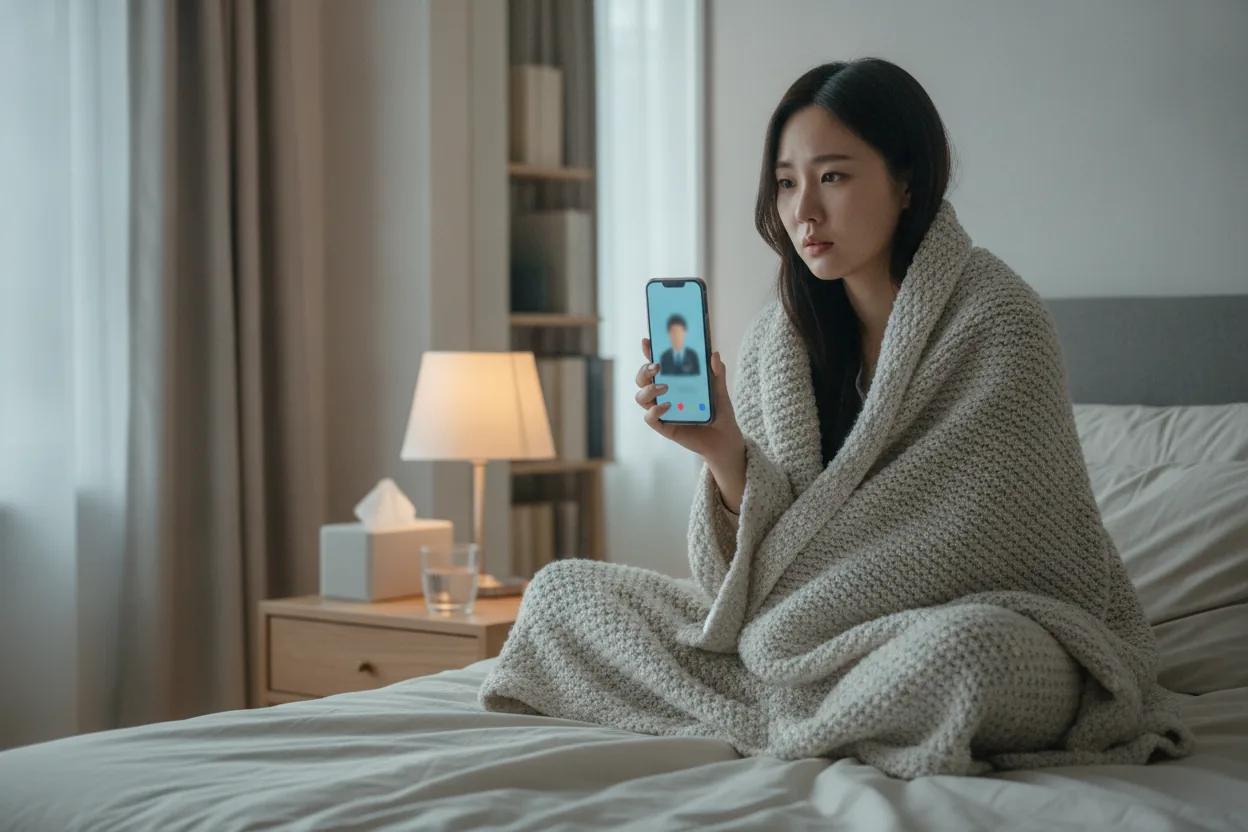
Three years ago, calling a doctor from your bed in Seoul was technically illegal. Today it costs a modest consultation fee and takes under ten minutes on a phone, and a meaningful share of Seoul residents now handle a cold or stomach bug this way without ever leaving the apartment. Most visiting foreigners have no idea this system exists, so they're still losing a night to discomfort that locals solved years ago. Nobody really explains that the app is only step one. Get the rest of the sequence wrong and a manageable illness turns into a 2am taxi ride to the ER.
Non face to face medical consultation, known in Korean as 비대면 진료, moved from a pandemic era emergency measure to a permanent fixture of Korean healthcare sometime in the last two years. Knowing which app to open, what it costs, and where the prescription actually gets filled is the difference between a rough night and a manageable one. That sequence starts with the apps themselves.
Finding Telemedicine Apps That Actually Serve Foreigners
The Telemedicine Sequence: App to Pharmacy
Open a telemedicine app
Doctor Now, Naver Map, or Kakao Map, video consult under 10 minutes
Doctor issues prescription
Printed slip or digital code, consultation fee around 15,000 won
Prescription goes to a yakguk (pharmacy)
Walk in or courier delivery, separate business by law
Medication dispensed
Pickup in person or courier fee added on top of drug cost
Source: Based on article description of Korean telemedicine process
The apps themselves are mostly in Korean, which is the first wall a foreigner hits. Some have partial English interfaces or English speaking doctors listed by filter, but honestly, most non face to face consultations in Seoul still happen in Korean, with a translation app or a Korean speaking friend bridging the gap.
- Naver Map and Kakao Map both surface telemedicine clinic listings inside their apps.
- Doctor Now lists same day video consultations. Pricing is worth checking directly in the app since it varies.
- Olive Young stores often sell the exact over the counter version of what a telemedicine doctor just prescribed
- Nightly video consultation windows on many platforms run into the evening hours, covering at least some of the time when clinics are closed, though this varies by platform
- Home delivery of medication, where permitted, usually adds a courier fee on top of the drug cost
What nobody tells you up front is that telemedicine in Korea isn't a replacement for a pharmacy visit. It's a bridge to one. The doctor still issues a prescription, and someone still has to walk it to a pharmacy or wait for a courier. The convenience is real, but it's about skipping the clinic waiting room, not the pharmacy system entirely. That system, separate from the clinic by law, is where the next confusion usually starts.
Understanding Why Pharmacies Stand Apart From Clinics
Where to Buy What: Clinics, Pharmacies, and Convenience Stores
| Location | Can Diagnose | Prescription Drugs | Basic OTC |
|---|---|---|---|
| Telemedicine App | Yes | No, issues only | No |
| Clinic | Yes | No, issues only | No |
| Yakguk (Pharmacy) | No | Yes | Yes |
| Convenience Store | No | No | Yes, narrow range |
Source: Based on article description of Korean healthcare separation of duties
This is the part that trips up almost every newcomer, including people who've lived in Seoul for months. In Korea, a doctor and a pharmacist are structurally separated by law. A clinic cannot hand you a pill bottle on your way out, and a supermarket cannot sell you antibiotics. The prescription is a printed slip of paper, or increasingly a digital code, that only means something once it reaches a licensed pharmacy.
- Pharmacies in Korea, called yakguk, operate as standalone small businesses, almost never attached to a hospital building
- Most sit close to the clinic that wrote the prescription, often in the same small commercial block
- A basic prescription fill for common cold medication tends to be fairly inexpensive, though the exact price varies by pharmacy and medication
- GS25 and other convenience stores sell a narrow category of basic over the counter drugs, like Tylenol equivalents, but nothing requiring a prescription
- Pharmacists near Itaewon or Yonsei University often speak workable English without advertising it. You just have to ask.
Korea has held onto a deliberate separation of diagnosis from dispensing more strictly than many Western systems. Once you know the pharmacy is a separate stop, the process becomes a predictable two step errand: app, then pharmacy. The next question is where to find a pharmacy that can actually talk you through dosage in English.
Locating an English Speaking Pharmacy Near You
Seoul Telemedicine at a Glance
Source: Based on article key facts about cost, time, and legal status
Searching pharmacy Seoul English in Naver Map or Google Maps surfaces a workable list, but the results skew heavily toward specific neighborhoods. Gangnam, Itaewon, Yeouido, and the areas around major English speaking hospitals tend to have at least one pharmacy within a few blocks that handles foreign patients regularly enough to have a system for it.
- Severance Hospital's International Health Care Center in Sinchon has pharmacies nearby accustomed to English prescriptions
- Samsung Medical Center in Gangnam and Asan Medical Center near Seoul Forest both sit close to pharmacies that handle a steady stream of international patients
- Itaewon's main street has several pharmacies where staff default to English before you finish the first sentence in Korean
- Papago and other translation apps handle most dosage and side effect conversations well when no English speaking staff member is on shift
- Pharmacist consultation at the counter is free; the cost sits entirely in the medication itself
A detail that surprises a lot of visitors: Korean pharmacists are often more willing to explain dosage, interactions, and timing in detail than pharmacists in the US or UK, simply because the system expects a verbal consultation at every fill. Hospitals in Seoul also increasingly flag which nearby pharmacies have historically served international patients. Ask the clinic reception desk directly, since they'll usually tell you rather than offer it up front. The harder test comes once the clinics and pharmacies close for the night.
Handling the Night and Weekend Gap
The hardest hours in any country fall between midnight and 8am, and Seoul has built two overlapping systems to cover that gap, neither explained anywhere near enough. The first is the public night pharmacy network, a rotating list of pharmacies in each district required to stay open late or on holidays. The second is the telemedicine apps described above, which fill the hours before a physical pharmacy opens at all.
- Night pharmacies, called yagan yakguk, rotate by district and appear on local government websites and the 119 emergency portal, with lists that update often
- 24 hour pharmacies exist near major hospitals like Severance and Samsung Medical Center, but remain the exception in most neighborhoods, including Seongsu dong or Haeundae in Busan
- Calling 119 connects you to an operator who can direct you to the nearest open pharmacy or emergency clinic. English language support exists on that line, though wait times for an English operator can run a few minutes longer.
- Emergency room visits for non critical issues at night can be considerably more expensive than a telemedicine consultation before insurance, part of why telemedicine absorbs so many cases that used to end up in an ER waiting room
- Travel insurance with Korean coverage reduces most of these costs significantly, but reimbursement paperwork almost always needs an English receipt, which hospitals will issue on request
Fewer foreigners are ending up in emergency rooms for problems that don't need one, because the telemedicine and night pharmacy systems together cover almost the entire gap that used to force a 2am taxi ride to a hospital. That gap is exactly where this post started: the night of discomfort locals no longer tolerate, because they know the sequence and most foreigners don't. The system was never missing. What was missing was the order of operations: app first, pharmacy second, ER only if the first two can't handle it. Learn that sequence once, and the 2am taxi ride stops being the default ending to a bad night.