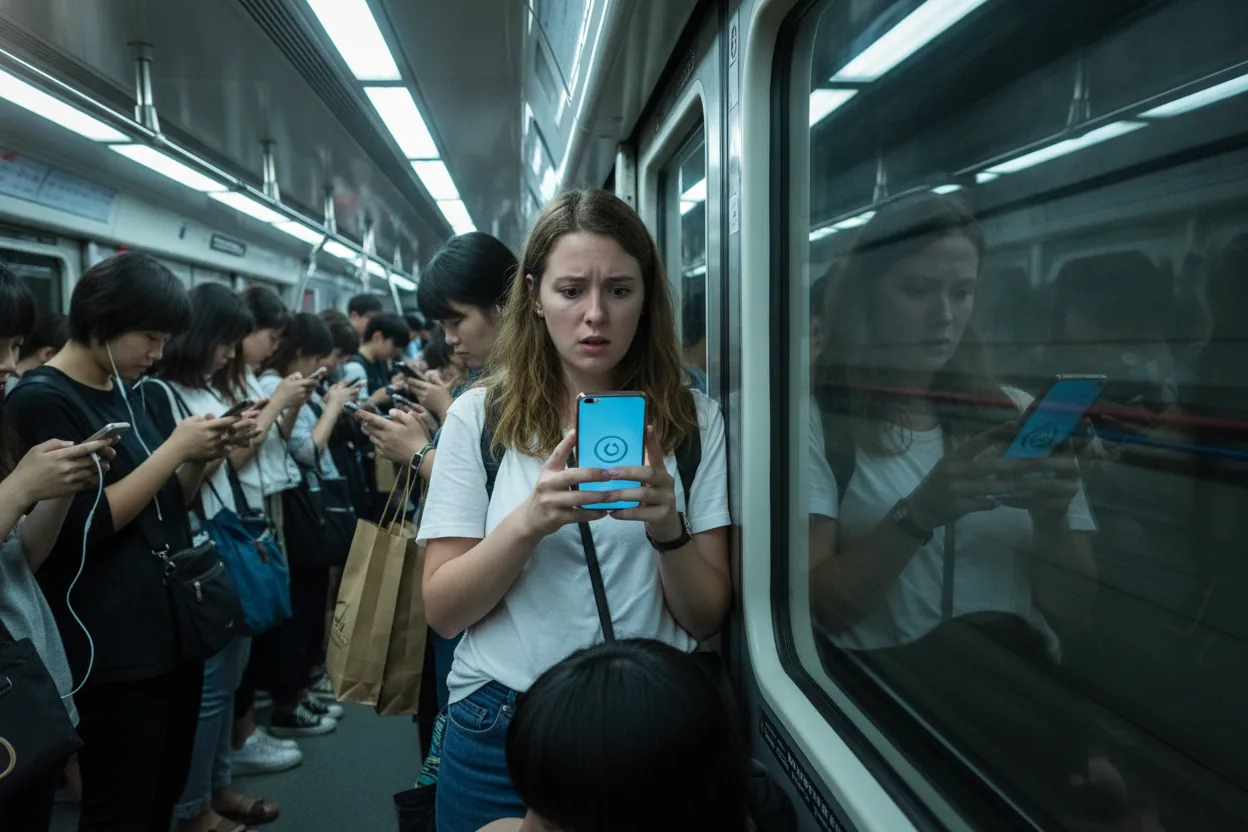
Seoul runs 35,000 free public WiFi hotspots and 4 million people connect to them every day, a number most travel guides cite as proof you can skip a data plan entirely. What those guides skip is the moment the subway doors close on Line 2 and that fast signal dissolves into patchy handoffs and repeated logins between every transfer. Locals who have stood there trying to load a map know the pause; visitors relying on the network alone learn it the hard way, one stalled screen at a time. Korea's free WiFi is good. That's not really in question. What's actually in question is whether it's good in the specific moments a traveler needs it.
That gap is the whole story. Free WiFi in Korea is dense, fast where it works, and unreliable in the exact moments a traveler needs it most. After a decade of watching visitors try to survive on hotspots alone, I've landed on this: WiFi in Korea works best as a supplement, not a substitute. People who rely on it entirely spend more time troubleshooting logins than actually using their phones. Here's where that free signal holds up, and where it quietly falls apart.
Mapping Where The Free Signal Actually Reaches
Where Free WiFi Actually Performs Well in Korea
| Location | Speed Range | Reliability |
|---|---|---|
| Incheon Airport | 50 to 150 Mbps | Stable |
| Seoul Metro Stations | 30 to 100 Mbps | Good, drops on trains |
| Seoul and Busan Buses | Varies by vehicle age | Inconsistent |
| Gimpo, Gimhae, Jeju Airports | Not specified | Less consistent |
| Cafes (Starbucks, Twosome) | Dependable | Requires login/app |
Source: Article estimates based on traveler observations
Start with the places where Korea's free WiFi performs best. Incheon Airport runs the strongest version of this system in the country: fast, stable, low friction. Seoul Metro stations come a close second, though the experience changes the moment the doors close.
- Incheon Airport: roughly 50 to 150 Mbps across terminals, network name AirportWiFi.
- Seoul Metro stations: 30 to 100 Mbps inside station halls and platforms.
- Seoul and Busan city buses run free WiFi on most routes, though quality depends heavily on how old the vehicle is.
- Gimpo, Gimhae, and Jeju airports: WiFi exists, but it's noticeably less consistent than Incheon.
- Cafes like Starbucks and Twosome Place have dependable WiFi, though most require a Korean phone number or app login to get on.
Here's what the coverage map doesn't show. The moment a train pulls out of a station, that 30 to 100 Mbps signal degrades into patchy handoffs between cars, and every transfer means re-authenticating from scratch. Anyone who has stood on Line 2 trying to load a map between Hongik University and Sinchon knows this pause. Multiply that by five transfers on a full day of sightseeing and the free network stops feeling free, since five transfers is roughly how many logins stand between a traveler and a working map on an ordinary sightseeing day. Closing that gap is what a SIM or eSIM is actually for, and here's what that costs.
Counting What A SIM Or eSIM Actually Costs
The Five Transfer Login Problem on a Sightseeing Day
Each subway transfer means re-authenticating from scratch, degrading the free WiFi experience step by step.
Source: Article estimate: roughly 5 transfers on an ordinary sightseeing day
The price of Korean mobile data has stayed remarkably stable even as everything else in the country has gotten more expensive. A short trip doesn't require much spending to stay connected the entire time.
- Tourist eSIM, 5 days unlimited: roughly 20000 to 27500 won depending on provider.
- Physical SIM at Incheon Airport kiosks: around 8800 to 33000 won depending on duration, from 3 days up to 30 days.
- KT, SKT, and LG U+ tourist SIMs: similar pricing tiers, sold at airport counters and in Myeongdong.
- WOWPASS or T-money combined SIM bundles: occasionally discounted when bought alongside transit cards.
- Pocket WiFi rental runs around 5000 to 8000 won per day, a range that's held fairly steady for several years.
A pocket WiFi device sounds appealing until you actually carry one for a week. It needs its own battery charge. It separates travel companions from each other if the battery dies mid day. It becomes one more thing to return at the airport counter before a flight. An eSIM, by contrast, installs in under five minutes at the gate before landing, assuming Incheon's arrival hall WiFi cooperates long enough to download the profile. For a solo traveler or a couple, the eSIM has quietly become the default. The cheapest plans start around 20000 won, and that entry cost ended this debate for most travelers years ago.
What actually decides it now is convenience during the exact moments free WiFi fails: the taxi ride when KakaoTaxi needs a live signal to find you, the moment you're lost near Seongsan dong's back alleys and Naver Map needs real time GPS, the instant you want to send a photo home without waiting for a cafe login screen. That gap in coverage, not the price difference between options, is what most travelers end up paying to close. Not every trip needs that fix, though.
Deciding When Free WiFi Is Actually Enough
Connectivity Cost Ranges for a Korea Trip
Total price range (min to max) shown as segmented bars, in won.
Tourist eSIM (5 days unlimited)
Physical SIM (3 to 30 days)
Pocket WiFi Rental (per day)
Bar widths scaled relative to the widest range (physical SIM, 8,800 to 33,000 won). Pocket WiFi is a daily rate, not a trip total.
Source: Article price estimates in Korean won
None of this means the free network is pointless. For a specific kind of trip, it covers almost everything a visitor needs, and figuring out which trip that is matters more than any blanket recommendation.
- Short city stays under 3 days concentrated in central Seoul.
- Travelers using offline maps downloaded in advance.
- Group trips where one person carries a data plan for the whole group.
- Business travelers staying in hotels with reliable in room WiFi.
- Anyone planning day trips outside Seoul should think twice, whether that's Busan's Haeundae coast or Jeju's countryside.
Jeju is the clearest example of where the free network thins out. The airport WiFi works fine, but drive twenty minutes toward the eastern coast and public hotspots become sparse, replaced by cafe WiFi that requires a Korean number to register. Busan's Haeundae Beach area is well covered, but the fishing villages an hour further east are not. A 2026 policy shift is upgrading roughly 3,000 of the oldest hotspots to WiFi 6, aimed at fixing speed and stability in zones that already have coverage, not extending coverage into these gaps. Three thousand upgraded routers in Jongno do nothing for a traveler stuck without signal on a coastal road near Seongsan.
The real answer depends less on Korea's infrastructure, which is excellent by almost any global standard, and more on what kind of traveler you are. Someone spending four days entirely inside Seoul's subway grid, sleeping in a hotel with solid WiFi, eating at places with QR menus that load over cafe networks, can plausibly get through the trip without a won spent on data. The moment that itinerary includes Busan, Jeju, a rural temple stay, or simply the need to call a KakaoTaxi from a street corner at 11pm, the free network stops being enough on its own. The pattern holds trip after trip: travelers who buy an eSIM before landing never think about connectivity again for the rest of the week. The ones who try to save that money end up standing outside a GS25 at midnight, phone held up to the window, hoping the store's WiFi reaches the sidewalk. That entry level eSIM cost, around 20000 won, is what separates those two trips. Korea's free WiFi is good exactly up to the moment a traveler steps outside its coverage map, and a small, fixed cost covers the rest.