What foreigner pricing at Korean restaurants actually means
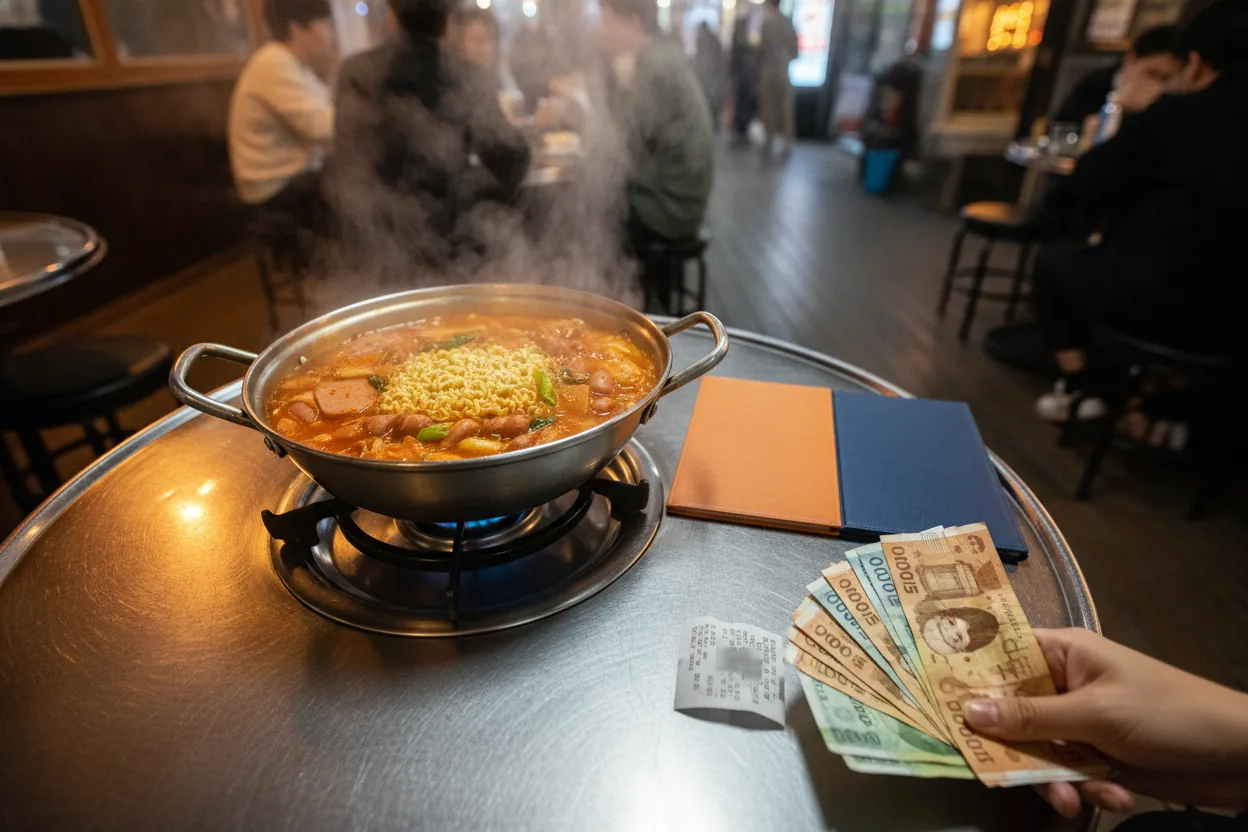
A Taiwanese traveler at a Myeongdong budae-jjigae restaurant expected to pay 9,500 KRW for stew and noodles. The bill came out to 12,500 KRW. A 3,000 KRW gap, and the owner's explanation was simply that a different menu applied. Korea doesn't have an official foreigner pricing policy the way Japan's restaurants openly admit to. So what actually produced that gap, and why does it keep happening to tourists specifically?
The confusion usually starts with how Korean restaurants display their menus. Many smaller eateries, especially in tourist-heavy neighborhoods like Myeongdong or the alleys near Gyeongbokgung Palace, use plastic food models or laminated photo menus with prices printed directly on them. These models exist to help non-Korean speakers point and order without reading Hangul. The catch: the printed price on the model doesn't always match the price on the actual paper menu or the final receipt, and a customer who can't read Korean has no way to catch the mismatch at the table. The 3,000 KRW gap in Myeongdong came from exactly this: the model showed one price, a separate photo menu showed another, and the customer had no way of knowing which one would land on the bill.
Korea also runs on a long-standing custom, not a law, of giving out side dishes and water refills for free. VisitKorea, the Korea Tourism Organization's own travel guide, describes asking for more water or more banchan (side dishes) as something that typically comes free. But because it's custom and not regulation, individual restaurants can deviate from it, especially when a side dish has its own listed price on the menu. A foreign diner who doesn't know this unwritten rule either gets overcharged for something that should've been free, or gets blamed for assuming something was free when the restaurant priced it separately all along.
That distinction reframes the whole question. Korea's issue isn't an institutionalized two-tier pricing system like Japan's buffet discounts. It's gaps in menu transparency that happen to land hardest on tourists who can't read the fine print. The next section looks at two documented cases that show this mechanism in practice, and how it stacks up against Japan's more openly acknowledged pricing gap.
Specific cases show where the real overcharging happens
Several documented incidents, mostly surfaced through the Taiwanese travel community PTT, show the pattern in concrete terms. The Myeongdong budae-jjigae case is one of them: a traveler ordered a stew and added ramyeon noodles displayed on the food model, expecting a total in line with the posted prices. The bill came out higher. When the traveler pushed back, the owner pointed to a different photo menu with a higher printed price for the same add-on, a discrepancy that only surfaced because the customer had ordered from the model instead of the Korean-language menu.
An earlier case, reported around the same period, was worse. A traveler ordered eomuk-tang, a fish cake soup, at a restaurant in an alley near Gyeongbokgung Palace and got charged well above what seemed reasonable for the dish. Pressed for time before a flight, the traveler paid without arguing on the spot. According to accounts of the incident, the traveler later filed a complaint through a tourist complaint channel after getting home, and the case was reportedly passed along for further review. This matters for a practical reason: a language barrier at the counter doesn't have to be the end of the story. A complaint filed after the fact, even once a traveler has left the country, can still trigger an official review.
Both cases trace back to the same mechanical cause. The gap originated at the point of ordering, from a mismatch between what was advertised on a model or photo and what showed up on the bill. Neither restaurant told a tourist outright that this was a foreigner price. Instead the overcharge got dressed up as a menu discrepancy, which is harder to prove as deliberate and easy for an owner to wave away by pointing to a different printed price.
Korea's situation diverges most clearly from Japan's right here. In the Tamatebako example reported by the ABC in June 2024, owner Shogo Yonemitsu went on record explaining that the price gap reflected the cost of hiring English-speaking staff and the extra work of teaching foreign customers Japanese dining etiquette. Controversial, sure, but transparent: a stated business reason for a visible price difference. Korea's cases look messier. No restaurant on record has publicly defended a foreigner-specific price. What travelers are actually running into is a transparency problem around food models and photo menus, one that produces the same financial sting as deliberate dual pricing without ever being a formal policy.
For anyone eating in Korea, the practical lesson is simple: treat food models and photo menus as a starting point, not a final price. Confirming the total before ordering, especially when adding items like extra noodles or side dishes, closes the exact gap that both the Myeongdong and Gyeongbokgung cases fell into. The menu mismatch explains part of the problem. It doesn't account for a separate source of confusion, though: Korea's custom of free side dishes and refills, which creates its own kind of billing dispute.
Why Korean custom around free refills complicates the picture
Part of what makes this hard to pin down is that Korean restaurant culture mixes genuinely free services with items that look free but aren't. Self-serve water, metal chopsticks and spoons, and a basic set of side dishes are standard at most Korean restaurants and cost nothing, regardless of nationality. VisitKorea's own guidance backs this up as the general norm. But some side dishes, particularly premium add-ons like extra meat, cheese, or certain banchan at specialty restaurants, are listed separately on the menu and billed accordingly. A tourist who assumes everything on the table is complimentary, just because that's the reputation Korean dining has, can end up disputing a charge that was legitimate the whole time.
This cuts both ways. Some reports of foreigner overcharging turn out to be billing for items that were never meant to be free, misread by a visitor going off reputation instead of the actual menu. And restaurants that apply the free-refill custom inconsistently create real confusion of their own, since the same side dish might be free at one place and charged at another with no signage explaining the difference. That inconsistency, more than any hidden policy, is what trips up visitors who assume Korean dining customs work the same way everywhere. Between the menu mismatches described earlier and this inconsistency around free items, the practical question becomes what a traveler can actually do when a bill looks wrong.
A few concrete steps are all it takes to report a bad bill in Korea
Travelers who suspect they got overcharged have a formal channel: the Korea Tourism Organization's Tourist Complaint Center, the same type of body that reportedly handled the eomuk-tang case near Gyeongbokgung Palace. Filing a complaint doesn't require settling the dispute at the restaurant counter in real time, which matters when you're rushing to catch a flight or stuck behind a language gap. You can lodge a complaint after you're already home, and the Tourist Complaint Center can forward cases to local food sanitation authorities for investigation, which is reportedly what happened in that case.
The more useful habit is prevention, not cure. Check the printed Korean-language menu against any food model or photo display before ordering. Ask for a written total before paying. Keep the receipt. These are simple steps, and any one of them would have changed the outcome in both the Myeongdong and Gyeongbokgung cases. In a system that runs mostly on custom rather than fixed law, documentation at the moment of the transaction is the traveler's strongest protection. Restaurant owners, for their part, generally have more to gain from clear, consistent photo menus than from disputes that end up logged with a national tourism authority.
That's the actual answer to the question this post opened with. The 3,000 KRW gap in Myeongdong wasn't evidence of a hidden foreigner price list. It was the predictable result of a food model, a separate photo menu, and no fixed-price law requiring the two to match. Korea's tourist overcharging problem is a transparency failure, not a tiered pricing system, and it closes the same way it opens: at the counter, before the order goes in, by checking the price in front of you against the one that's about to land on the receipt.