Five separate discount layers sit on top of a single Korea duty free purchase right now, and most travelers redeem exactly one of them. Guidebooks treat duty free as a fixed price with a tax break attached. The actual system involves a floating won rate, stacked app coupons, membership tiers, and a pickup counter that can miss your flight if you book the wrong terminal. On a large order, the gap between careless and prepared can run into the hundreds of dollars. On a 15 dollar sheet mask, that same effort isn't worth it at all. The real question is which layers actually stack, and when stacking them stops being worth the trouble.
Duty free in Korea is not a fixed discount. It's a stack of five separate discounts that almost nobody combines correctly, starting with a currency pattern most shoppers never think to check.
The Won Is Doing Quiet Work On Every Receipt
The Five Stackable Discount Layers, In Order
Check KRW to USD rate morning of purchase, not before
Coupons often must be applied before checkout begins
Flat amount off for new app accounts
Percentage off unlocks once USD spend cutoff is met
2 to 5 percent added based on lifetime spend status
Source: Source: Article analysis of Korea duty free purchase process
Korean duty free prices are quoted in USD but charged in KRW at whatever the exchange rate happens to be that day. When the won trades weak against the dollar, a pattern seen through much of 2025 into 2026, the KRW amount on the receipt ends up smaller in real purchasing power than the sticker price suggests. Nobody explains this at the counter. It just happens.
- The won-to-dollar rate has leaned weaker through much of 2025 and into 2026, though the exact level moves day to day, so check it rather than assume it.
- A 200 dollar duty free item can cost meaningfully less in effective terms than the same item bought in a country with a stronger local currency.
- Shinsegae Duty Free and Lotte Duty Free both settle purchases in KRW at the day's published rate.
- Check the rate the morning of purchase, not the week before. That's the only moment that actually matters.
This isn't a guaranteed discount. It's a currency condition that happens to favor buyers right now. Once that currency layer is working in a shopper's favor, the next layer to stack on top of it comes from the apps themselves.
Can Coupons Actually Stack On A Single Purchase?
When Stacking Discounts Is Worth The Effort
|
LARGE ORDER Hundreds $ Potential savings gap between careless and prepared shoppers |
SMALL ORDER $15 Sheet mask example, stacking effort not worth the trouble |
Rule of thumb: purchase size determines whether all 5 layers are worth chasing
Source: Source: Article analysis, Korea duty free purchase examples
Shinsegae Duty Free and Lotte Duty Free both run app based coupon systems that behave less like a single discount and more like a small negotiation. A welcome coupon, a spending threshold coupon, and a membership tier discount can all apply to the same transaction if entered in the right sequence, and most first time visitors only ever redeem the first one they see.
The typical stack combines a flat amount off for downloading the app, a percentage off once spending crosses a certain USD threshold, and an additional discount tied to membership status that renews or upgrades with purchase history. None of these three cancel each other out. They add.
- Lotte Duty Free's app has offered a welcome discount for new accounts in the past, though confirm the exact amount in app before counting on it.
- An additional percentage discount has historically unlocked once spending crosses a certain USD threshold. The cutoff and rate shift, so check in app before relying on it.
- Another 2 to 5 percent comes tied to loyalty tiers, like Shinsegae's membership program based on lifetime spend.
- Thresholds shift by season and promotion cycle. Treat these as observed ranges, not fixed rules.
The catch is timing. Coupons often need to be applied before checkout begins, not after, and some are only visible inside the app rather than on the desktop site. Anyone who walks into a downtown store without opening the app first is leaving one of the five layers on the table. This coupon stack works the same way whether the purchase happens downtown or online, but where the item is bought determines how, and whether, it actually reaches the traveler.
Downtown Stores And Airport Pickup Solve Different Problems
Downtown Store vs Online App: Different Jobs
| Factor | Downtown Store | Online App |
|---|---|---|
| Best For | Browsing and trying products | Repeat, known purchases |
| Best Use Case | Luxury items needing in-hand view | Items already decided on |
| Coupon Stack | Same 3-layer stack applies | Same 3-layer stack applies |
| Risk Factor | Locations: Myeongdong, COEX | Pickup counter, wrong terminal can miss flight |
Source: Source: Article analysis of Korea duty free purchase channels
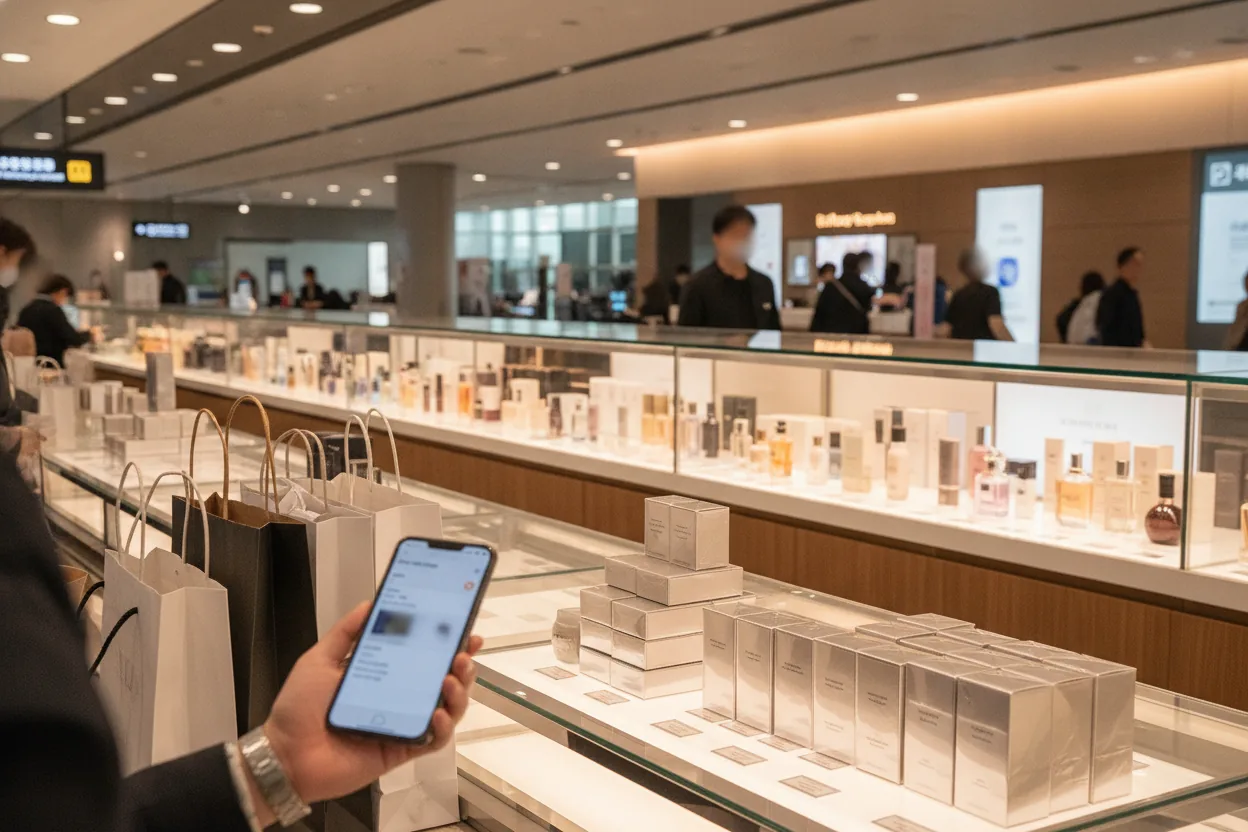
Downtown duty free stores in Myeongdong and around COEX in Gangnam exist for browsing, trying products, and buying luxury items where seeing the actual piece in hand matters. Online duty free apps exist for repeat purchases of things a traveler already knows they want, particularly skincare and cosmetics where the packaging and shade never need checking in person.
This is where the pickup counter question comes in, and it trips up more travelers than any pricing layer. Duty free purchases made downtown or online aren't handed over at the point of sale. They're collected at a designated pickup counter at Incheon International Airport after passing through security, and the counter location depends on which retailer and terminal.
- Terminal 1 and Terminal 2 at Incheon each have separate duty free pickup zones. Book the wrong terminal and you risk missing the item entirely.
- Lotte Duty Free pickup counters typically sit past security in the departure area, grouped by gate zone.
- Shinsegae and Shilla pickup counters follow a similar past security layout but in different concourse sections.
- You'll want more than 90 minutes before boarding, a tighter margin than most travelers realize for collecting a large order.
None of this is complicated once you've done it once. The problem is that almost nobody checks the terminal and counter assignment before landing, and Incheon's layout does not forgive guesswork. Getting the pickup logistics right only matters, though, if duty free was the correct place to buy the item in the first place.
Duty Free Is Not Always The Right Call
Duty free pricing looks like a discount by default, but it competes against Olive Young promotions, Korean domestic sales events, and even certain GS25 convenience store bundles that occasionally undercut the duty free price on identical skincare SKUs. A tax free discount on an item that was already marked up for the export market isn't automatically cheaper than the same item on sale at a Myeongdong Olive Young flagship.
Duty free clearly wins on international luxury brands: cosmetics houses, designer accessories, and liquor categories where the Korean retail price already sits below many other countries even before the tax free discount applies. It tends to lose on Korean domestic beauty brands, the kind Olive Young sells in a 10,000 to 30,000 won range that already reflects local pricing with no export markup built in.
- Sulwhasoo and Whoo, premium Korean brands, often make sense at duty free thanks to added coupon stacking.
- Innisfree, COSRX, and Anua frequently price lower at an Olive Young sale than at duty free.
- Liquor and imported luxury cosmetics favor duty free almost every time.
- Olive Young's paid membership program can add an extra discount on top of an existing sale price, though the amount varies by plan, so check before assuming.
Experienced shoppers land on a split strategy rather than an all or nothing choice: luxury and liquor at duty free, mass market Korean skincare at Olive Young or its app, and everything checked against the day's won rate before deciding either way. That split strategy answers the question this post opened with. The five layers stack, but stacking them is worth the extra ten minutes of app checking and coupon sequencing only past a certain order size. For a large purchase, almost certainly. For a single 15 dollar sheet mask, probably not, and that distinction is the whole point.