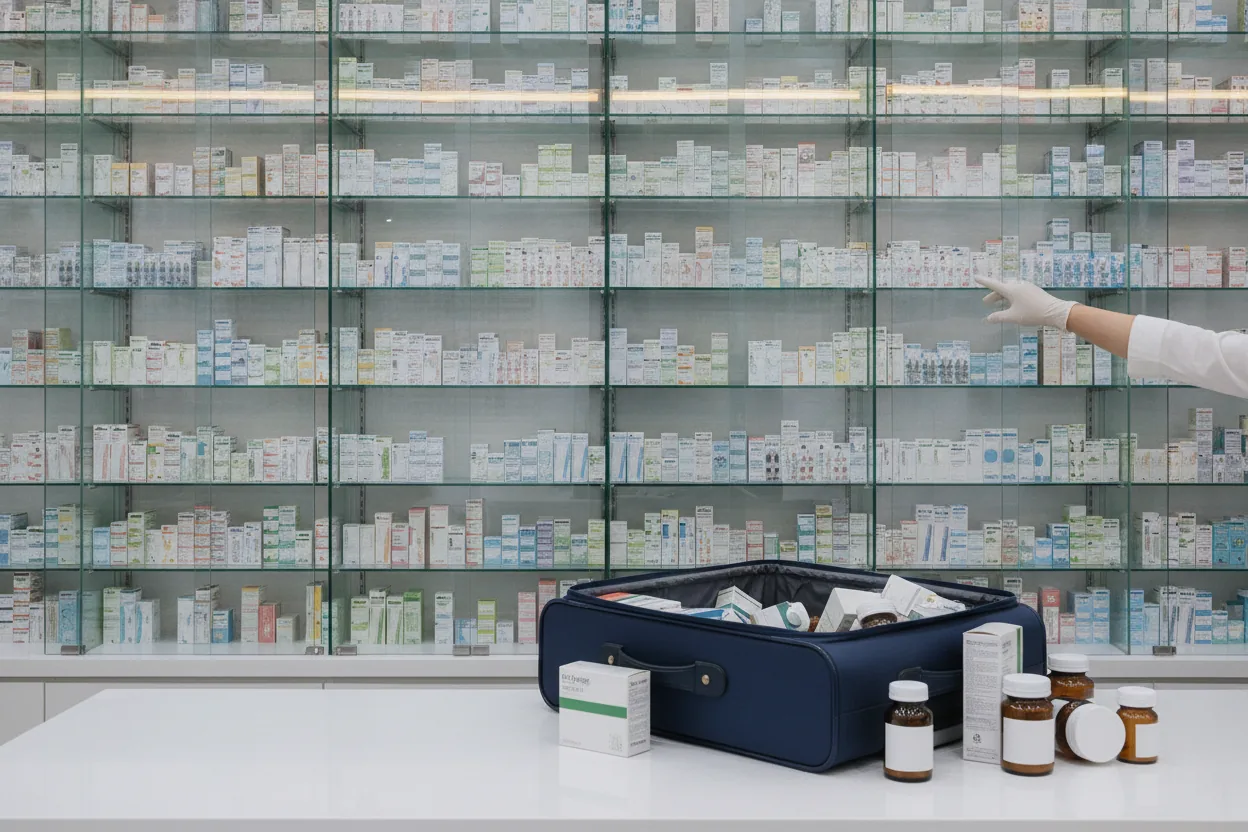
Zero. That's how many boxes of Sudafed you can bring into Korea before a customs officer wants a word with you. Pseudoephedrine, the decongestant sitting in half the cold medicine cabinets back home, is prescription only here. Visitors show up assuming that whatever was over the counter in London or Toronto will be over the counter in Seoul, and Tylenol and Claritin seem to back that up, right up until Sudafed doesn't. Long term residents figured out that the real split has nothing to do with that theory and everything to do with which pharmacy counter you walk up to, and what you ask for by name. Get it wrong and you're either wasting a trip to the pharmacy or making an unplanned one to the clinic. So this comes down to three practical questions: which drugs actually require a prescription here, how you bridge the language gap at the counter, and where you find a pharmacy when you need one outside normal hours.
Do Korean Pharmacy Rules Match What You Assume From Home?
Common Medications: Availability at Korean Pharmacies
| Home Name | Ingredient / Korean Ask | Status in Korea |
|---|---|---|
| Tylenol | Acetaminophen | Over the counter |
| Advil | Ibuprofen (ask for Brufen) | Over the counter |
| Pepcid | Famotidine | Over the counter |
| Claritin / Allegra / Zyrtec | Loratadine / Fexofenadine / Cetirizine | Over the counter |
| Benadryl | Diphenhydramine, ask 수면유도제 | Sold as sleep aid only |
| Sudafed | Pseudoephedrine | Prescription and ID required |
Source: Article reporting based on long term resident accounts
Newcomers arrive with a simple theory: if a drug was available without a prescription in London, Toronto, or Sydney, it should be available without a prescription in Seoul. Tylenol and Claritin sit right there confirming it. Then Sudafed doesn't, and the theory falls apart.
The actual split looks different from what most visitors expect. Acetaminophen, sold under the Tylenol name in Korea too, is over the counter everywhere, including convenience stores like GS25 and CU for small pack sizes. Ibuprofen is over the counter, usually under the brand Brufen rather than Advil, so asking for Advil by name and getting a blank look is a common first encounter. Famotidine, the active ingredient in Pepcid, is over the counter. Loratadine, sold as Claritin, is over the counter. Fexofenadine, sold as Allegra, is available without a prescription according to many residents, though you should confirm the exact dosage thresholds with a pharmacist. Cetirizine, sold as Zyrtec, is also available without prescription in most pharmacies.
Diphenhydramine, the Benadryl active ingredient, is a different situation entirely, not a legal one so much as a structural one. Korea doesn't really sell it as an allergy pill the way the United States does. It shows up mainly as a sleep aid, sometimes under names like Danzamin, and pharmacists respond faster to a request for 수면유도제 (sleep inducing drug) than to the word Benadryl. Pseudoephedrine requires a prescription and ID, though double check current requirements with a pharmacist since these things shift.
One ingredient, pseudoephedrine, explains almost every surprised American at a Korean pharmacy counter. Knowing the rule exists is one thing. Getting the right box handed to you at the counter is another, and that depends less on the law than on what words come out of your mouth.
Does a Printed Pharmacy List From Home Actually Help?
Bridging the Pharmacy Counter Language Gap
Source: Article reporting based on long term resident accounts
The common assumption is that arriving with a printed list of drug names, or Google Translate open on your phone, solves the language problem completely. It solves more of the problem than most guides admit, just not in the way people expect.
Pointing a phone camera at a package and translating the label confirms ingredients before you buy, and Korean pharmacists are used to foreign residents doing exactly this. Brand name confusion, not language, turns out to be the more common failure point. Ask for Advil and you get a pause. Ask for ibuprofen or Brufen and a box lands in your hand in five seconds. Korea labels by active ingredient or by a Korean brand name with no relationship to what you know from home, so translating the chemical name works better than translating the brand.
Prescription continuity is where this habit becomes genuinely useful. Korean pharmacies and clinics run on 처방전 (cheobangjeon), paper or digital prescriptions, and long term foreign residents get in the habit of photographing every prescription before handing over the paper copy. Two reasons for this. First, prescriptions in Korea expire within a use by window, commonly just a matter of days, so a photo record helps you track what was prescribed when if a new doctor needs the history. Second, saved 처방전 and pharmacy receipts feed directly into the year end tax deduction process (연말정산) for medical expenses, 의료비 공제, a real line on a real tax form.
None of this requires fluent Korean. It requires one habit: photograph the paper before you leave the counter. That habit matters most during ordinary daytime visits, when finding a pharmacy is easy. The harder problem is what happens when you need one at 11pm on a Sunday, when the nearest open counter isn't obvious at all.
Can You Actually Find a Pharmacy Open at 11pm on a Sunday?
The One Ingredient Behind Most Pharmacy Surprises
Source: Article reporting based on long term resident accounts
Visitors often assume Korea, efficient and round the clock in so many other ways, must have pharmacies open at all hours on every corner the way Seoul has convenience stores. It doesn't, and this gap catches people who thought they'd already figured the system out.
Most neighborhood pharmacies close by 8 or 9pm and shut entirely on Sundays and public holidays, which surprises anyone used to the always open culture of GS25. What Seoul and other cities run instead is a public night pharmacy system, 공공심야약국, a designated rotation of pharmacies that stay open specifically during the hours when almost everything else is closed, typically covering the window from around 10pm to 1am. These are official city run designations, not just a random pharmacy that happened to stay open late. Separately, a holiday and night pharmacy locator system, 휴일지킴이약국, lets you search which specific pharmacies nearby are open on a given holiday or late night, since the rotation changes by district and by date.
Experienced residents don't memorize a schedule. They know the search terms before the night they need them: 공공심야약국 for the city designated late pharmacies, 휴일지킴이약국 for holiday coverage. Searching these terms in Korean, even through a translation app, returns results that searching in English generally doesn't. For anything beyond an aspirin level problem at that hour, Seoul also runs an English language medical information line, sometimes cited under the number 1339, though you should expect it to function more as triage and direction than a pharmacy substitute, and it's worth verifying the current number and hours before you rely on it.
A pharmacist who already knows your allergies and regular prescriptions from repeated visits moves faster and safer at 11pm than a first visit to an unfamiliar late night rotation pharmacy ever will. One pharmacy, visited repeatedly, beats ten pharmacies visited once each. Korean pharmacy rules don't map onto what you knew from home, but they're learnable, and the learning happens fastest at a single counter you keep going back to, not a new one every time something runs out.