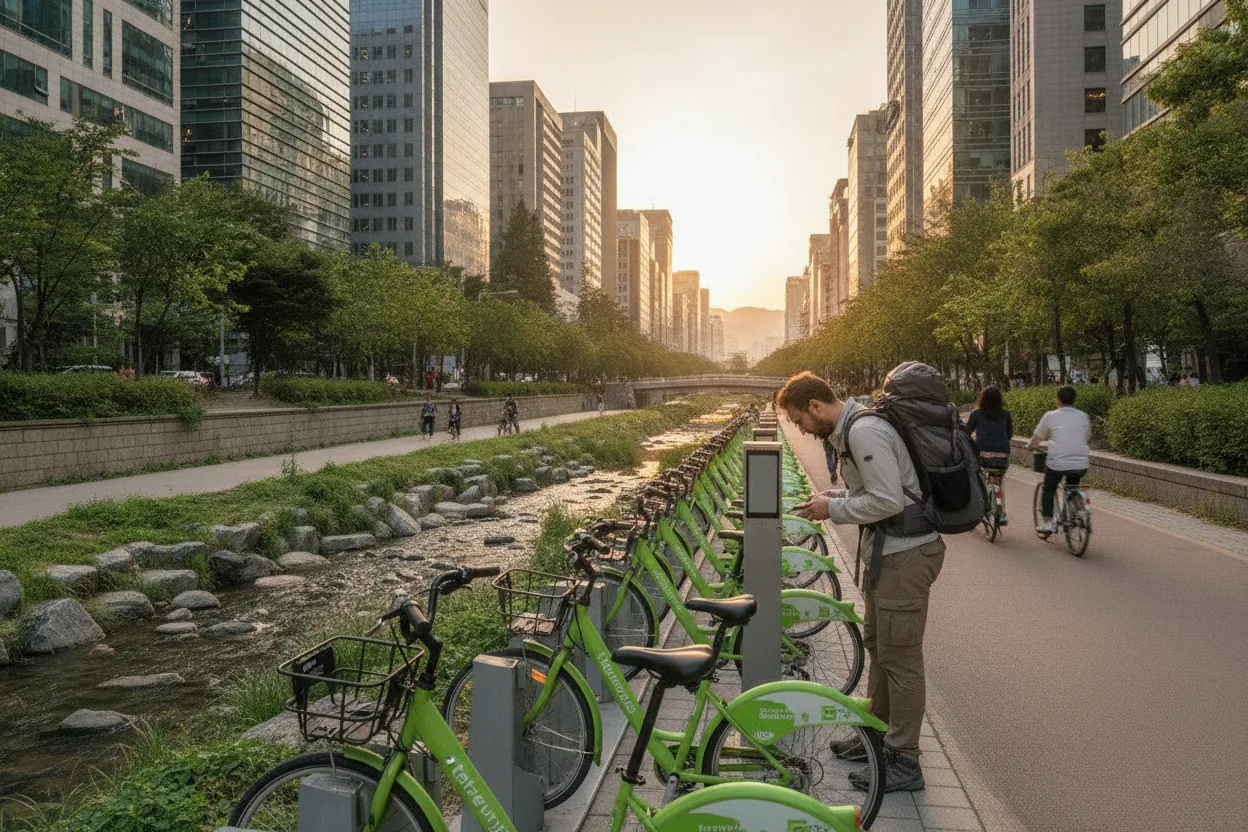
1000 won: less than the price of a single subway swipe, yet most tourists walking through Seongsu-dong or along the Han River never touch one of Seoul's bright green Ttareungi bikes. Guidebooks tell visitors this is a members-only system locked behind a Korean bank account and a resident registration number. The app itself quietly offers a non-member path that gets a foreigner riding in minutes, no signup at all. So why do bike lanes along the Cheonggyecheon stay full of locals and empty of visitors? And what exactly is failing when a foreign card gets declined at the rental terminal?
Three failed card attempts. That's roughly how many times a foreign visitor tries to register before giving up on Seoul's public bike system entirely, based on patterns friends and readers have described over the years. Zero signup required is the part almost nobody mentions, and it's the detail that changes how you should approach this system. Ttareungi, Seoul's public bike share, has a non-member path that lets you ride within minutes. No Korean bank account. No resident registration number. No app account tied to a phone plan. The gap between what tourists assume about Ttareungi and what the system actually allows explains why the bike lanes along the Cheonggyecheon stay full of locals and strangely empty of visitors.
Why Do So Many Foreign Visitors Assume Ttareungi Is Off Limits?
Three Ways to Access Ttareungi as a Visitor
Path Options Inside the App
Step 1: Open app, see Korean text
Assumed path: Member signup → hits wall (needs resident number, local phone) → Tourist gives up
Step 2: Tap language toggle
Path A, Foreigner / Overseas Tourist option → Tourist pass purchase, no resident number needed
Step 3: Choose non-member riding
Path B, Buy day pass on the spot → Riding within minutes, zero signup, zero account
Source: Based on article description of Ttareungi app and website flows, 2026
The assumption makes sense on the surface. Korea's digital infrastructure often gates services behind a resident registration number or a Korean-issued credit card, and bike share looks, at first glance, like one more example. Someone opens the Ttareungi app, sees Korean text on the home screen, tries to sign up like a member, hits a wall asking for local phone verification, and closes the app assuming the whole system is locals-only.
Both the app and the Ttareungi website offer a language toggle, and inside that toggle sits an option labeled Foreigner, sometimes shown as overseas tourist depending on the app version. Selecting it switches the entire flow into a tourist pass purchase path rather than the membership signup path. No resident number, no domestic bank link, no waiting period.
A third option exists that even fewer people notice: non-member riding. You don't need an account at all to ride once. You just need a day pass, purchased on the spot. Most guidebooks describe Ttareungi as a subscription system, which is technically true for residents, but that description erases the two other doors that exist specifically for short-term visitors.
The people who lose out here are the ones who trust the guidebook over the app itself. The people who gain are the ones willing to spend ninety seconds tapping through menus they don't fully understand yet. Once you know these three paths exist, the next question is what they actually cost, since price is what most guidebooks get vaguest about.
What Does a Ttareungi Ride Actually Cost in 2026?
Ttareungi Pricing Options for Short Term Visitors, 2026
| Ride Type | Duration | Approx. Price |
|---|---|---|
| Standard bike | Under 60 min | ~1000 won |
| E-bike | Under 60 min | 1000 won + premium |
| Day pass | Unlimited rides, set time per ride | 1000 to 2000 won |
Note: treat these as ranges, not fixed figures. The price shown in the app always outranks older printed guides.
Source: Based on current published pricing patterns described in article, ranges approximate and subject to app updates
Guidebooks tend to round Ttareungi pricing into a vague, comforting number, something like cheap or a dollar or two. That vagueness hides a structure that rewards planning and punishes improvisation.
Based on current published pricing patterns, a single ride under one hour runs somewhere around 1000 won for a standard bike, with e-bikes costing somewhat more, though the exact premium can vary depending on duration and battery assist tier. A one-day pass for unlimited rides within that day (limited to a set time per ride) tends to fall in the 1000 to 2000 won range, and that's the pass most short-term foreign visitors should compare against single rides, not against subway fares. Treat these as realistic ranges rather than fixed figures. Ttareungi has adjusted pricing more than once in recent years, and the price shown in the app should always outrank anything printed in an older guide.
- Single ride under 60 minutes, standard bike.
- Single ride under 60 minutes on an electric assist bike costs a bit more, and the gap widens depending on how the app tiers battery use that day.
- One-day unlimited pass, standard bikes.
- Multi-day or seasonal passes: members only.
These four tiers cover almost every visitor scenario, from a one-off ride across the Han River to a week of daily commuting between an Airbnb and Gyeongbokgung. The season passes, the ones that unlock genuinely cheap unlimited riding across weeks or months, sit behind full membership, which means a real Korean phone number and account verification. That's a fair trade for the price, but it also means the tourist pass path, while convenient, is never going to be the cheapest way to ride for anyone staying in Seoul longer than a week. Short-stay visitors gain simplicity. Longer-stay foreign residents gain real savings, but only after clearing the membership hurdle once. Getting the pricing tier right matters less, though, if the rental itself fails at the terminal, which is where most of the actual frustration happens.
Why Does the Card Actually Get Declined?
The Cost of Not Knowing the Non-Member Path
3
Failed card attempts before giving up on registration
0
Signups required on the non-member path
~90 seconds
Time spent tapping through menus to unlock the tourist or non-member path
Source: Based on patterns described by article author from friends and readers' experiences
Here's where most of the frustration lives, and where the explanation people reach for is almost always wrong. Travelers assume a declined card means their foreign card isn't accepted at all, so they stop trying. The real explanation, the one that matches what the app's own troubleshooting flow points to, has nothing to do with the card network. It comes down to two phone settings that have nothing to do with payment: Bluetooth and GPS.
Ttareungi's unlock mechanism talks to the bike's terminal over a short-range Bluetooth connection, and it checks your GPS location to confirm you're actually standing near the station, not attempting to rent a bike from your hotel room. If either setting is off, the rental step can fail in a way that displays as a payment error, even though your card was never the problem. Turning both on before attempting the rental resolves a surprising share of what look like card declines.
The other common failure point is simpler: a QR code that won't scan, usually because of glare, a scratched terminal screen, or low light. The workaround is printed right on the bike and almost nobody reads it. Every Ttareungi bike has a five-digit number stamped near the right pedal, and typing that number directly into the app substitutes for the QR scan entirely. This single fact, more than any card network issue, is probably responsible for more abandoned rental attempts than actual payment failures.
Who loses in this scenario? Anyone who reads a failed rental as proof the whole system rejects foreign cards, and walks away. Who gains? Anyone patient enough to check Bluetooth, check GPS, and try the five-digit number before assuming the worst. The fix costs nothing and takes fifteen seconds, which makes the abandonment rate around this issue one of the more avoidable travel frustrations in Seoul. Getting the bike unlocked, though, is only half the transaction. Ending the rental correctly matters just as much.
Does Returning a Ttareungi Bike Work the Way You'd Expect?
Renting gets most of the attention in guides, but returning is where a surprising number of people accidentally leave a rental open, and open rentals can keep charging or flagging the account. The common assumption is that returning is as simple as parking the bike near a rack and walking away. It isn't, and the gap between assumption and requirement here is small but expensive if ignored.
A complete return has three parts, and skipping any one of them means the system still considers your bike rented. First, the bike has to be docked into an actual rack slot, not just left leaning near one. Second, you pull the rear wheel lock closed, a physical motion easy to forget after a long ride. Third, and this is the step almost everyone skips, you need to confirm the return notification, which arrives as an app notification, a KakaoTalk alert, or a text message depending on how your account or pass was set up.
The flexible part, and the genuinely useful part for tourists covering a lot of ground, is that return location doesn't need to match rental location. Rent a bike near Gyeongbokgung, ride down through Bukchon, return it at a station near Insadong. That flexibility is what makes Ttareungi useful for point-to-point sightseeing days rather than closed-loop joyrides, provided you complete all three return steps rather than assuming the dock alone is enough.
Miss the confirmation step and you might find yourself still shown as an active renter later, a confusing and entirely avoidable problem to explain to a hotel front desk in a language you don't speak. That gap between docking the bike and confirming the return is where most lingering charges start, and it costs nothing to close except reading one extra notification.
None of this requires a resident registration number or a Korean bank account, which is the exact assumption that keeps visitors off these bikes in the first place. The language toggle, the five-digit pedal number, and the three-step return are the whole system. The bike lanes along the Cheonggyecheon are open to anyone who taps through ninety seconds of menu screens instead of trusting a guidebook that never checked.