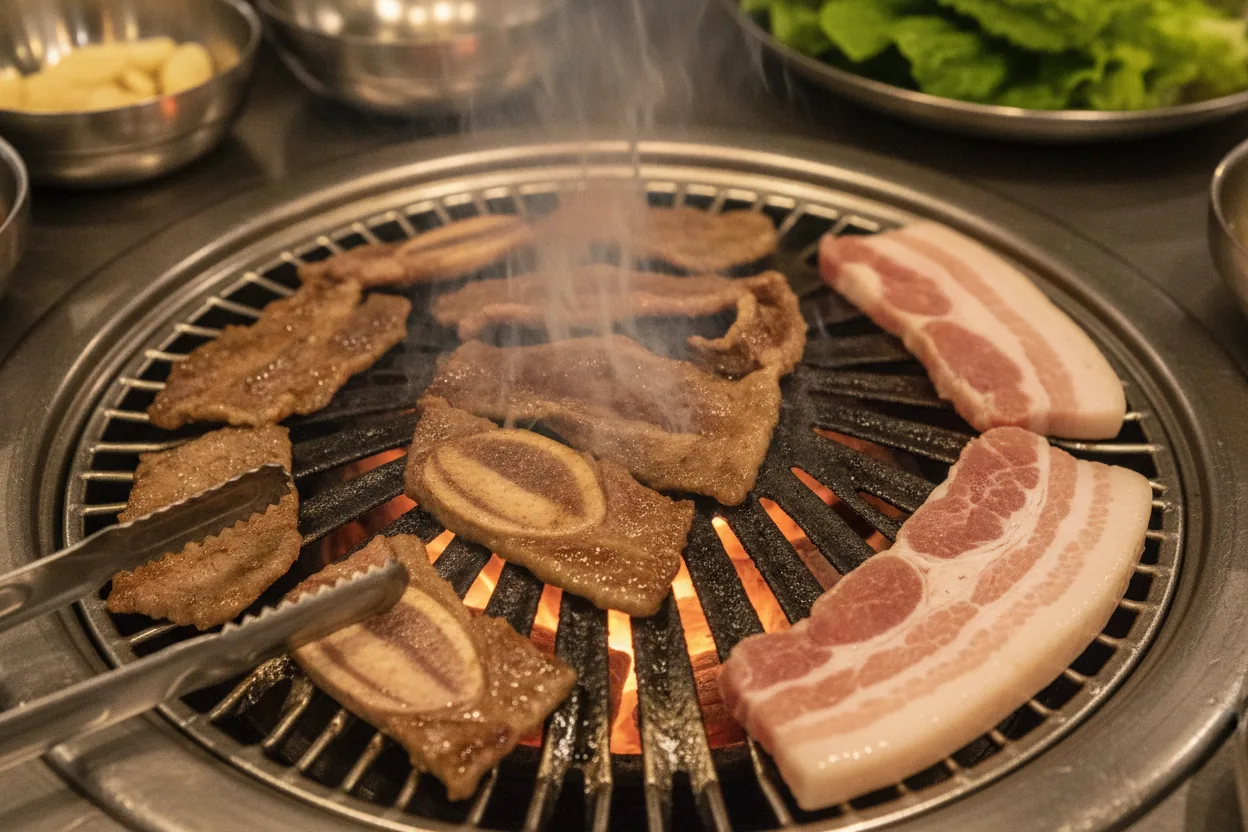
Roughly 20,000 won buys a serving of pork belly in Seoul. Beef short rib costs noticeably more for the same weight, and no guidebook mentions that the real cost of ordering by pointing isn't won, it's minutes. One of those cuts cooks in four seconds. The other takes four minutes. The table next to you just ordered wrong, and the panic won't set in until around the eighth minute of a dying grill. The whole menu sorts into exactly two categories, and knowing which one is which is the only thing standing between a steal and a scramble.
Korean barbecue menus look like a wall of Hangul and hope, so most first-time visitors just point at something. That gap, between the person who knows galbi from moksal and the person guessing, decides whether a sixty thousand won dinner for two feels like a steal or a scramble. Marinated and unmarinated: that's the whole menu, split into two camps. That one distinction tells you how to order, how long to grill, and roughly what you should expect to pay. Treat the numbers below as observed patterns from typical Seoul barbecue pricing rather than fixed figures, since menus shift by season and by how each restaurant sources its meat.
What Is The Actual Difference Between Galbi And Bulgogi?
Korean BBQ Cuts Compared: Marinade, Grill Time, and Price
| Cut | Marinade | Grill Time | Price Tier |
|---|---|---|---|
| Galbi | Marinated | Slow, forgiving | High |
| Bulgogi | Marinated | Slow, forgiving | Low to Mid |
| Chadolbaegi | Unmarinated | Seconds per side, unforgiving | Mid to High |
Marinated cuts tolerate a wandering eye. Unmarinated cuts do not, regardless of what you paid.
Source: Observed patterns from typical Seoul barbecue pricing, as described in article
A lot of guidebooks treat galbi and bulgogi as interchangeable. They're not. Galbi (갈비) is beef short rib, marinated in a soy based glaze built on sugar and garlic, and it caramelizes over direct flame in a way that makes it the cut most restaurants put on the cover of the menu. Bulgogi (불고기) is thinner, usually sliced beef, sitting in a gentler, sweeter marinade, and it's been the entry point dish for generations of people who tried Korean food once and never left. Both are marinated, which means both are forgiving on the grill. Walk away for thirty seconds to refill your water and the meat won't punish you for it.
Pricing on these two varies by neighborhood and by whether the beef is domestic Korean hanwoo or imported. In Seoul, galbi at a mid-range barbecue spot in a neighborhood like Mapo or Seongsu-dong tends to cost noticeably more per serving than the basic unmarinated pork cuts, and hanwoo versions push the price up further still. Bulgogi, because it uses thinner cuts and stretches further, often prices lower per serving at casual spots, though the hot-pot style version served at a table burner can run as a shared pot priced for two or more. Any figures you see on a menu are a snapshot, not a fixed price. Hanwoo markets and seasonal beef costs move all year.
What nobody tells first-timers is that chadolbaegi, thin-sliced unmarinated brisket, sits in a different category entirely from both of these, and ordering it the way you'd order galbi is exactly where people go wrong. So what happens when the cut on your plate has no marinade to protect it?
Why Does Unmarinated Beef Change How You Should Order?
How to Order Korean BBQ Without Burning Your Dinner
Source: Article narrative on marinated versus unmarinated cuts
Chadolbaegi (차돌박이) is the cut that punishes inattention. Sliced paper thin, often wagyu-style brisket, completely unmarinated, and it cooks in literally seconds per side. Drag it through the grill, into sesame oil and salt, and it comes out clean, nutty, slightly fatty in the good way. Leave it on too long and it goes from done to leather in the time it takes to answer a text. This is the cut where the marinated-versus-unmarinated rule earns its place as a practical ordering tool: marinated cuts are slow and forgiving, unmarinated cuts are fast and unforgiving, and knowing which one is in front of you decides how closely you need to watch the grill.
Price-wise, chadolbaegi tends to sit in the mid-range of a Korean barbecue menu, with the exact cost per serving varying by restaurant in Seoul, and higher if the place markets wagyu-grade brisket rather than a standard import. The thinness isn't a cost-cutting trick, it's the format. The whole appeal is that it never needs tenderizing or a long marinade to taste good. A restaurant charging a premium for chadolbaegi is usually charging for the marbling and the cut quality, not for volume, because a plate of it looks deceptively small next to a plate of galbi at a similar price.
Samgyeopsal sits at the other end of the forgiveness spectrum from chadolbaegi, and it happens to be the cheapest entry point on most menus. Which raises a specific question: if pork belly is this cheap and this popular, why does the pork jowl two lines down the menu disappear from every table before the belly does?
Why Does Pork Jowl Disappear From The Grill First?
Four Seconds vs Four Minutes: The Real Hidden Cost
|
Chadolbaegi (unmarinated)
4 sec
per side on the grill
|
Galbi (marinated)
4 min
per side on the grill
|
Source: Article description of chadolbaegi versus galbi grill times
Pork belly, unmarinated and grilled slowly, is the cut most associated with Korean barbecue internationally, and it's often the most budget-friendly option on the menu, dipping even lower at older, no-frills joints in areas like Jongno or parts of Busan. Some restaurants now dry-age their samgyeopsal, which pushes the price up somewhat but delivers a nuttier, deeper flavor that a same-day fresh cut can't touch.
Hangjeongsal, pork jowl, is the cut regulars order first and visitors often skip entirely because they don't recognize the name. It's heavily marbled, intensely juicy, and most restaurants portion it smaller than samgyeopsal because the yield per pig is low. That scarcity shows up in the price. Hangjeongsal tends to cost more per serving than basic pork belly, sometimes quite a bit more at specialty pork-focused restaurants, putting it above basic belly despite coming from the same animal. Ask a Korean friend which plate they reach for first at a barbecue dinner, and jowl wins more often than belly. That tells you something about where locals spend their calories versus where the menu photo tries to point tourists.
Moksal, pork neck, sits in a quieter middle position. Leaner than belly, chewier, and priced close to samgyeopsal, usually within a small margin of it per serving. It rarely gets hyped on an English-language menu the way galbi or samgyeopsal does, which makes it one of the better value orders for someone who wants real texture without paying a jowl-level premium. All four pork cuts here, belly, jowl, neck, and the chadolbaegi beef comparison from before, point to the same pattern: scarcity and marbling drive price more than the animal itself does. That still leaves the biggest price gap on the menu unexplained: the one between pork and beef overall.
Is The Price Gap Between Beef And Pork Really About The Animal?
Beef cuts across the board run more expensive than pork cuts in Korea, and it has nothing to do with quality. Beef, particularly hanwoo or any imported USDA Prime grade beef, carries import costs, feed costs, and a cultural premium that pork simply doesn't carry. A restaurant grilling USDA Prime beef is working with a top American grading tier, and the marbling that earns that grade is exactly what shows up as flavor on the plate, and exactly what shows up as a higher number on the check. Hanwoo carries an even steeper premium domestically, raised on a longer feeding cycle and marketed as a national product rather than a commodity import.
Order by pointing often enough in Seoul and you'll eventually assemble a working mental map of the menu the slow way, through a few overcooked chadolbaegi and a few underwhelming bulgogi pots. The marinated-versus-unmarinated line from the start of this guide is what shortens that learning curve. Marinated cuts forgive a distracted grill. Unmarinated cuts don't. And that single fact decides whether the table next to you spends its eighth minute panicking over a dying grill, or reaching calmly for another round of hangjeongsal before anyone else gets there first.