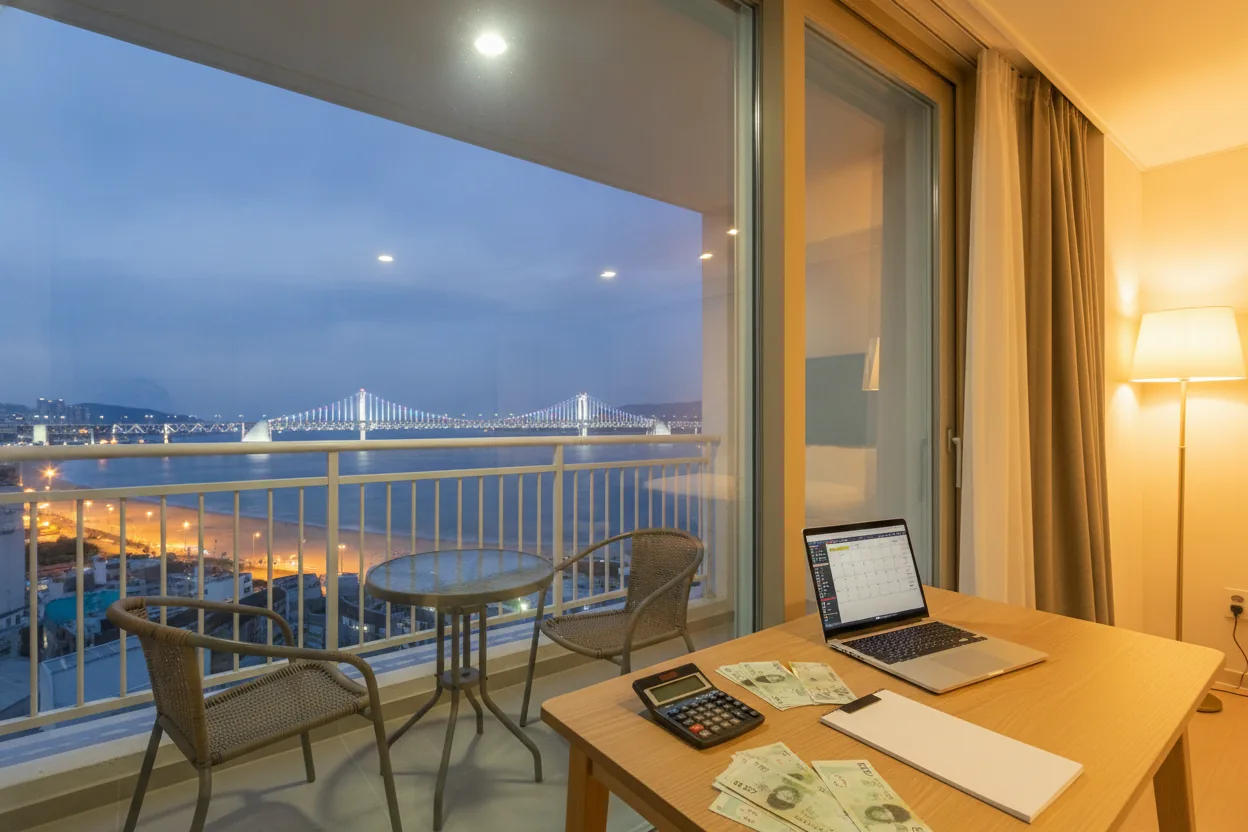
Somewhere out there, a spreadsheet exists that would embarrass a lot of travelers. Book a hotel near Haeundae or Gwangalli one night at a time for a month and the total lands in the low millions of won without anyone really noticing it climb. Tourists get told to price Busan like a vacation, night by night, while people who actually live there know a furnished monthly rental in the same neighborhood, same beach view included, usually costs less. That gap isn't a rounding error. So why does the hotel still feel like the safe bet once you're staying more than ten nights?
Here's my take: past ten nights in Busan, the hotel is the expensive option, not the safe one. People just don't do the math until it's too late to change course. Below is where the savings actually sit, and where the tradeoffs bite back, starting with the most obvious comparison: what a nightly rate turns into once you multiply it out.
Comparing Nightly Hotel Rates To Monthly Rental Totals
30 Night Stay: Hotel vs Short Term Rental Cost Breakdown
| Item | Hotel (Haeundae) | Rental (Gwangalli) |
|---|---|---|
| Base 30 nights | 3,300,000 won | 1,600,000 to 2,200,000 won |
| One time fees | None listed | 150,000 to 300,000 won |
| Breakfast (30 mornings) | 75,000 to 105,000 won | Optional, cooked |
| Estimated Total | approx. 3,400,000 won+ | approx. 2,050,000 won |
| Gap of roughly 1.3 to 1.4 million won over one month | ||
Source: Estimates as of September 2026, based on article figures
A three star business hotel near Haeundae or Seomyeon runs a moderate nightly rate as of September 2026, depending on floor and view. Multiply that by 30 and you've got a number that adds up fast, before you've even bought a meal. Short term rental platforms in Busan, the ones listing apartments by the week or month instead of the night, quote monthly totals that beat that range even after cleaning fees and platform commission get tacked on.
- Nightly rates for a mid range Haeundae hotel average somewhere in the low six figures of won, as of September 2026.
- That's 3.3 million won for 30 nights, before breakfast or laundry.
- A one room short term rental near Gwangalli or Millak typically runs 1.6 to 2.2 million won for the month.
- Cleaning and platform fees add 150,000 to 300,000 won, usually charged once, not nightly.
The nightly rate looks harmless on its own. That's exactly why it survives as the default. Stretch it across 30 nights and the comparison stops being close at all. A traveler passing through for two nights has no reason to go hunting for a monthly rental, but someone staying four weeks by the beach is quietly choosing to pay an extra million won for the privilege of skipping one extra booking form. And the lodging line is only half the story, because where you sleep decides how you eat.
Calculating What A Kitchen Actually Saves
Where the Monthly Won Goes: Hotel Stay vs Rental Stay
Hotel Route (approx. 3,400,000 won)
Rental Route (approx. 2,050,000 won)
Bar widths scaled to total spend; rental route bar reflects its lower overall total versus the hotel route.
Source: Derived from article cost estimates, September 2026
Ask a long term Busan resident what changed their food budget and they won't mention a restaurant. They'll mention the stove. A short term rental with even a cheap two burner induction top and a rice cooker kills the need to eat out for breakfast, often lunch too, and Busan grocery prices reward that shift harder than Seoul's do.
- Eggs at a GS25 or Emart near Gwangalli run a modest price per dozen.
- Pork belly at a local market like Millak Market runs a moderate price per kilogram.
- A convenience store breakfast eaten in a hotel room instead costs 2,500 to 3,500 won a pop, small until you multiply it by thirty mornings.
- Cooking most meals at home runs 25,000 to 40,000 won a week for one person.
None of this means cooking every night. It means having the option, which a hotel room never gives you. A hotel breakfast buffet in Haeundae adds up to a real monthly sum if you take that route every single morning. A rental kitchen doesn't erase that spending, it just makes it optional, and that one bit of optionality is basically the whole difference between a budget you control and one that drifts on you. Food's one recurring cost a kitchen hands back to you. The neighborhood around that kitchen matters just as much to the monthly math, though.
Weighing Location Against Price In Gwangalli And Haeundae
Daily Breakfast Cost: Hotel Habit vs Kitchen Option
Hotel Room, No Kitchen
2,500 to 3,500 won
per breakfast, forced daily spend
Rental With Kitchen
25,000 to 40,000 won
per week, covers most meals, optional
A kitchen turns a forced daily cost into an optional weekly budget, the core difference over 30 nights.
Source: Article estimates, per person, per day
Price alone doesn't settle this, because location changes what you're actually getting for either option. A rental one block back from Gwangalli beach at a moderate monthly rate is not the same product as a hotel room sitting directly on the Haeundae strand at a comparable nightly rate. Travelers who only compare totals miss that every time.
- Many Gwangalli area short term rentals sit a five minute walk from Millak Market.
- The Gwangan Bridge drone show, held select weekend nights, is visible free from Gwangalli beachfront buildings.
- Raw fish restaurant row along Gwangalli offers set menus at moderate prices per person.
- Ground floor convenience stores come standard in most mid rise Gwangalli and Millak buildings, so you're never more than an elevator ride from instant ramen at 2am.
What actually tips the balance for a month long stay isn't the beach view, since both hotels and rentals in these areas can hand you that. It's the pile of small frictions a hotel never solves: no kitchen, no washing machine, housekeeping showing up when you didn't ask for it, a front desk that expects you gone on schedule instead of settled in. Newer Gwangalli and Millak developments increasingly bundle in a free ocean view gym and a paid sauna, as of 2026, which quietly replaces a gym membership or spa visit you'd otherwise be paying for separately. Hotels rarely hand that over for free, and when they do, you'll find it baked into the nightly rate somewhere. Check what a building actually includes before you compare it against a hotel on price alone. Comfort and amenities settle one part of the decision. The rest comes down to how long you're staying and how much flexibility you're willing to give up for the savings.
Deciding Based On Length Of Stay And Flexibility Needs
The honest answer to hotel versus rental in Busan has less to do with price and more to do with how long you're staying and how much you care about being able to change plans midway. Short term rentals in Korea generally lock you into a fixed block, often with only a partial refund if you cancel early, while hotels let you cancel a single night with barely a scratch.
- 7 nights or fewer, the hotel wins on flexibility and simplicity, no contest.
- 10 to 14 nights, the two roughly break even on cost, though the rental starts pulling ahead on comfort.
- 21 to 30 nights, rentals save a meaningful amount over hotels, the exact figure swinging with hotel tier.
- Deposits or cancellation exposure on a monthly rental run 30,000 to 100,000 won, but verify per listing since terms vary widely.
None of these numbers hold steady across every listing, and that's worth sitting with instead of glossing over. A beachfront rental quoted at a moderate rate in a shoulder month can jump noticeably higher during peak summer weeks in July and August, since Busan short term pricing tracks the same seasonal demand pushing hotel rates up in that same window. Book a September or October stay and you're negotiating in a calmer market than someone locking in the same unit for August. Pull up actual listings for your exact dates before you decide anything.
Which brings us back to the question this whole thing started with: the hotel default survives not because it's cheaper, but because almost nobody stretches the nightly rate across thirty days until after they've already booked. Past ten nights in Busan, that math stops favoring the hotel. A rental near Gwangalli or Haeundae, kitchen included, fixed monthly rate locked in, is the choice that actually protects your budget instead of just your convenience.