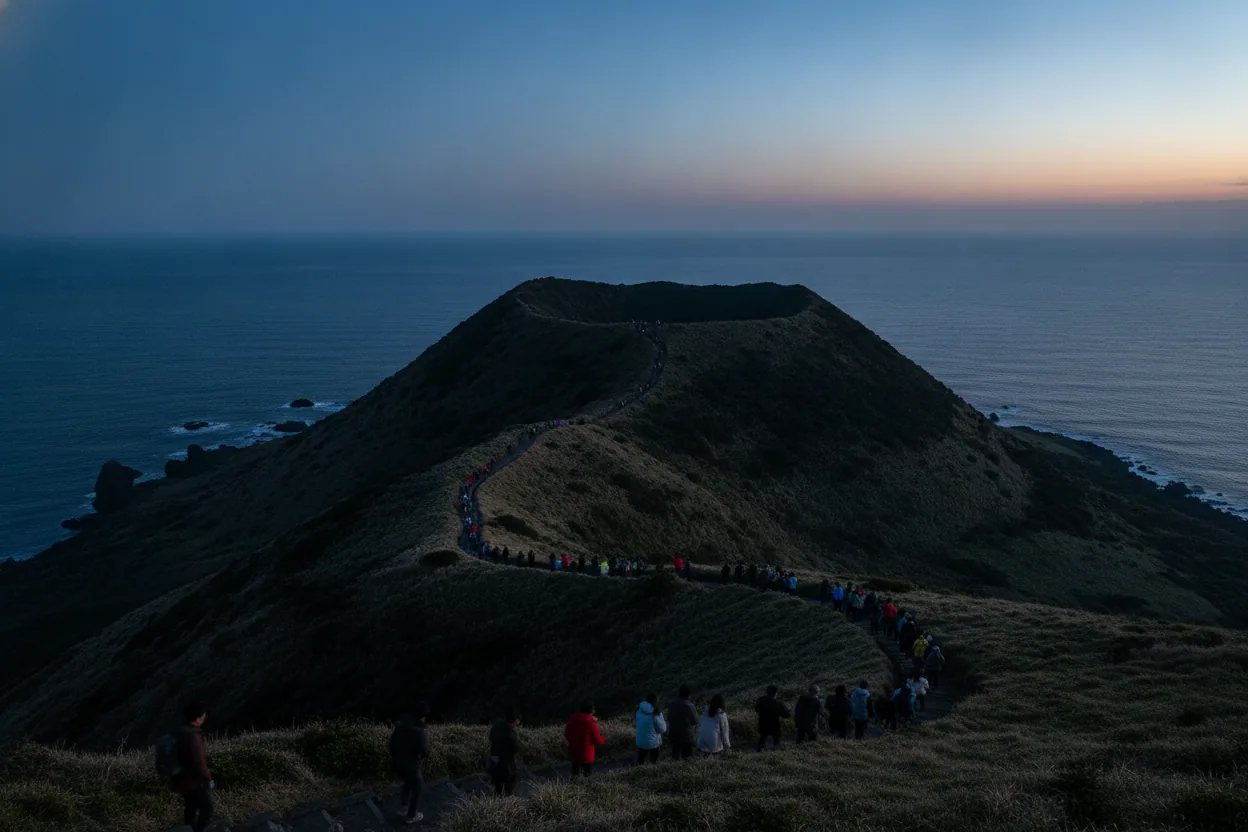
Ninety minutes is the arrival window that separates a person who watches the sun break over the East China Sea from a person who watches four hundred phone screens block that same view. Guidebooks tell you Seongsan Ilchulbong opens as early as 4am during peak summer and leave it at that. Locals know the number shifts by more than an hour across the calendar, and that the real math is sunrise minus the climb minus a buffer most first timers underestimate. So what time should you actually show up? It depends on a sunrise clock, a transport gap, and a crowd pattern that no posted opening hour will ever spell out for you.
Seongsan Ilchulbong is a volcanic tuff cone on the eastern tip of Jeju Island, and it draws crowds because it's one of the only places in Korea where you can watch a sunrise over open ocean from an elevated crater rim. The entrance fee sits around 5000 won for adults and about 2500 won for teenagers and children, though these figures shift slightly year to year, so treat them as a realistic range rather than a locked number. Most visitors don't get the destination wrong. They get the assumption wrong, the idea that Jeju runs on the same predictable rhythm as Seoul, when almost everything about this hike, from bus timing to sunrise math to the food stalls near the base, depends on details a standard guidebook glosses right over. The next four sections walk through exactly those details, starting with the one that determines everything else: the sunrise clock itself.
The Sunrise Math That Changes Every Visit
The Arrival Math: Working Backward From Sunrise
Calculate Your Departure Time Backward From Sunrise
e.g. 5:10am (late June) or ~7:30am (late December)
Minus 25 to 30 min (up to 40 min with photo stops)
Minus 20 to 30 min for tickets and walk from parking
Set your alarm around this buffer, not around sunrise itself
Source: Based on article estimates of climb time and buffer
Sunrise at Seongsan Ilchulbong shifts by more than an hour across the calendar year, and that single fact reorganizes the entire visit. In late June, sunrise happens around 5:10am, which is why the peak opens its gates about an hour before sunrise, around 4am, giving visitors enough daylight to climb safely. By late December, sunrise slides to somewhere in the mid-to-late 7am range, and the mountain generally adjusts its opening hours to match, though the exact shift depends on the season and is worth confirming closer to your travel date.
This isn't a minor scheduling detail. It's the entire logic of the visit. A traveler who checks a generic sunrise time online without checking Seongsan's specific opening hours for that month risks showing up either far too early, standing in the dark at a locked gate, or far too late, climbing into a crowd that's already claimed the rim. Jeju's local tourism office publishes monthly adjusted hours, and checking those against the sunrise time for your exact travel date is the one piece of homework that actually pays off here.
The climb itself takes about 25 to 30 minutes for most people at a normal pace, sometimes 40 if you stop to look back at the coastline, and you will want to do that more than once. So the real arrival math is sunrise time minus 45 minutes for the climb, minus another 20 to 30 minutes for the ticket line and the walk from the parking area. First timers tend to underestimate that buffer, not the climb. Set your alarm around the buffer, not around sunrise itself.
That buffer only matters, though, if you can actually get to the mountain in the dark, and that's where Jeju's transit gaps start to matter more than the sunrise clock itself.
The Transport Gap Most Visitors Miss
Summer vs Winter Sunrise Visit Comparison
| Detail | Late June | Late December |
|---|---|---|
| Sunrise Time | Around 5:10am | Mid to late 7am range |
| Gate Opening | Around 4am | Adjusted later, shift varies |
| Climb Duration | 25 to 40 minutes | 25 to 40 minutes |
| Total Time Gap | Roughly 1 hour before sunrise | Over 2 hours shift vs summer |
Source: Based on figures cited in the article
Getting to Seongsan Ilchulbong before dawn is where Jeju's limited late night transit options actually bite. Public buses do run to Seongsan, but the schedule isn't built around a 4am sunrise crowd. Regular bus service generally doesn't start until the early morning hours, well after sunrise chasers need to already be on the mountain, though it's worth confirming exact start times before relying on it.
That's why the overwhelming majority of sunrise chasers rent a car for their Jeju stay. Rental prices on the island are widely cited as ranging from roughly 30000 to 60000 won a day for a compact vehicle depending on season and company, and that flexibility is what makes a 4am departure from Seogwipo or Jeju City actually possible. A taxi works too. KakaoTaxi operates on Jeju, though availability at 3am from more remote accommodation can be thin, so anyone counting on a pre-dawn pickup should build in extra waiting time or arrange it the night before through their guesthouse.
Jeju Air, along with T'way and other budget carriers, tends to offer some of the cheaper flights out of Seoul's Gimpo Airport. The flight itself takes about an hour, and one way fares commonly fall in a broad low-to-mid tens of thousands of won range depending on how far ahead you book and the season. That one hour flight time makes Jeju one of the more accessible island destinations in Asia relative to the scale of scenery it delivers. But landing in Jeju City and reaching Seongsan on the far eastern coast still takes close to an hour by car, a detail that trips up travelers who assume the whole island sits a short hop from the airport.
Anyone planning a sunrise visit without a rental car should treat that transport gap as the real planning priority, ahead of the ticket price or the hike itself. Once transport is sorted, the next question is what that ticket price actually buys you, since the 5000 won figure covers far less than most visitors assume.
What The Entrance Fee Does And Does Not Cover
Key Costs and Times at a Glance
Adult Entrance Fee
5,000 won
Teen/Child Fee
2,500 won
Car Rental (per day)
30,000 to 60,000 won
Total Arrival Window
90 minutes
Sunrise Time Shift Across the Year
Over 2 hours
Source: Based on figures cited in the article
The 5000 won adult entrance fee covers access to the marked trail and the crater rim viewpoint. That's essentially the full scope of it. There's no separate sunrise premium fee, which counts as one of the few genuinely visitor friendly parts of the pricing structure here compared to other Jeju attractions that have added surcharges for peak timing in recent years.
Discounted tickets apply for teenagers and children, generally in the 2500 to 4000 won range, and some Korean domestic tourism passes or regional discount cards can shave a bit off the adult price, though these vary by season and are worth checking at the ticket booth rather than assuming in advance. Locals visiting with a Jeju resident card sometimes pay a reduced local rate, which occasionally surprises visiting friends of Jeju residents when the counter price comes in lower than expected.
The ticket doesn't cover parking, which typically carries a separate small fee at the main lot near the entrance, usually in the 1000 to 3000 won range for cars, and that figure shifts based on which lot drivers use and how early they arrive. It doesn't cover food either. There's no restaurant on the crater itself, and the food stalls near the base selling grilled squid, hotteok, and coffee take cash and card but aren't cheap, often running 20 to 30 percent above what the same items cost at a regular GS25 or a Jeju City market. That pricing pattern tracks with almost every landmark adjacent food stall cluster in Korea, from Myeongdong street carts to the stalls outside Bulguksa in Gyeongju.
The entrance fee is genuinely low by international standards for a landmark of this profile, but the total cost of the visit, once transport, parking, and a coffee to fight the pre-dawn chill get factored in, lands closer to 15000 to 25000 won per person than the 5000 won headline number suggests. Budget for that fuller number, not the ticket price, when deciding whether to add this to a tighter Jeju itinerary.
Money and timing are only half the equation. Even with the math and the budget sorted, who else shows up on any given morning still shapes the experience more than either one.
The Crowd Pattern Locals Already Know
Seongsan Ilchulbong crowds don't spike randomly. They spike in a pattern tied directly to Korean and international holiday calendars, and knowing that pattern is the difference between a quiet sunrise and a shoulder to shoulder one. Weekends year round bring noticeably heavier crowds than weekdays, and Korean school holiday periods in summer, plus the stretches around Seollal or Chuseok, push numbers up further still.
Foreign visitors cluster around the same handful of dates too, particularly Golden Week adjacent travel windows and the peak of Korean autumn foliage season in October and November, when the crater rim and surrounding Seongsan village fill with domestic and international tourists chasing the same photo. A Tuesday sunrise in early June or early September, outside major holiday windows, is a genuinely different experience from a Saturday sunrise in late July, even though the ticket price and opening hours barely change between the two.
There's a secondary crowd pattern worth knowing too. Many tour groups and photography tours arrive specifically for sunrise, then clear out within 30 to 40 minutes of the sun clearing the horizon. Visitors who linger on the rim for another hour after that initial rush often find a noticeably emptier mountain and better light for photos, since the volcanic tuff formation and the patchwork of canola or barley fields below look different, and arguably better, in the fuller morning light than in the flatter pre-dawn glow everyone is chasing.
Locals on Jeju who hike Seongsan regularly, whether for exercise or just because they live nearby, tend to go on weekday afternoons instead, skipping the sunrise rush entirely. Staying past the initial rush costs a visitor nothing extra and buys a version of the mountain the tour buses never see.
With the sunrise math, the transport gap, the real cost, and the crowd pattern all mapped out, the last piece is turning that knowledge into an actual plan for the day.
What A First Time Visitor Needs To Plan For
The biggest planning error is treating Seongsan Ilchulbong as a standalone half day trip rather than part of a tighter eastern Jeju loop. The peak sits close to other well known stops including Seopjikoji, its coastal walking path neighbor, and the black sand adjacent beaches around Seongsan village. A sunrise visit pairs naturally with a slower morning exploring the immediate area rather than a rushed drive back to Jeju City.
Weather is the other underestimated variable. Jeju's coastal weather shifts quickly, and a clear forecast the night before doesn't guarantee a visible sunrise. Low cloud along the horizon is common enough on the eastern coast that even well planned trips sometimes end in a gray, cloud obscured dawn rather than the vivid orange break shown in postcards. Checking a Jeju specific weather forecast, rather than a general Korea forecast, the evening before is a small step that meaningfully improves your odds, if the itinerary allows flexibility on which day to attempt the climb.
Footwear matters more than most visitors expect going in. The trail is a mix of stairs and packed dirt path, manageable in sneakers for most fitness levels, but it can get slippery after rain, and pre-dawn darkness on the lower sections means a small flashlight or a phone light is genuinely useful, not optional gear.
So the ninety minute window from the opening line comes down to this: set the alarm by the buffer, not the sunrise. Sort transport before ticket price. Budget for the fuller cost, not the headline 5000 won. And if the schedule allows any flexibility at all, aim for a weekday outside the holiday calendar and stay on the rim after the tour buses leave. That's the difference between watching the sunrise and watching everyone else watch it.