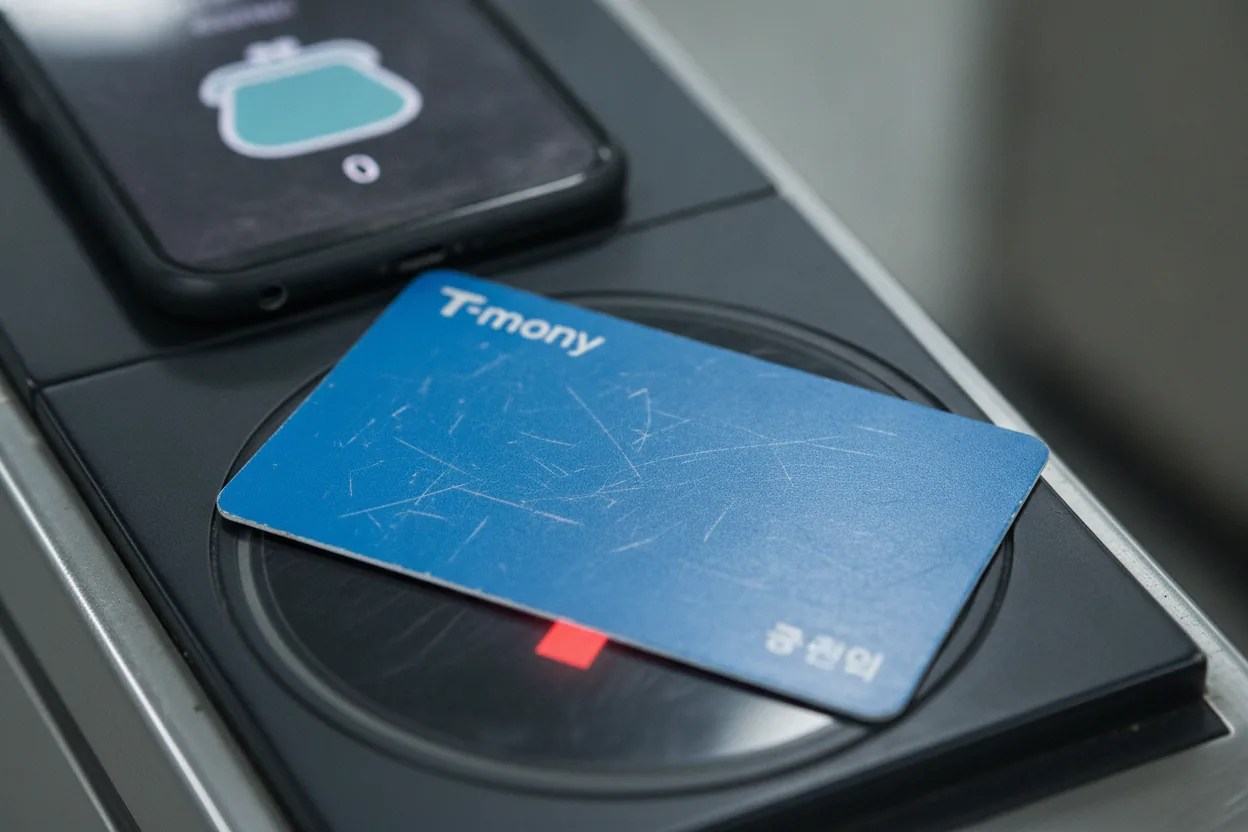
A T-money card is Korea's universal tap-to-pay transit card
The T-money card itself never expires. The cash loaded on it does: sit on it for 5 years without a top-up or tap, and that balance can vanish quietly while the plastic still reads as working fine. That split between the card and the money on it explains why so many longtime owners run into a scan failure they can't explain, and why only some of them actually qualify for a refund.
Most foreign visitors and new residents assume a transit card works the same way everywhere: load money, use it until it runs out, done. T-money mostly follows that logic, with one exception that catches long-term users off guard. Article 26(1) of the T-money terms of service says the card itself, described as a prepaid electronic payment method, can be used and refunded without an expiry date. That part matches what most people expect. A card bought in 2016 is still a legitimate, working piece of plastic a decade later.
What catches people off guard is that the money sitting on the card plays by different rules than the card itself. The balance is only guaranteed to remain valid for 5 years from the last top-up or tap. After that point of inactivity, it can expire even while the physical card still works fine. Say a card sits untouched since 2019 with 2,000 won still loaded on it: that balance can expire even though the plastic is perfectly intact. The card is permanent. The balance isn't. This one distinction is the root of almost every "my balance is fine but the card won't scan" complaint, and knowing which half you're actually dealing with, the plastic or the balance, determines whether there's even a fix available.
That same card/balance split explains three different failure patterns
People searching for this issue usually land on one of two assumptions: either the card is broken, or the balance should carry over forever no matter how long the card sits idle. Neither is quite right. T-money's own policies break this down into three separate problems that constantly get lumped together.
- Balance expiry from inactivity. If your last top-up or tap happened more than 5 years ago, the stored balance has likely expired even though the card reads as having funds. A card from 2018 that hasn't been touched since is a textbook case.
- Physical card failure unrelated to balance. Heat does a surprising amount of damage here. One long-term user described their T-money card warping after sitting in a pocket next to a hot pack, though in that particular case the card kept working anyway. Not every card survives that kind of heat exposure, and a warped or cracked card can simply stop being readable by bus scanners.
- Negative balance confusion from skipped tap-outs. On buses, forgetting to tap out doesn't block the card. Instead, the system assumes you rode to the final stop and charges the maximum fare, which can push the card into negative territory. A card is allowed to go slightly negative for one ride as a convenience, but repeated negative rides stack up and make the card behave unpredictably until someone reloads it.
Treating all three as the same bug is exactly why so many people give up on a card that could still be fixed or refunded. Each one has a different remedy, and only one of them, physical failure, actually gets your purchase price back.
Of those three problems, only physical failure comes with a refund, and only within a time limit
Most people assume that if a card stops working, they're owed whatever balance it held, no questions asked. The real rules are narrower and time-limited. If a card is genuinely faulty, meaning physically intact but unreadable by scanners, you can get back the remaining balance. The original purchase price only comes back if the fault is reported within 2 years of purchase. To claim this, you submit the card through a convenience store refund envelope, an Incheon Subway Line 1 or Line 2 service center, a T-money Town location, or the PC version of the T-money website. Damage the card yourself, say by bending or cracking it, and it gets reclassified as a damaged card rather than a faulty one. You recover the balance only, not the purchase price. That two-year window is the detail almost everyone misses. A card that fails in year three gets you nothing back on the purchase price, even when the fault was clearly the card's and not yours.
A lost card is a different risk from a failed one, and most owners haven't covered it
Plenty of people assume a lost T-money card works like a lost bank card: report it, freeze it, get the balance back. It doesn't, not by default. A physical T-money card that was never enrolled in the Public Transport Safety Card service, known in Korean as 대중교통안심카드, can't have its balance recovered if lost. Whoever picks it up keeps tapping it until the balance hits zero, and T-money has no way to trace the loss back to you after the fact.
Protecting a card means completing three steps before anything goes wrong: sign up for a T-money account, register the card to that account, and enroll in the lost or stolen card service. Skip any one of these and a lost card with 30,000 won on it is just gone. Registration takes a few minutes and costs nothing. Anyone skipping it is betting on never losing a wallet, which is not a bet I'd take.
That same 5-year balance clock gives travelers an easy way to keep an old card alive
Visitors often figure a card bought for one trip to Seoul is a throwaway item with no lasting value. For travelers who reload at kiosks with a foreign credit card instead of hunting down cash, the same balance-expiry clock applies, and this time it works in their favor. A reload resets the 5-year validity window, so one top-up near the end of a trip is often enough to keep an old card's balance alive for years afterward. As of 2026, a T-money card is still required for Seoul subway rides and most bus routes, so the card isn't going anywhere, but the balance clock inside it keeps ticking in the background whether anyone notices or not.
A card from a trip five years ago, reloaded just once near the end of that trip, may still have a live balance sitting on it today. That makes T-money cards better souvenirs than most travelers realize, as long as someone remembers to tap them occasionally.
The card lasts forever, the money on it does not
That's the split this whole issue comes down to: the plastic survives indefinitely, the balance doesn't, and a scan failure can come from either side depending on how the card was treated. Anyone holding onto an old T-money card from years ago should check the balance and tap it at least once every few years, register it for loss protection if it carries real money, and keep it away from heat sources like hot packs or direct sunlight in a car. Register your card and reload it occasionally, and you lose nothing. Stash it in a drawer for half a decade assuming the balance is waiting for you, and you're the one most likely to find out, too late, that it quietly expired months or years ago.