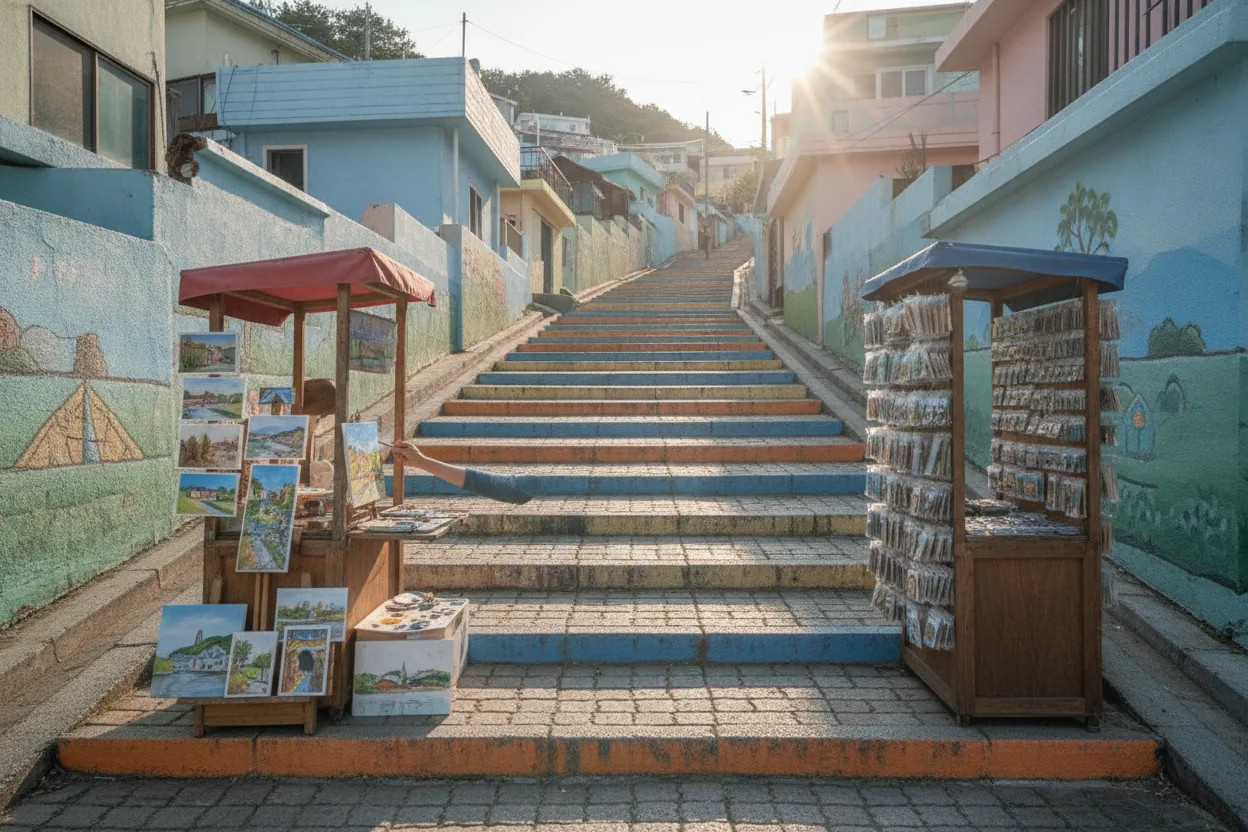
A hand painted postcard from a Gamcheon resident artist costs 3,000 won. A mass produced magnet of the same mural, printed in bulk far from Busan, also costs 3,000 won. Guidebooks lump Gamcheon in with Nampo or Seomyeon as one more souvenir strip, so visitors assume every stall on the hill runs the same transaction. Almost nobody walking up that hill realizes there are two separate economies hiding behind one price tag. So here's the question worth asking before you buy anything there: which of the two economies is your money actually feeding?
Gamcheon Sells Two Different Economies At The Same Price Point
Same Price Tag, Two Different Economies
Both items cost about the same, 3,000 won, but the money goes two very different places.
Hand painted postcard
3,000 won
Painted by a resident artist, sold with permission to reproduce their own mural. Money stays in the village.
Mass produced magnet
3,000 won
Printed in bulk far from Busan, could be sold in Myeongdong. Money leaves the village.
Identical price bracket. Identical shelf appeal. Only one supports the community that makes Gamcheon worth visiting.
Source: Article: Gamcheon Culture Village, Buying Art vs Buying Souvenirs in Busan
Walk the main lanes of Gamcheon on any Saturday and you'll pass dozens of small stalls selling what looks like identical inventory: keyrings, magnets, postcards, small prints of the famous Little Prince statue overlooking the sea. Prices cluster in a fairly modest range for souvenirs like these, though the exact amount shifts by stall, by item, and by whatever the exchange rate happens to be doing that day.
What the price tag won't tell you is where the thing came from. Some of those postcards are hand painted by artists who actually live in the village, sold with permission to reproduce murals they painted themselves. Others were printed in bulk and could just as easily be sitting on a shelf in Myeongdong. Both sit in roughly the same price bracket. Both look charming tucked into a tote bag. Only one of them puts money back into the community that makes Gamcheon worth visiting in the first place.
You don't need to become an art authenticator on vacation to tell them apart. Look for a signature, a small artist name card taped to the shelf, or a shopkeeper who can tell you which house on the hill the piece came from. The information center near the entrance can point you toward which studios are currently active and selling, since the artist roster shifts as people move in and out of the village. Ceramic pieces from the craft workshops tend to be the safest bet, coming directly from the two or three permanent workshop spaces rather than a wholesale supplier. You won't be able to verify provenance on every single item, and that's fine. The point is just noticing that the choice exists at all.
Two price brackets, one price tag. The same split shows up again once you look past the souvenir stalls toward the parts of Gamcheon built for making things rather than selling them.
A Pottery Session In Gamcheon Costs Less Than A Seoul Olive Young Haul
How To Spot The Real Artist Economy
Step 1
Look for a signature on the piece
Step 2
Check for an artist name card taped to the shelf
Step 3
Ask the shopkeeper which house on the hill it came from
Step 4
Confirm active studios at the information center near the entrance
Step 5
Default to ceramics from the two or three permanent workshops
Source: Article: Gamcheon Culture Village, Buying Art vs Buying Souvenirs in Busan
Most visitors treat Gamcheon as a photo circuit: stamp the passport, find the fisheye lens mural, grab the obligatory shot with the Little Prince statue, leave within ninety minutes. Fair enough, that's a legitimate way to see it. But it's also the version that skips the part of the village built for people who want to make something rather than just photograph it. And that's where the same two-economy split from the souvenir stalls shows up again, this time between a quick photo stop and an actual purchase from a working studio.
Two or three permanent workshop spaces run short sessions in pottery, printmaking, and traditional Korean paper craft, at prices that feel almost absurdly modest for the one to two hours the sessions run. Compare that to a casual Olive Young shopping basket in Seoul, where a sunscreen, a sheet mask, and a cushion foundation add up fast before you've even gotten to anything you'd call a real splurge. A full craft session in Gamcheon still ends up costing noticeably less than that basket, and you walk away with something you made instead of something you bought off a shelf.
Nobody built these workshops with foreign tourists in mind. They target domestic visitors, mostly groups from Seoul or Daegu doing a weekend Busan trip, and the instruction happens entirely in Korean. English speakers can generally still follow along through gesture and demonstration, since pottery wheels and printmaking blocks don't require a shared language to operate. What they do require is planning. Weekend sessions fill up, and walking in cold on a Saturday afternoon is the most common way to hear that everything's booked. A phone call, a stop by earlier in the day, or asking your Busan accommodation staff to call ahead in Korean solves this in minutes.
What you walk away with, a small glazed bowl or a block printed postcard, ends up a far more specific souvenir than anything on the main lane, and for next to nothing. It also comes from the same workshop spaces that anchor the village as a place where people actually live and work, not just a backdrop for photos. Which is the point the next section makes directly.
Gamcheon Still Functions As A Neighborhood, Not Just A Backdrop
A Pottery Session vs A Seoul Olive Young Haul
Relative spend comparison described in the article: a full craft session in Gamcheon still costs noticeably less than a casual Seoul skincare basket, and you keep something you made.
Gamcheon Pottery Session
Seoul Olive Young Basket
Same rough spend adds up fast on consumables you'll use up, versus one craft session that produces something lasting.
Source: Article: Gamcheon Culture Village, Buying Art vs Buying Souvenirs in Busan
Gamcheon Culture Village started as a hillside settlement for refugees during the Korean War. The murals and public art came later, part of a government led regeneration project in the late 2000s. People still live in many of those houses. That one detail should change how a thoughtful visitor behaves, even though it's the first thing you forget the moment a camera comes out.
The resident artist studios make this clearest. Several are set up as combined studio and gallery spaces, open on weekends, tucked into renovated houses or buildings that previously sat empty. These aren't performances staged for tourists. They're working studios where someone happens to also sell what they make. Buying directly from one of these, even an inexpensive print, is a different act from buying the same image printed on a tote bag at a stall near the entrance. One transaction supports a resident. The other feeds the broader tourism supply chain, which isn't bad exactly, just different.
There's a reasonable comparison here to what happened in Seongsu dong in Seoul, where a neighborhood built around small studios and workshops gradually filled with larger retail and chain stores as rents climbed and foot traffic grew. Gamcheon has stayed smaller and slower moving, partly thanks to its geography. Steep stairs and narrow lanes just don't scale the way a flat commercial district does. That physical limit has, so far, protected the balance between resident life and tourist flow in a way flatter, more accessible neighborhoods never get to keep.
None of this means buying a tourist souvenir is a mistake. It means Gamcheon doesn't really have one price range, it has two, overlapping by coincidence. A 3,000 won postcard bought from a resident artist and a 3,000 won magnet printed somewhere else both end up in the same tote bag, but only one of them answers the question this piece opened with. The only way to tell them apart is to ask, right there on the spot, before you pay: who actually made this, and does it say so anywhere on the shelf?