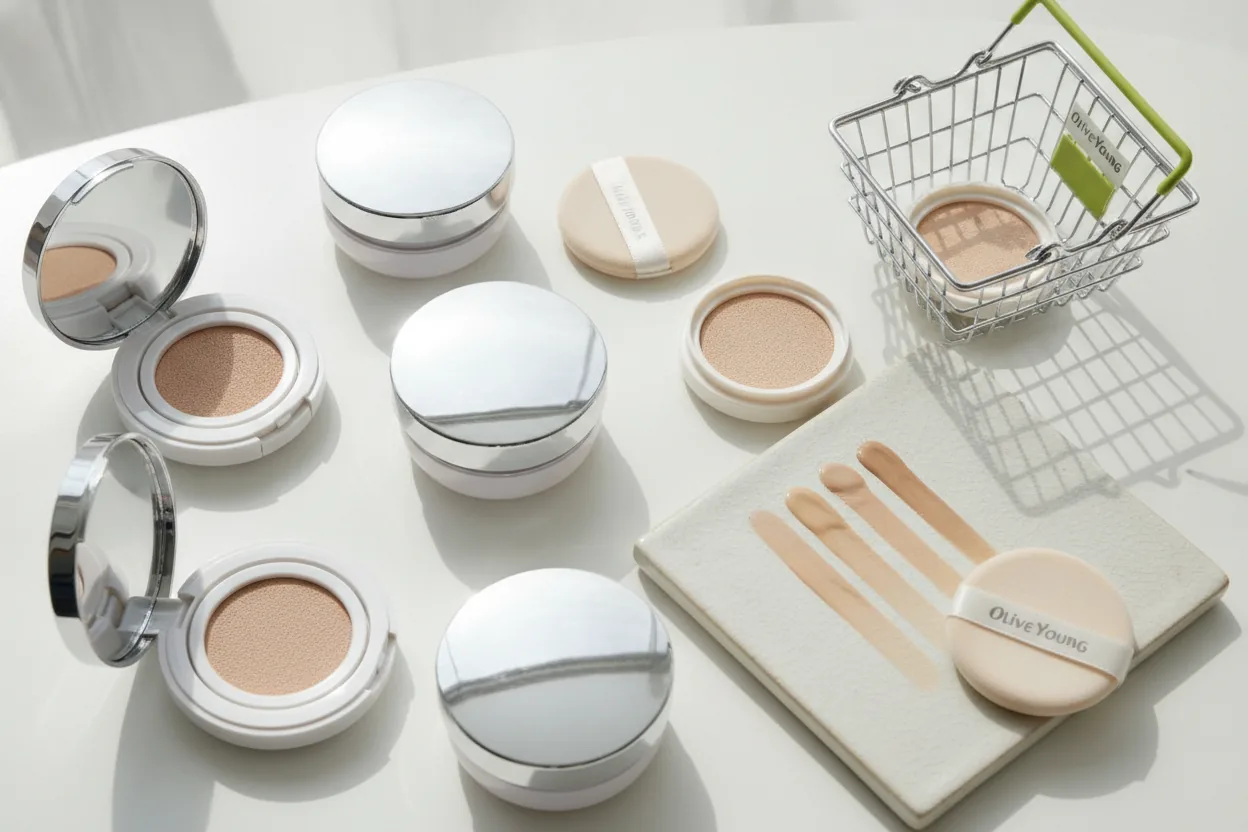
TirTir Mask Fit Red Cushion has a larger international fanbase than a domestic Korean one, a rare inversion for a product sold in every Olive Young in Hongdae. The brands filling haul videos and the brands Korean women are restocking on the Olive Young app at midnight are almost entirely different products, optimized for different climates, different SPF floors, and a refill economy that most international coverage never mentions. That gap between the global cushion conversation and the local one isn't random noise. It's the whole story of how Korean and Western beauty markets have quietly split into two separate categories sharing the same product name.
The influencer circuit, largely built around Western skin tones and camera performance, gravitates toward cushions with high coverage, dramatic finish, and strong color range. TirTir and Laneige Neo Cushion both photograph well and ship internationally without complications. Neither of those facts has much to do with why a Korean consumer in her thirties picks up a cushion at a Myeongdong Olive Young on a Tuesday afternoon. She's thinking about UV protection, sweat resistance, and whether the finish will still look reasonable at 6pm in July humidity. Those are very different criteria, and they produce very different purchase decisions.
What the Local Shelf Actually Looks Like
Korean Cushion Foundations: Local Pricing and Tier at Olive Young
Korean Cushion Foundations: Local Pricing and Tier at Olive Young
| Brand / Product | Price Range (KRW) | Market Tier | Refill Included |
|---|---|---|---|
| Sulwhasoo Perfecting Cushion | 65,000 to 70,000 | Prestige | Yes |
| Hera UV Mist Cushion | 48,000 to 55,000 | Premium | Yes |
| Laneige Neo Cushion Glow | 38,000 to 42,000 | Mid-range | Yes |
| IOPE Air Cushion | 38,000 to 44,000 | Mid-range | Yes |
All prices in Korean Won (KRW). Refill inclusion is a key domestic market signal.
Source: Observed Olive Young retail pricing, article data 2026
Walk into any Olive Young outside the tourist corridors, the Seongsu-dong branch or the one near Konkuk University station, and the cushion wall tells a story that no unboxing video does. Sulwhasoo Perfecting Cushion sits at the top of the prestige tier, typically observed around 65,000 to 70,000 won depending on promotional cycles. Below it, Laneige Neo Cushion Glow holds its own, hovering in the observed range of 38,000 to 42,000 won. The real volume movers in everyday Olive Young locations are brands that rarely trend internationally: Hera UV Mist Cushion, IOPE Air Cushion, and Dr.Jart Cicapair Cushion for anyone dealing with redness or sensitivity.
IOPE Air Cushion is worth pausing on because it's arguably the format's origin point. IOPE, an Amorepacific brand, introduced the cushion compact to the Korean market over a decade ago, and the product has been quietly refined every year since. Koreans who remember that history treat it with a kind of baseline loyalty that no influencer cycle has disrupted. Observed pricing at Olive Young sits in the 38,000 to 44,000 won range for the standard compact, which includes a refill. That refill structure matters more than most international coverage acknowledges. The Korean cushion market runs on refills, and a brand's refill availability is a quiet signal of how seriously it takes its domestic customer base.
Hera UV Mist Cushion operates in a slightly different register. The brand, also under Amorepacific, is positioned as a department store label that crossed over into Olive Young through selective distribution. Its UV cushion line is formulated with the Korean summer specifically in mind: high SPF, a semi-matte finish that resists the kind of midday shine that hits hard in Seoul from June through August. Observed pricing runs around 48,000 to 55,000 won. Not a budget product, but Korean consumers who wear cushions daily think about cost per wear across a full refill cycle, not cost per compact.
The products dominating Korean beauty community discussions on Naver Cafe and KakaoTalk group threads are almost never the ones leading Western influencer haul videos. That divergence is a reliable signal of where the genuine formulation investment is actually going.
Why SPF Changes the Entire Formula
How a Korean Consumer Chooses a Cushion Foundation
How a Korean Consumer Chooses a Cushion Foundation
Check SPF Rating
Must meet SPF 50+ PA++++ minimum threshold
Assess Sweat and Humidity Resistance
Must hold finish through Seoul summer heat (June to August)
Evaluate Finish at End of Day
Semi-matte preferred: must look reasonable at 6pm in July humidity
Calculate Cost Per Wear (Full Refill Cycle)
Price judged across refill cycles, not per compact unit
Restocked on Olive Young App
Refill availability confirms brand's commitment to domestic market
Source: Article analysis of Korean beauty community purchase criteria, 2026
Source: Article analysis of Korean beauty community purchase criteria, 2026
Korean dermatology culture has fully absorbed the message that daily UV protection is non-negotiable, which means a cushion foundation without a credible SPF rating is, to most Korean consumers, a product doing only half its job. The standard threshold most Korean shoppers treat as a floor is SPF 50+ PA++++. Anything below that tends to get mentally filed as an evening or special occasion product rather than an everyday base.
This is why the Korean market looks so different from the Western one at the formulation level. Western cushion foundations often lead with coverage and skin finish. Korean ones lead with sun care credentials and layer coverage and finish on top of that priority. IOPE Air Cushion carries an observed SPF 50+ PA++++, Sulwhasoo Perfecting Cushion the same, and Hera UV Mist Cushion posts SPF figures that Korean beauty community threads treat as a primary comparison point rather than a footnote. The SPF spec appears in the product name or at the top of every Korean store description across this tier. It's not a secondary claim. It's the headline.
TirTir Mask Fit Red Cushion, for all its international traction, carries an observed SPF 40 PA++. Perfectly reasonable by global standards. By the standards of a Korean consumer doing a direct comparison on a Naver beauty forum, it becomes a point of discussion rather than a point of pride. This isn't a criticism of the product. It explains why TirTir's domestic Korean fanbase skews younger and more experimental while its international fanbase runs significantly larger than its local one. That inversion tells you almost everything about how the Korean and global cushion markets have come apart.
Reading the Refill Economy
Brand Attribute Strength: Korean Local Market vs. International Market
Brand Attribute Strength: Korean Local Market vs. International Market
Intensity scale: Low Medium High Very High
| Brand | SPF Focus | Refill Economy | Intl. Popularity | Local Loyalty |
|---|---|---|---|---|
| IOPE Air Cushion | Very High | Very High | Low | Very High |
| Hera UV Mist | Very High | High | Low | High |
| Laneige Neo Cushion | Medium | High | High | Medium |
| Sulwhasoo Perfecting | Medium | High | Medium | High |
| TirTir Red Cushion | Low | Medium | Very High | Low |
Source: Article analysis of domestic Korean and international cushion market signals, 2026
Source: Article analysis of domestic Korean and international cushion market signals, 2026
Cushion refills in Korea are priced at roughly 60 to 70 percent of the full compact price, and every major Korean brand structures its line around this. Sulwhasoo refills are observed in the 42,000 to 48,000 won range. IOPE refills sit around 25,000 to 30,000 won based on observed in-store patterns. This isn't a marketing tactic in the way a loyalty program is a marketing tactic. It reflects a market where cushion foundations function as primary daily sun protection, meaning repurchase cycles are fast and consumers are paying close attention to the total cost of a year's use, not just the cost of entry.
Olive Young's membership system intersects with this in a specific way. Higher membership tiers receive points on refill purchases at the same rate as full compact purchases, which means a committed cushion user accumulates points fast enough to materially offset costs over a year. The Olive Young app tracks purchase history and surfaces refill prompts tied to specific compact purchases. Small detail, but a telling one. It reveals how deeply this category is embedded in daily routine rather than treated as an occasional beauty splurge.
Brands without a refill system, or with one that's difficult to locate in stores, tend to stall at a certain sales ceiling in Korea regardless of how they perform internationally. The refill is a commitment signal. It tells the Korean consumer that the brand expects her to return, which is a very different relationship than the one a compact bought once and never restocked offers. The brands tourists carry home in quantity from Myeongdong are often not the brands Korean women are restocking on the Olive Young app at midnight, and understanding which shelf you're actually shopping from is the whole game in Korean cushion foundations.
Price Tiers Mapped From Entry to Prestige
Korean cushion foundations span a wider price range than most international shoppers expect. At the accessible end, Missha M Magic Cushion and Etude House Any Cushion are both widely regarded as entry-level options, with prices that fall in an accessible range at Olive Young, though exact figures vary by promotional period and should be verified against current listings. Both have long domestic track records that their low prices don't obviously advertise. The Missha cushion in particular has survived years of market competition without formula changes dramatic enough to alienate its core buyers. In a market this competitive, that kind of staying power is its own endorsement.
The mid tier, roughly 30,000 to 45,000 won, is where the most active competition sits. Laneige, IOPE, Romand Bare Water Cushion, and Skin1004 Hyalu-Cica Water Fit Cushion all compete here. Skin1004 deserves specific mention because it followed an unusual trajectory: built partly on international social media attention, it subsequently earned serious domestic Korean credibility through formula performance rather than hype. That's a harder road. It's also a more durable outcome.
Above 50,000 won, the field narrows to Sulwhasoo, Hera, and a handful of department store brands like Whoo that skew toward a slightly older consumer and lean harder into traditional herbal ingredient positioning. These are not products most tourists are picking up in Myeongdong. They move through Olive Young's premium sections and department store beauty floors in Lotte and Shinsegae, where the sales consultant model still operates and trying before buying is simply expected.
Pricing across all tiers tends to compress during Olive Young's major sale periods, particularly the annual Olive Young festa observed in autumn and the midyear event in spring, when 30 to 40 percent discounts on cushion compacts are observed patterns rather than exceptional events. A shopper who times her refill purchase to one of these windows is operating on a completely different cost basis than one buying at full price every month. Korean consumers know this calculus precisely, and that knowledge is part of what separates a local buyer from a tourist making a single haul.
The most durable insight from watching this market over time is that the products with the largest international social media presence and the products with the deepest domestic Korean loyalty are increasingly sorted into separate columns. The column that gets less global attention is almost always the one where the formulation research is most serious.