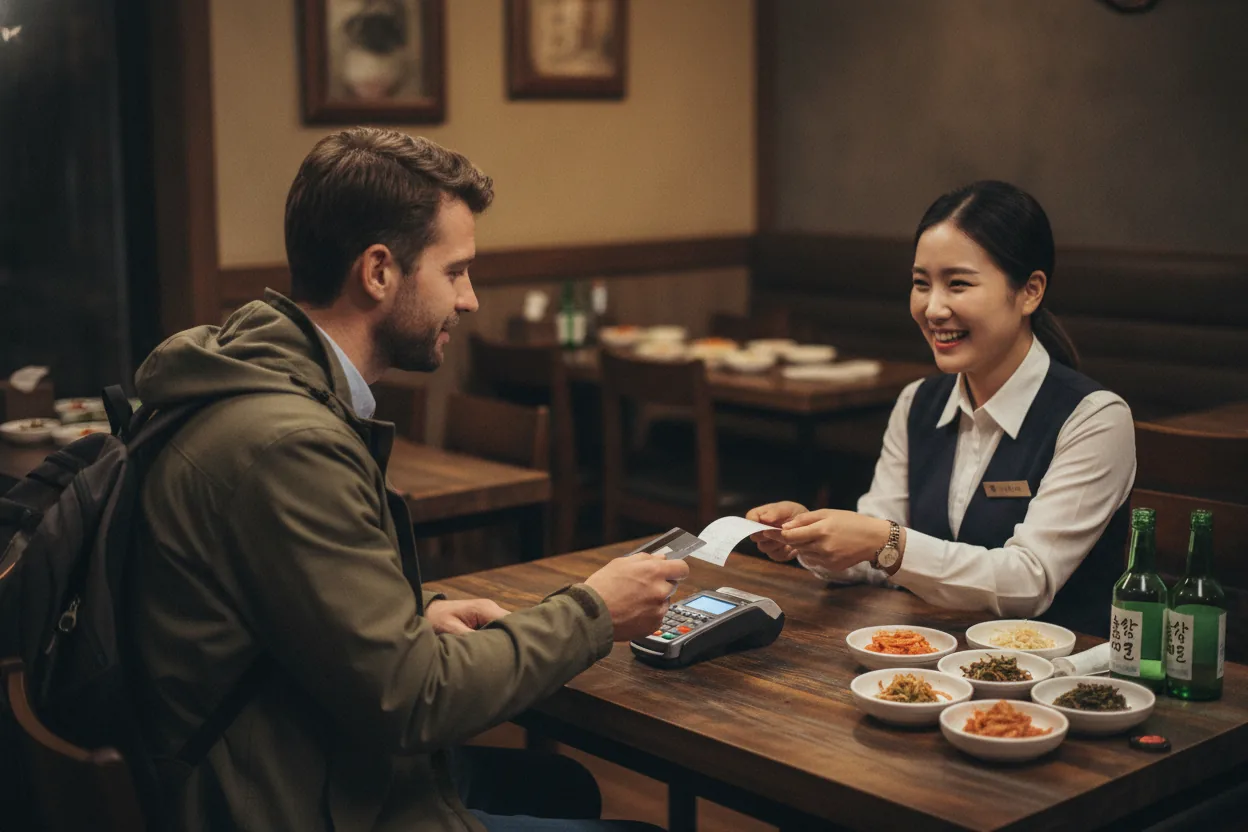
What Tipping Actually Means in Korean Service Culture
Zero percent. That's the standard tip at restaurants across South Korea, and the same goes for taxis, salons, and spas. So when should a visitor actually reach for their wallet, and when does a well-meaning tip just cause an awkward moment for everyone involved?
- Restaurants: 0 percent tipping, full stop, that's the standard practice
- Taxis: card payment is the norm across Seoul and other major cities, though rounding up the fare is a nice optional touch
- Hotels: bellhops and housekeeping don't expect tips at most properties. Luxury hotels catering to international guests are the occasional exception.
- Hair salons, spas, jjimjilbang (Korean bathhouses): the full service cost is already baked into the listed price
- Massage therapists: no customary tipping here either, even for the premium treatments
For a newcomer, this can feel almost backward. No line for gratuity on the receipt, no debate over 15 or 20 percent, no awkward math at the table. Once you understand that Korean wages are structured to remove tipping from the equation entirely, the absence of a tip line stops feeling like an oversight and starts feeling like the whole point. This is the first adjustment most visitors have to make, and honestly, it's the one that saves them the most unnecessary money.
Knowing tipping isn't expected is only half the picture. The other half is learning to spot the cases where a service charge has already been quietly built into the bill, since mistaking that charge for an invitation to tip is where most visitors slip up.
The 10 Percent Service Charge and Other Details Travelers Miss
Visitors rarely struggle with whether to tip. They struggle with spotting when a charge has already been added automatically. Some upscale restaurants and hotels apply a service charge called bongsaryo (봉사료), typically around 10 percent, directly onto the bill. If that line already appears on your receipt, there's no reason to add anything further. Reading the receipt closely solves most of the guesswork that guidebooks tend to overcomplicate.
- Bongsaryo (봉사료): a roughly 10 percent service charge automatically added at some upscale restaurants and hotels, distinct from a tip
- Tour guides are one of the few roles where tips from foreign travelers get accepted, and genuinely appreciated
- Luxury hotel staff at five-star, internationally oriented properties sometimes accept 1,000 to 2,000 KRW (roughly 1 to 2 USD), an amount that's acceptable but never required
- If you tip anyway: do it quietly, in an envelope, offered with both hands, and save it for cases like a guide who went far beyond the job. Visible cash handed over in public can read as awkward or even condescending.
- Rideshare and taxi apps generally rely on digital payment systems that don't prompt for a tip, which tells you plenty about how little the culture expects one
The gap between insider and outsider knowledge here isn't really about money. It's about etiquette. A tourist who leaves cash on a restaurant table thinking they're being generous might actually puzzle or embarrass the server, while a traveler who simply says thank you with a slight bow has already given exactly what the culture expects. So the wallet-reaching moment from the start of this guide has a clear answer: keep it closed almost everywhere, check the receipt for bongsaryo before adding anything, and save the rare cash gesture, offered quietly and with both hands, for the guide or host who genuinely went out of their way.