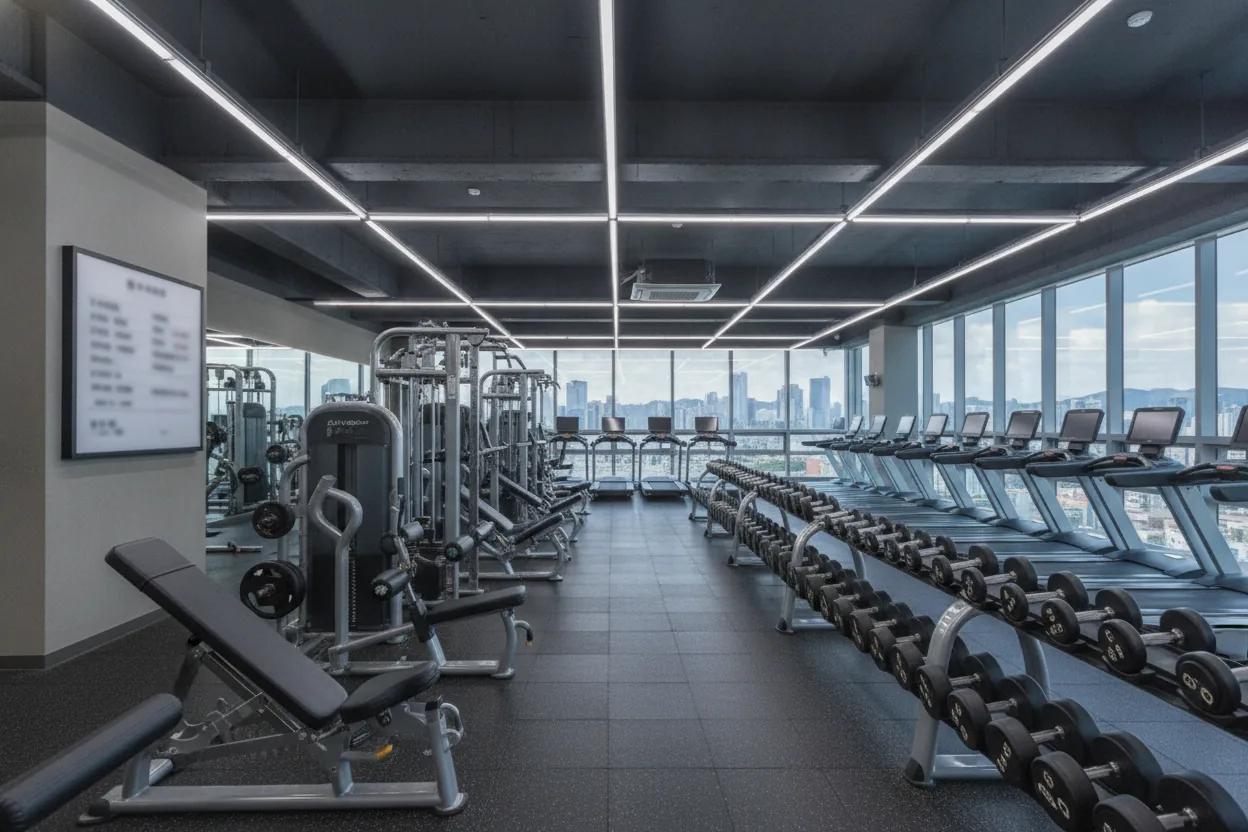
What a Seoul gym membership actually includes and costs
A one-month gym membership in Itaewon runs around $90. Across town at a standard neighborhood gym, you're looking at $35 to $47, roughly half. Both memberships get you the same basics: weights, cardio machines, sometimes a sauna. So what's the extra $50 or so actually buying, and does that matter more if you're visiting for three weeks than if you're settling in for a year?
Seoul gyms are everywhere, packed in tight. Public parks across the city, and across Korea generally, come with free outdoor exercise equipment, which is why plenty of casual exercisers never bother paying for a membership at all. Indoor gyms cluster near subway stations and residential blocks, so even within one neighborhood you'll find several competing for the same customers. That density gives you real leverage to negotiate, and several expats living in Seoul have confirmed it works even if your Korean is shaky at best.
Pricing swings hard depending on the neighborhood and who it's built for. In areas popular with foreign residents and short-term visitors, like Itaewon, a one-month membership can run around $90, with day passes near 25,000 won, about $18. That's close to double what a local neighborhood gym charges, and the reason isn't better equipment. It's English-speaking staff and shorter, more flexible contracts aimed at people who won't be in Seoul long. Line those Itaewon numbers up against US gym pricing and the comparison gets interesting fast.
Seoul rates against US gym chains, and what the gap means for visitors
US gym pricing covers a huge range, and the cheap end actually beats a lot of what Seoul offers. Planet Fitness starts at $15 a month plus taxes and fees. Crunch Fitness starts at $9.99. 24 Hour Fitness begins around $10 to $21 a month, according to NerdWallet and Truemed. Gold's Gym sits higher, with some sources citing $45 to $60 a month plus an initiation fee that can hit $59, putting it roughly in line with a mid-tier Seoul gym. The Health & Fitness Association's 2024 US Health & Fitness Consumer Report put average US monthly fitness dues at $65 in 2023, almost exactly between Seoul's budget and premium tiers. That average sets up the real question for anyone visiting Seoul short-term: the two markets don't really diverge on price. They diverge on contract length.
Many Korean neighborhood gyms are built for long-term local customers, so they'll default to three, six, or twelve-month contracts. If you're only staying a month, or even three weeks, you need to ask for a shorter deal specifically, because it won't be offered upfront. Reddit's r/Living_in_Korea community, where foreign residents swap tips on exactly this issue, notes that a three-week stay should expect to pay close to $70 for a monthly pass, and negotiating that rate down, even across a language barrier, is common and usually works. Same pattern as before: density creates competition, and competition gives you room to talk your way into a shorter, cheaper deal than the posted terms suggest.
Why chain gyms charge more, and where the money actually goes
Contract length explains part of the gap between Seoul and the US, but it doesn't explain why some Seoul gyms cost more than other Seoul gyms. Chain gyms with multiple locations justify their higher prices with equipment variety and cross-branch access, the same logic Gold's Gym uses in the US, where its "Platinum Club Access" tier adds multi-location access, group classes, tanning beds, and pools on top of the "Single Basic" plan. Seoul works the same way: a 47,000 won Gymboxx membership buys you access to multiple branches and full equipment, a noticeably better deal than the roughly $90 Itaewon gyms charge for comparable access. That Itaewon premium is paying mainly for English-language service and tourist-friendly flexibility, not better equipment. Worth remembering before you sign anything.
Budgeting a short stay means asking for the unlisted price
Strip out the language premium and the contract-length premium, and the takeaway for a short-term visitor is straightforward: the listed price is rarely the final price. Day passes and single-month deals exist almost everywhere in Seoul, from parks with free equipment to gyms in areas like Songtan that cater to foreign residents near US military bases. Asking directly for a short-term or discounted rate, especially outside the high-turnover foreigner-focused neighborhoods, is normal here and it pays off often enough to be worth the awkwardness. That $90 Itaewon membership and the $70 negotiated three-week rate aren't two different products. They're the same gym access, priced differently depending on whether you ask the question the listed price was designed to make you skip.