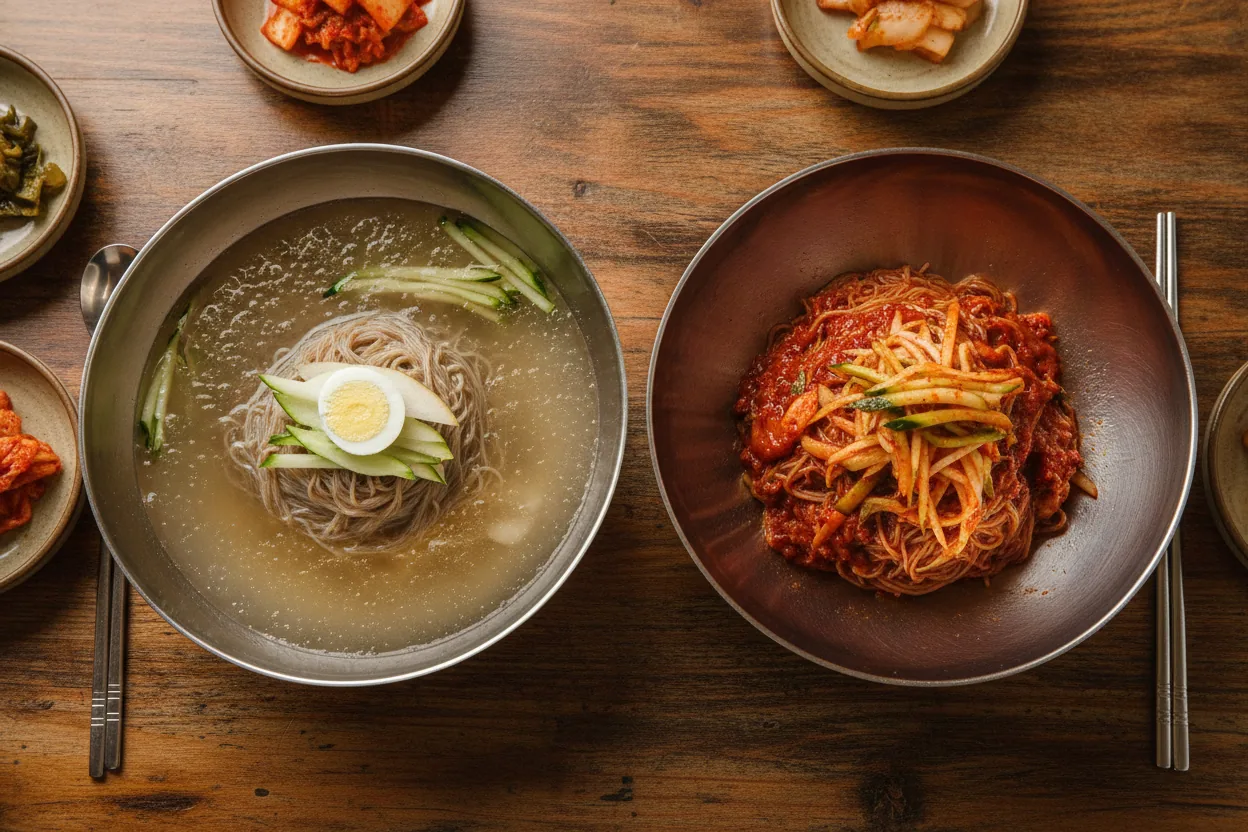
Order naengmyeon expecting one dish and you'll pay 12,000 to 16,000 won for a bowl that might arrive as a nearly flavorless icy soup, or as a tangle of red-sauced noodles with no broth at all. Guidebooks lump both under "cold noodles," but locals know Pyongyang style mul naengmyeon and Hamhung style bibim naengmyeon are separate traditions: different noodles, different regions, different rules for what makes a bowl good. Sit down without knowing which one you ordered and you'll spend a full minute confused, wondering where the broth went or why it tastes like almost nothing. The difference isn't a menu quirk. It decides whether you get a fine meal or the version of the dish that actually explains why it's lasted this long.
Most visitors treat naengmyeon as a single dish: cold noodles, hot day, done. It's not one dish. Pyongyang style mul naengmyeon and Hamhung style bibim naengmyeon come from different regions, use different noodles, and reward completely different kinds of attention. After a decade of eating both across Seoul, Busan, and small regional shops, here's where I land: bibim naengmyeon is the easier entry point for a first timer, while mul naengmyeon is the one that actually tells you whether a restaurant knows what it's doing.
Mul Naengmyeon Rewards A Patience Most Tourists Do Not Bring
Pyongyang Mul Naengmyeon vs Hamhung Bibim Naengmyeon
| Attribute | Mul Naengmyeon | Bibim Naengmyeon |
|---|---|---|
| Region Origin | Pyongyang | Hamhung |
| Noodle Type | Buckwheat | Potato or sweet potato starch |
| Broth | Beef stock plus dongchimi, ice cold | None, sauce based |
| Flavor Profile | Subtle, builds slowly | Bold, spicy, immediate |
| Best For | Judging restaurant quality | First time visitors |
Source: Based on article description of regional naengmyeon traditions
Visitors assume cold noodle soup on a hot day should taste refreshing and bold, something you notice immediately. Mul naengmyeon does the opposite. The broth, usually a mix of beef stock and dongchimi (tangy radish water kimchi), stays deliberately subtle. Thin buckwheat noodles sit in broth so cold it often carries visible ice crystals, and the whole bowl is built around restraint rather than punch.
This is where first timers misjudge the dish. A bowl that tastes like almost nothing on the first bite isn't a failure of seasoning, it's the intended experience. The tang builds slowly. The sweetness from the radish water shows up on the third or fourth spoonful. Beef slices, pickled radish, cucumber, boiled egg half, and sometimes a few slices of Asian pear round out the flavor rather than dominate it. Koreans who grew up eating this dish aren't tasting boldness. They're tasting balance, and balance takes longer to register than heat or spice does.
A well made bowl at a mid range Seoul restaurant runs somewhere in the 12,000 to 15,000 won range as of this year. Specialist shops in areas like Jongno or Euljiro often charge a bit more, with some estimates pushing toward the higher end of the general market, though exact figures vary and reflect rising buckwheat and beef costs more broadly rather than any single confirmed price point. Take this as an observed pricing pattern rather than a verified industry figure, one that matches general food inflation trends over the past two years.
Here's the practical tell: if a restaurant serves mul naengmyeon lukewarm, or without any ice presence in the bowl, that's a signal, not a minor inconsistency. The near freezing temperature is non negotiable in traditional preparation. A shop that skips it either doesn't understand the dish or has decided most customers won't notice. Some won't. You now will, and that single detail is worth more than any online review before you sit down.
That same attention to what a restaurant gets right or wrong applies just as directly to the other style. Where mul naengmyeon asks for patience, Hamhung style bibim naengmyeon asks for the opposite, and understanding why changes what you should order first.
Bibim Naengmyeon Rewards Impatience And Punishes Nothing
Mul Naengmyeon Price Range in Seoul, 2026
Mid Range Seoul Restaurant
₩12,000 to 15,000
Specialist Shops (Jongno, Euljiro)
₩16,000+
Key signal: A bowl served lukewarm or without visible ice is a red flag, near freezing temperature is non negotiable in traditional preparation.
Source: Observed pricing pattern described in article, not a verified industry figure
Visitors expect a spicy noodle dish to be straightforward, familiar, and easy to like on contact. That assumption turns out to be mostly correct, which is exactly why bibim naengmyeon works so well as a first naengmyeon experience for someone new to Korean food.
Hamhung style bibim naengmyeon uses noodles made from potato or sweet potato starch rather than buckwheat, and the texture difference isn't subtle. These noodles are notably chewier, almost springy, and they hold up under a thick gochujang based sauce that's sweet, spicy, and vinegar sharp all at once. There's no broth to soften the experience. What you get instead is a tangle of noodles coated in red sauce, often topped with raw skate or another firm white fish, plus cucumber and boiled egg for contrast.
Three things separate a bibim naengmyeon worth ordering again from one you'll forget by dinner. The noodle chew should resist the bite instead of snapping too easily. The sauce needs to balance sweetness against real chili heat, not just sugar with a vague kick. And the raw fish has to taste clean, with a firm texture, not the slightly off softness that tells you it's been sitting too long.
These markers matter because they separate a shop that makes bibim naengmyeon as a side item from one that treats it as a specialty worth getting right. Pricing sits close to mul naengmyeon at most casual to mid tier restaurants in Seoul, with some Busan and Hamhung style specialists charging more when raw skate is a signature component rather than an afterthought. The raw fish topping is the ingredient most likely to push a bowl toward the higher end of that range, since fish costs have moved more than noodle or sauce costs over the last year.
This is also the dish that travels best for a visitor with limited time. It needs no acclimation period, no second or third spoonful to understand what's happening. Hand this one to someone on their first day in Korea. Save mul naengmyeon for later in the trip, once the palate has adjusted to eating things that are quiet rather than loud.
Knowing what each dish should taste like only solves half the problem. The other half is knowing where to spend money on either one, since price and quality don't move together in any simple way across restaurants.
Restaurant Choice Changes What You Are Actually Paying For
How Mul Naengmyeon Flavor Unfolds, Spoonful by Spoonful
1st Bite
Tastes like almost nothing
2nd Bite
Subtle tang starts to build
3rd to 4th Spoonful
Sweetness from radish water emerges
Full Bowl
Balance registers, toppings round it out
Source: Based on flavor sequence described in article
Many tourists assume naengmyeon is interchangeable across restaurants, priced mainly by portion size. It isn't. The pricing reflects provenance, technique, and how much the shop is willing to spend on broth ingredients or noodle quality, not just calories on a plate.
Older, specialist naengmyeon restaurants, the kind that have made only this dish for decades, tend to charge a modest premium over a general Korean restaurant that lists naengmyeon as one item among fifty, though the exact amount varies by shop and isn't something consistently documented. That premium buys real beef bone broth simmered for hours rather than a shortcut base, and buckwheat noodles with a higher buckwheat ratio, which changes both texture and how quickly the noodles break down in the bowl. A shop cutting corners on buckwheat percentage produces noodles that turn mushy faster, a detail invisible on a menu but obvious after two bites.
Summer months bring another wrinkle. Naengmyeon is seasonal in spirit even though most restaurants serve it year round now, and demand spikes hard between June and August. Some well known specialist shops in Seoul develop lines out the door during lunch hours in peak summer, and a few limit bowls per customer or run out of key toppings like Asian pear by mid afternoon. None of this shows up as a price increase. It shows up as availability pressure instead, which is arguably the more useful thing to know before you plan a visit around a specific dish.
Anyone ordering naengmyeon expecting a light, cheap side dish should recalibrate. It isn't always light, and at specialist shops it isn't always cheap either, running close to what a full rice meal costs elsewhere. Diners willing to pay the premium get a distinct, well executed bowl, whether Pyongyang subtle or Hamhung bold. Diners chasing the cheapest option get speed and convenience, but they lose the version of the dish that actually explains why it's lasted this long.
So the confusion at the table, the wrong bowl, the missing broth, the flavor that seems to be absent, isn't a sign that naengmyeon is inconsistent or poorly explained on menus. It's a sign that two different dishes have been folded into one word. Order knowing which tradition you want, mul naengmyeon for restraint or bibim naengmyeon for immediate payoff, and the bowl in front of you stops being a guess and becomes the specific thing you asked for.