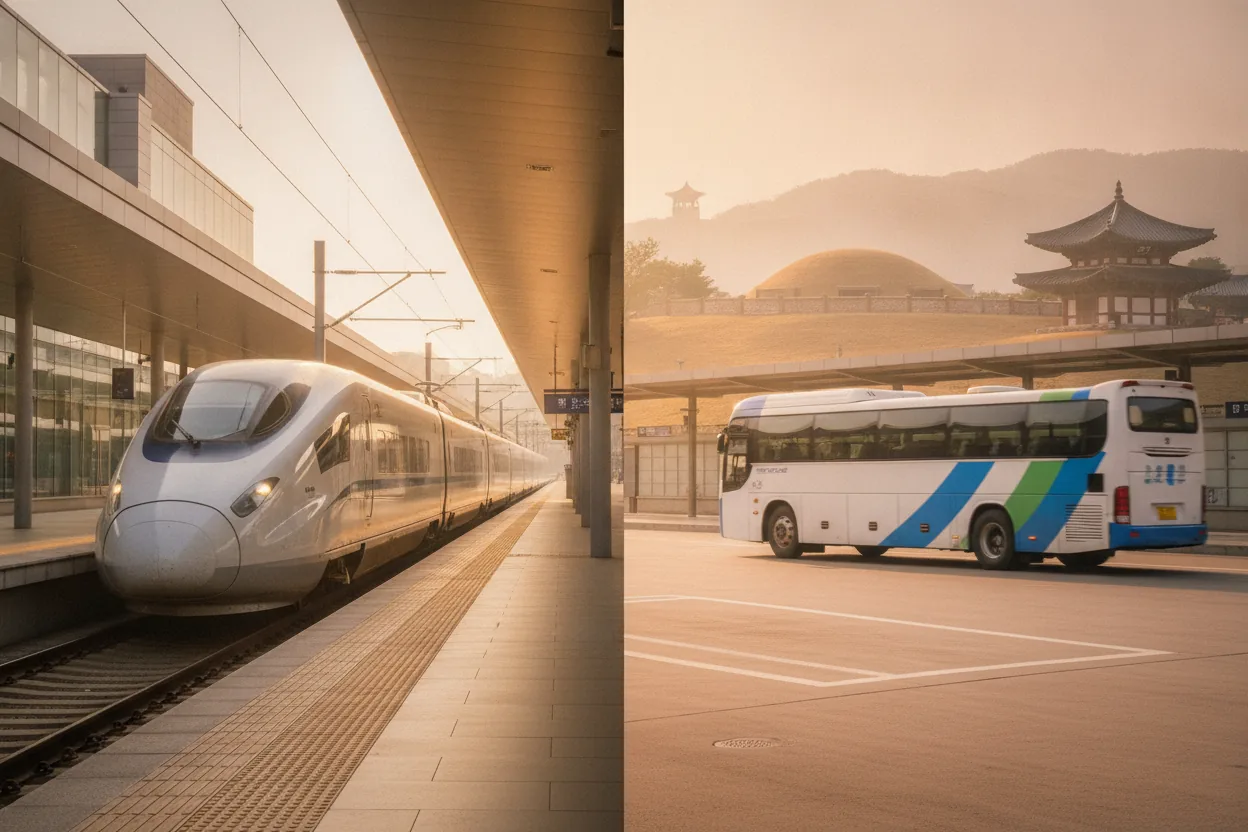
Getting From Seoul to Gyeongju: The Basic Options
Two or three extra hours in Gyeongju, or a cheaper fare instead. That's really the whole Seoul to Gyeongju decision, boiled down to one trade-off between the KTX and the express bus. Both get you to the old Silla capital. The question is which one deserves your money and your daylight when you've only got one day to work with.
- KTX trains run from stations like Seoul Station or Suseo Station to Singyeongju Station, the modern rail gateway to old Gyeongju.
- Express buses depart from Seoul's major terminals, usually Seoul Express Bus Terminal in Gangnam or Dong Seoul Terminal, though the exact departure point depends on which operator and route you book.
- Singyeongju Station sits several kilometers from Gyeongju's historic downtown, so you'll need a taxi or local bus to actually get into town.
- Some premium express buses use a 2 seats plus 1 seat layout, which gives you noticeably more legroom than standard bus seating.
- Long-distance buses sometimes stop at a highway rest area along the way. Adds time, but you get a bathroom break and a chance to grab a snack.
Both options are reliable, and both get plenty of use from domestic and international tourists. The real decision comes down to how you personally weigh time against cost, and that's exactly where most first-time visitors get stuck. Let's break that trade-off down properly.
Why the Time vs Money Trade-off Matters for a Day Trip
Travel guides comparing the two routes consistently frame the KTX as the faster option and the express bus as the budget pick. On a multi-day trip, that distinction barely matters. On a single-day round trip to Gyeongju, it matters a lot, because every hour you spend commuting is an hour you're not spending at Bulguksa Temple or sitting in a traditional cafe somewhere nearby.
- The KTX is the fastest way to get there, which means more actual hours in Gyeongju when your schedule is tight.
- The express bus is cheaper, and for travelers who care more about total cost than speed, that's the deciding factor.
- Creatrip's travel guide points out that on many routes, express buses keep costs down more effectively than the KTX does, though the KTX still wins on speed almost every time.
- That same guide recommends picking based on whether you personally value price or time more, rather than assuming one option beats the other across the board.
- Guides also recommend the KTX and SRT specifically for longer routes like Busan, Daegu, and Daejeon, and Gyeongju falls into that same distance category from Seoul.
For a Seoul to Gyeongju day trip, the math leans toward the KTX. Lose an extra hour or more each way on a bus and you're eating directly into the daylight you need to actually see the Silla-era sites and still make it back to Seoul that night. If your schedule is more flexible, or your budget's tighter, the express bus still works fine, especially if you're planning a full, unhurried day rather than a sprint between temples. So here's where it lands: if getting back those two or three hours in Gyeongju matters more to you than the fare difference, take the KTX. If the fare matters more and your schedule has some give in it, the express bus is a perfectly reasonable way to get there.