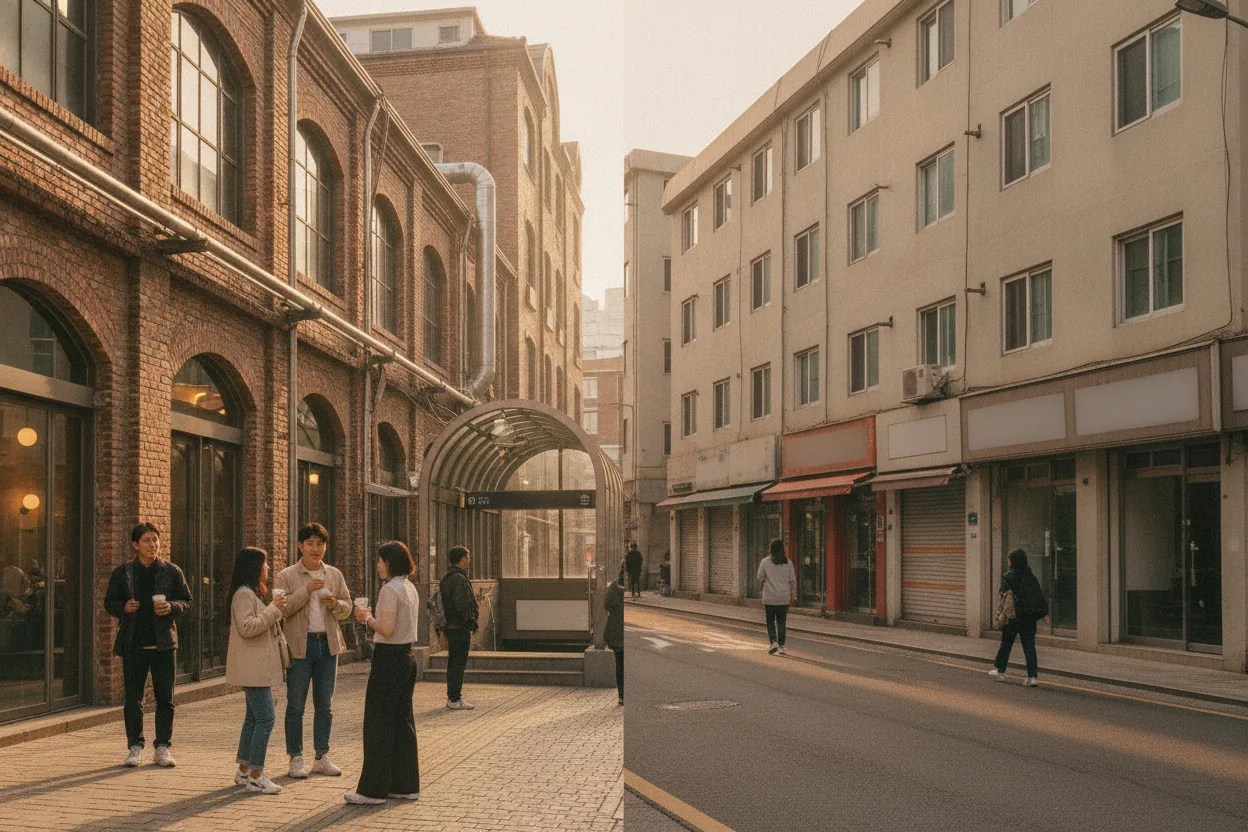
A studio in Seongsu now rents for roughly the same ₩850,000 a month as a studio in Mapo, a gap that barely existed ten years ago when Seongsu was still a cheap shoe manufacturing district. Most rent comparisons stop there, treating the two neighborhoods as interchangeable once the won figures match. Anyone actually living in either one knows a coffee near Seoul Forest Station costs noticeably more than the same coffee near Hongik University Station. That gap between the lease number and the real monthly outflow is where outsiders get the story wrong, and residents adjust their budgets around it without ever saying so out loud. So here's the real question: if the rent is now identical, what exactly does that identical number hide, and how much does it cost you to not know?
Seoul housing costs aren't really about square meters anymore. They're about which story a neighborhood tells about itself, and how much that story has started costing in won. Mapo and Hongdae still sell affordability and energy. Seongsu sells a lifestyle that increasingly resembles what Seongsu used to be priced to escape. The two neighborhoods have converged in monthly rent, but not in what that rent buys you day to day.
Why Has Seongsu Rent Caught Up To Mapo Rent?
Seongsu Rent Closing the Gap With Mapo Over Ten Years
Source: Estimated trend based on article narrative
Seongsu dong, a former shoe manufacturing district east of Gangnam Daero, now commands rent that has risen to roughly match Mapo and Hongdae, somewhere in the same general monthly range, though the exact figure varies by property type and listing. Ten years ago those two figures weren't in the same conversation. Seongsu was industrial and cheap, and Mapo was already the budget conscious, student heavy, foreigner friendly zone near Hongik University.
The apartments themselves aren't really what changed. Seongsu's building stock didn't get larger or newer at a pace that explains the jump. The real shift is demand from a specific kind of resident: young professionals who want proximity to the cafes, galleries, and converted warehouses that now define the area, plus the new residential towers that have gone up along the Seoul Forest side of the neighborhood. Listing platforms like Blueground now classify Seongsu as medium to high cost, the same tier as districts that have never been cheap.
Mapo, by contrast, still gets tagged as medium cost despite its subway connectivity, its university population, and its genuinely strong nightlife and restaurant density. Why hasn't Mapo followed Seongsu upward at the same speed? Partly because its identity is already locked in as a student and young professional zone, and landlords there are competing against a large existing supply of older officetels and villas rather than selling a transformation story.
The practical upshot for anyone comparing the two: if your budget is around ₩850,000 a month, you're no longer choosing between a cheap neighborhood and an expensive one. You're choosing between two identities at the same price point, and the real difference shows up in daily spending, not rent. Here's what that daily spending difference is actually made of.
What Does That Monthly Rent Actually Buy You Day To Day?
Same Rent, Different Neighborhood: Seongsu vs Mapo
| Factor | Seongsu | Mapo |
|---|---|---|
| Monthly Rent (Studio) | ~₩850,000 | ~₩850,000 |
| Cost Tier (Listing Platforms) | Medium to High | Medium |
| Neighborhood Identity | Lifestyle, galleries, converted warehouses | Budget, student, nightlife |
| Coffee Near Station | Higher | Lower |
| Retail and Dining Pressure | Flagship stores, pop ups, tourists | Older officetels, stable supply |
Source: Based on qualitative comparisons described in the article
Walk down Seongsu's main commercial stretch near Seoul Forest Station and a coffee at the design forward cafes that cluster there tends to cost noticeably more than elsewhere in the city. Walk through Mapo near Hongik University Station and a comparable coffee, at a comparable sized independent cafe, lands cheaper. That difference compounds. A resident who eats out four or five times a week, buys coffee daily, and shops at Olive Young or GS25 for odds and ends will feel a meaningfully different monthly outflow in Seongsu than in Mapo, even though the rent line on their budget is nearly identical.
Neighborhood cost tables miss this entirely, because they only track rent. Seongsu's restaurant and retail scene has been pulled upward by brand flagship stores, pop up shops from fashion and beauty companies, and a tourist flow that didn't exist five years ago. Mapo's commercial strip, built around decades of student foot traffic, has structural pressure to stay affordable because its core customer base is price sensitive and large.
There's also a transport dimension worth separating out. Both neighborhoods are well served by subway, Seongsu on Line 2, Mapo and Hongdae on Line 2 and Line 6 plus the Airport Railroad. T money fares are flat citywide regardless of neighborhood, so that part of the cost equation doesn't shift. Where it shifts is in how often you end up taking a KakaoTaxi home late at night. Seongsu's nightlife is more scattered and spread along industrial blocks with fewer late bus options, so taxi use runs higher there than in Hongdae, where the subway runs later on weekends and the bar district stays walkable.
None of this makes Seongsu a bad financial decision. It means the ₩850,000 figure, treated alone, hides a lifestyle cost gap that adds up month to month depending on habits, though pinning that gap to an exact won amount is harder than it looks. Rent sets the floor. The next variable that moves the real cost, especially for anyone paid outside Korea, is the exchange rate.
Does The Exchange Rate Change Who Can Afford Which Neighborhood?
How Identical Rent Hides a Different Real Cost
Source: Narrative logic drawn from the article
A renter paying in US dollars felt a real shift this fall. The won strengthened against the dollar over the past few months, which means the same ₩850,000 Mapo studio or ₩1 million Seongsu unit got more expensive in dollar terms across that window, independent of anything landlords did.
Roughly speaking, that ₩850,000 rent cost meaningfully fewer dollars earlier in the year than it does now, as the won gained ground. No landlord raised that rent. Currency movement did the same job on its own, and it matters most for foreign residents and remote workers paid in dollars who budget in their home currency rather than in won. A freelancer earning in dollars and watching the won strengthen is effectively watching Seoul get pricier every month even if the lease number never changes.
This dynamic cuts differently depending on who you are. Someone paid in won, working for a Korean company, feels none of this. Someone paid in dollars or another foreign currency, which describes a large share of the digital workers that Blueground data says Mapo attracts, feels every basis point. The neighborhoods marketed toward international and remote workers are precisely the ones where currency swings matter most, and almost no rental listing mentions that.
Should renters try to time their lease signing around exchange rate dips? That's a harder call than it sounds, because Seoul leases typically run one year with jeonse or wolse structures that aren't easily renegotiated mid term. The more realistic takeaway is that anyone earning in foreign currency should track the won rate the way they track rent itself. A multi month shift in the exchange rate isn't a rounding error. It's a real change in what a fixed won salary or fixed won rent actually costs back home, and it rewards whoever pays attention to it.
The identical ₩850,000 figure in Seongsu and Mapo was never the answer, it was the question. The real cost splits three ways: the rent itself, the daily spending pattern the neighborhood's identity imposes on you, and, for anyone earning outside won, what the exchange rate is doing while you're not looking. A renter who prices all three before signing a lease ends up with a far more accurate monthly number than one who stops at the figure on the listing, and that gap in knowledge is worth more than any single rent discount.