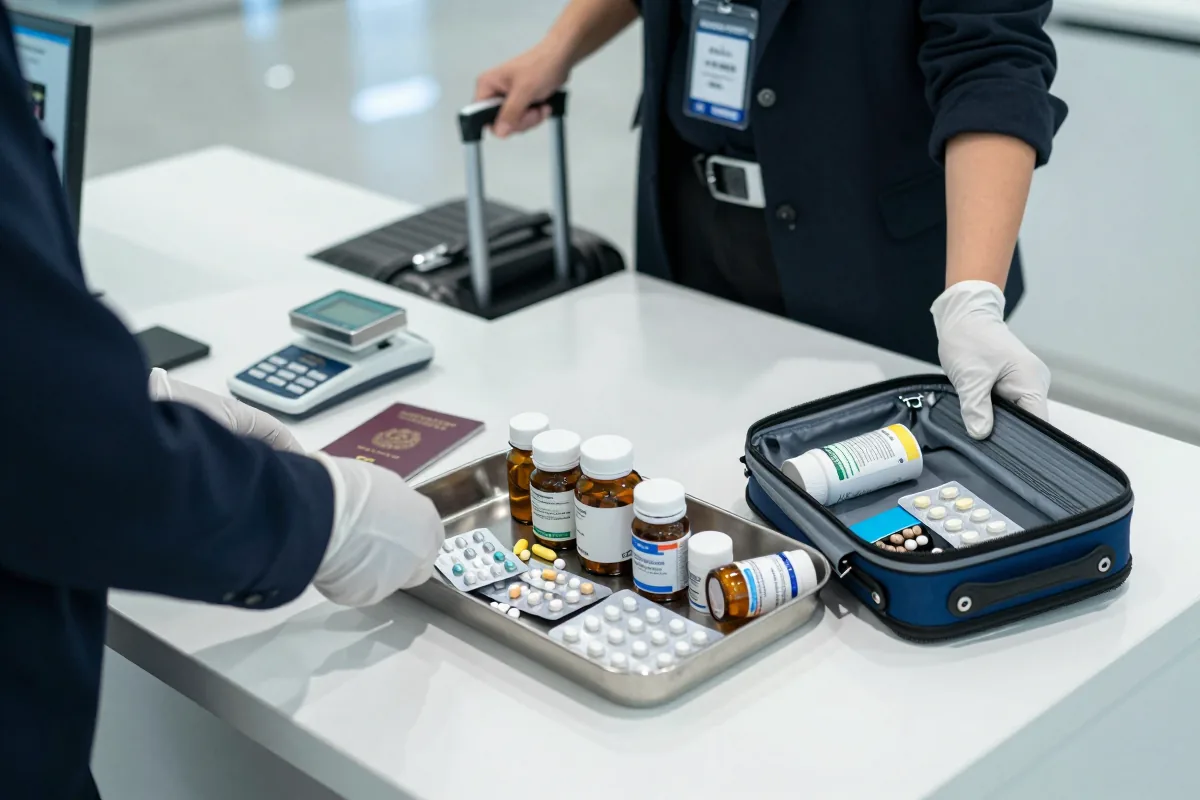
One traveler spent four hours in a customs interview room at Incheon over a three month supply of a common ADHD medication. Another carried the exact same pill count of a different drug and walked through in ninety seconds. Tourists get told that a labeled prescription bottle is what matters. It isn't. The actual determining factor is the active ingredient and whether Korean law classifies it as controlled. Same pill count, both cases. So what explains the four hour gap?
Korea doesn't regulate medicine the way most travelers assume. There's no blanket rule that says bring whatever your doctor prescribed and you'll be fine. Instead there's an ingredient list, a permit system run by the Ministry of Food and Drug Safety, and a hard line between ordinary medicine and controlled medicine, a line that has nothing to do with how dangerous a drug feels and everything to do with how Korean law classifies the molecule. The biggest risk for a foreign patient isn't the pill count. It's failing to check the active ingredient against Korea's controlled substance list before packing. Everything below comes down to that one check, and the two travelers at Incheon are the clearest way to see why.
Many travelers assume a prescription bottle settles the matter at Korean customs.
Two Paths Through Korean Customs
Path A: Ordinary Medicine
Check ingredient
Show label + passport
Cleared in ~90 sec
Path B: Controlled Medicine
Check ingredient
Apply for MFDS import permit
Apply weeks before departure
4 hour interview without it
Same pill count, same traveler profile. The outcome depends entirely on how the active ingredient is classified under Korean law, not on the prescription label.
Most people traveling with medication assume a prescription bottle with their name on it settles the matter. Show the label, show your passport, move along. That logic works at Tokyo Narita. It works at most EU borders too.
For ordinary medicines, the figures actually back this up. A prescription or pharmacy label is exactly what Korean customs wants to see, and the quantity ceiling is generous: up to six bottles or a three month supply for personal use, depending on the medicine format. Keep the original packaging. Keep the receipt if you have it. A loose ziplock bag of unlabeled tablets, even if it's genuinely your blood pressure medication, invites questions a labeled box would have answered before anyone asked.
Where this assumption falls apart is controlled medicine. A prescription from your home country doctor is not a substitute for a Korean import permit. The Ministry of Foreign Affairs and the Ministry of Food and Drug Safety run two separate approval systems, and only one accepts a foreign prescription as sufficient documentation on its own. If your medication contains a stimulant, a strong opioid, certain sleep aids, or specific anxiety medications, the prescription proves the medicine is yours. It doesn't prove you're allowed to bring it into the country.
Write down the generic ingredient name, not just the brand name, before you book anything else. Brand names shift by country. Adderall isn't widely available as a retail product in Korea under that name, and a drug like Concerta can carry a different approval status than its generic equivalent, so brand name alone isn't something to rely on. The ingredient name is the only stable reference point, so start there. That single step, checking the ingredient rather than the label, is also what separates the two paths the next section covers: a routine refill versus a permit application that has to start weeks before departure.
The three month supply rule sounds universal, but it doesn't cover every drug.
Ordinary Medicine Allowance vs Controlled Medicine Requirement
|
Ordinary Medicine 3 months or up to 6 bottles, personal use |
Controlled Medicine Permit required regardless of supply length |
Key fact: A foreign prescription proves the medicine is yours. It does not prove you are allowed to bring it into Korea if the active ingredient is on the controlled list.
Two separate systems: Ministry of Foreign Affairs and Ministry of Food and Drug Safety each run their own approval process. Only one accepts a foreign prescription alone.
Three months. That number shows up everywhere online and gets repeated like it applies evenly across every medicine category. It doesn't.
The three month supply or six bottle allowance applies to ordinary, non-controlled medicines for personal use. It's a ceiling, not a guarantee. A traveler carrying six bottles of a common antihistamine faces a very different conversation at customs than a traveler carrying a three month supply of a benzodiazepine, even though casual conversation lumps both under the same "three month rule." That allowance was built as a convenience threshold for ordinary medicine. It was never meant to cover anything on the controlled list.
Controlled medicine runs on a completely separate track. For those, the Ministry of Food and Drug Safety requires an import permit applied for before departure, not at the airport, not after landing. The approval document needs to travel with the physical medicine. Processing time for this permit isn't a fixed number of business days according to current public data, and online estimates vary widely, so anyone in this category should treat the application as something to start weeks ahead rather than days.
If your medicine list includes anything in the stimulant, strong sedative, or certain opioid painkiller categories, the three month number doesn't apply to you at all. Start the permit process as soon as the trip is booked, because skipping it is the one mistake that turns a routine customs check into a detained package or a confiscated medicine. For anyone whose drug doesn't require a permit, the more immediate question becomes what happens on the ground in Korea once the supply runs out, which is where a Korean pharmacy refill comes in.
Guidebooks describe Korean pharmacy refills as a simple swap, but the process runs differently.
What Determines Your Customs Outcome
| Factor | Ordinary Medicine | Controlled Medicine |
|---|---|---|
| Accepted proof | Prescription or pharmacy label | Korean import permit (MFDS) |
| Quantity limit | Up to 6 bottles / 3 month supply | Set by permit terms, not a flat rule |
| Lead time | None, pack before trip | Weeks before departure |
| Example drug type | Antihistamine, blood pressure medicine | Stimulant, strong opioid, benzodiazepine |
A common assumption among first time medical travelers is that a Korean pharmacy functions like a CVS or a Boots: hand over a foreign prescription, get the equivalent medicine, done. Olive Young sells skincare and over the counter supplements on nearly every corner of Myeongdong and Gangnam, and that visibility creates a false impression that Korean pharmacies operate with similar openness.
The actual process looks nothing like that. A Korean pharmacy, called a yakguk, cannot legally fill a prescription written by a doctor outside Korea. For anything beyond basic over the counter relief, a traveler needs a prescription written by a clinic or hospital physically located in Korea. The real sequence for a foreigner needing a refill runs like this: find a clinic, see a Korean doctor, get a Korean prescription, then take that prescription to a yakguk.
How much does that detour cost? A walk-in consultation at a general clinic for a prescription renewal is an added cost without national health insurance, and the exact amount varies quite a bit between clinics, particularly in areas like Itaewon and Gangnam that cater to foreign patients. With insurance coverage, which most tourists don't have, that drops significantly. The medicine itself, once prescribed locally, usually runs cheaper than in the United States and roughly comparable to or slightly below European pricing, though this varies by drug and should be treated as an observed pattern rather than a fixed rate.
Anyone planning a stay longer than a few weeks who depends on a regular prescription should budget one clinic visit into the trip as the default plan, not a backup. That clinic visit is the manageable version of what happens when a traveler hasn't planned at all, and the next section covers what the gap between running out and getting refilled actually looks like in the worst case.
Travelers fear confiscation most, but the real worst case runs deeper.
The fear most travelers carry into this topic is that customs will take the pills away. Annoying, yes. Solvable, usually, since a Korean doctor can often prescribe a local equivalent once you're through the airport. But confiscation framing misses where the actual risk sits.
The real worst case is medical, not bureaucratic. A traveler assumes their medicine will make it through, packs light on the theory they can sort it out later, and then either has the medicine seized or discovers no Korean pharmacy will fill it without a local prescription they haven't obtained yet. Missing doses of certain medications, particularly those managing seizures, cardiac conditions, or psychiatric conditions, isn't a minor inconvenience. It's the actual danger here, and it's what the Ministry of Foreign Affairs guidance is built around.
If a missed dose produces symptoms, the guidance is blunt: get urgent help immediately rather than waiting it out. Korea's emergency medical infrastructure in Seoul and Busan is fast and well equipped, but a tourist without Korean language ability or local insurance navigating an emergency room at 2am over a medication gap faces a worse outcome than any customs delay.
The sequence that actually protects a traveler is boring and procedural. Identify the generic ingredient name of every regular medication. Check its classification before departure. Apply for a permit early if the drug is controlled. Carry a prescription or medical certificate plus original packaging for everything else. None of this is exciting, but all of it costs less than an emergency room visit or a missed connecting flight because a suitcase got flagged. The travelers most likely to skip this sequence are the ones who assume the system is built to catch smugglers, not people like them, which is the last gap worth closing.
People assume this rule targets smugglers, but it catches ordinary prescriptions too.
There's a quiet assumption that this entire system exists to catch people smuggling something obviously illicit, and that anyone traveling with a legitimate pharmacy prescription has nothing to think about. Wrong gap to worry about. This is actually the one that catches the most ordinary travelers, not the suspicious ones.
Several medications that are completely unremarkable and widely prescribed in the United States, Canada, or parts of Europe sit on Korea's controlled list because of their stimulant or sedative properties, regardless of how routine they feel to the person taking them. ADHD stimulant medications are the most common trap. Certain prescription sleep aids and some anxiety medications fall into the same category, sold over-the-counter-adjacent in other countries but tightly restricted here. A traveler who's taken the same pill daily for ten years with zero drama at home has no built-in signal that Korea will treat it differently.
Forum posts about what someone successfully carried through Incheon in 2023 or 2024 are not a reliable guide for a 2026 trip. Permit requirements and classification lists get updated, and what worked for one person's specific dosage and quantity doesn't generalize to another person's prescription.
Go ingredient by ingredient through your own medicine cabinet against current Ministry of Food and Drug Safety classifications before you book anything irreversible. For a short trip, that's twenty minutes of effort. For a multi-month medical travel stay, it's the single piece of homework that determines whether the trip runs smoothly or gets complicated somewhere between the pharmacy at home and the pharmacy counter in Gangnam. That's also the answer to the four hour gap at Incheon: one traveler had checked the ingredient against the list and had the paperwork to match. The other had a prescription bottle and nothing else. In Korea, those are not the same thing.