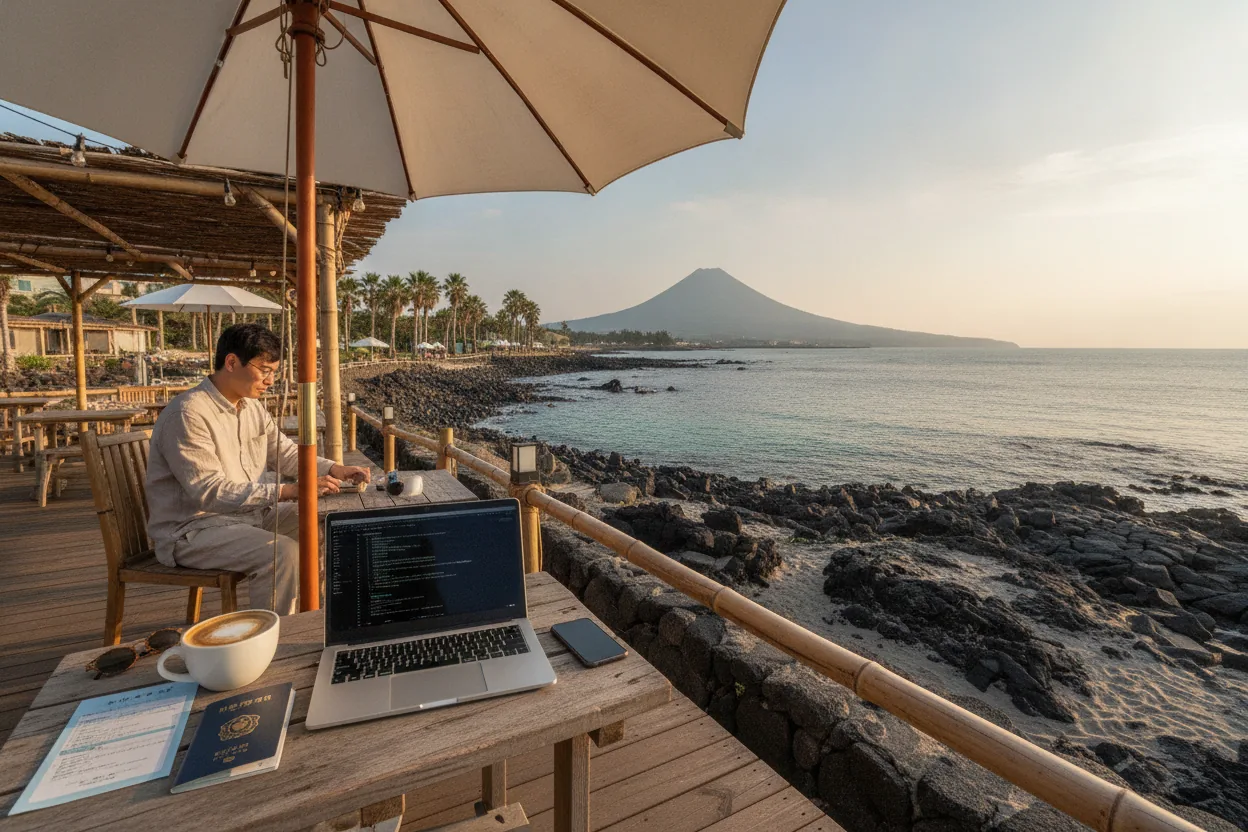
4.16 million won a month, roughly half the current threshold, is the new number Jeju is proposing to let remote workers stay for 90 days instead of 30. Outsiders will read that as a shortcut to island living. Anyone who actually understands Korean visa mechanics knows better: this isn't a residency visa at all, just a longer stay bolted onto the visa free framework, with no resident registration number and no automatic renewal past day 90. So what happens when the calendar runs out? Does 90 days even solve the daily logistics of banking, housing, and phone contracts on the island? That gap between the headline and the fine print decides whether this policy changes anyone's life or just their itinerary.
Jeju is proposing a policy shift that halves the income requirement for its workcation visa track and triples the visa free stay window from 30 days to 90. Korea has reportedly been losing ground in the regional race for digital nomads to Japan, Malaysia, and Spain, and Jeju's answer isn't a flashy new visa category. It's a recalibration of two numbers that determine who actually qualifies. The rest of this comes down to what those two numbers mean in practice, why Jeju specifically needs them to work, and whether 90 days actually holds up against the daily mechanics of living on the island.
What The New Numbers Actually Mean
Digital Nomad Visa Income Thresholds by Country
| Country | Annual Income Threshold | Max Stay |
|---|---|---|
| Malaysia | ~$24,000 | Not specified |
| Jeju (proposed) | ~$35,000 (50M won) | 90 days |
| Spain | ~$40,000 (34,000 euros) | Not specified |
| Japan | ~$65,000 | 6 months |
Source: Reported program benchmarks cited in article, subject to currency and policy changes
Start with the income threshold. At 4.16 million won a month, that works out to somewhere in the neighborhood of 50 million won a year, roughly the mid 30,000 dollar range depending on the exchange rate that week. For comparison, Malaysia's digital nomad program has used an income cap near 24,000 dollars annually, and Japan introduced a six month digital nomad visa in March 2024 with an income threshold reported around 65,000 dollars. Spain's digital nomad visa requires income of roughly twice the national minimum wage, which has landed near 34,000 euros, close to 40,000 dollars. These figures shift with currency rates and policy updates, so treat them as observed benchmarks, not fixed comparisons.
Jeju is positioning itself deliberately below Japan and Spain, closer to the Malaysia end of the spectrum but with a shorter stay window. Ninety days is still half of what Japan offers, but it's enough time to settle into a working rhythm instead of just stretching out a holiday. A freelancer or remote employee earning the equivalent of a mid tier Seoul office salary, somewhere around 45 to 55 million won a year, now clears the bar without needing a six figure US salary or a Spanish level income behind them.
The catch, and there's generally a catch with Korean visa adjacent programs, is that this isn't a residency visa. It rides on the existing visa free entry framework, which means it extends how long someone can legally stay without ever converting their status into something more permanent like an F series visa. That distinction matters if you're trying to open a Korean bank account, sign a long lease in Jeju City or Seogwipo, or get a local phone plan without a foreign resident registration number.
That's also where insiders and outsiders part ways. People who understand Korean visa mechanics read this as a longer visa free stay, not a residency shortcut. Everyone else reads the headline and assumes otherwise. Understanding why Jeju is willing to make that tradeoff at all means looking at what the island actually needs from this policy.
Why Jeju Needs This More Than Seoul Or Busan
Jeju Workcation Visa: Before and After the Proposal
|
Current Income Rule ~8.3M won per month |
Proposed Income Rule 4.16M won per month |
|
Current Stay Limit 30 days visa free window |
Proposed Stay Limit 90 days visa free window |
Income requirement roughly halved, stay window tripled
Source: Jeju workcation visa proposal details as reported in article
Jeju has been building workcation infrastructure for a few years now, including shared office space in Gimnyeong Village on the island's northeast coast, built and supported by public agencies rather than private coworking chains like WeWork or FastFive that dominate Seongsu dong and Gangnam. The island had already built the plumbing, desks, wifi, meeting rooms, before it tried to lower the price of entry.
Seoul doesn't need this kind of policy the way Jeju does. Seoul's tourism and long stay foreigner economy runs on business visas, English teaching contracts, and a dense corporate expat scene that never depended on marginal income thresholds in the first place. Jeju's economy leans hard on tourism that's been softening for years. A longer term visitor who spends 90 days buying groceries at Emart Jeju, renting a scooter, and eating at local haenyeo run seafood spots near Seongeup or Hallim spends very differently than a three day tour group shuffling through Seongeup Folk Village and back onto a bus.
There's a quieter logic here too, about population. Jeju's working age population has been shrinking for years, and empty commercial space in smaller towns outside Jeju City is impossible to miss if you've driven the coastal road recently. A remote worker earning 4.16 million won a month in verified income isn't a low cost tourist. That's someone closer to a temporary resident with real spending power, and Jeju clearly wants more of exactly that kind of visitor instead of more short stay group tours.
This is a rural economic strategy wearing a digital nomad visa costume. The fact that it targets Jeju specifically, rather than Korea broadly, tells you exactly which problem Seoul doesn't have and Jeju does. Knowing why Jeju needs this policy is one thing. It doesn't answer whether the 90 day window actually holds up once someone tries to live inside it.
Does The 90 Day Window Actually Solve Daily Life?
What the 90 Day Jeju Stay Does Not Convert Into
Visa free framework
Income 4.16M won/mo
Up to 90 days
No auto renewal
Never granted along the way: resident registration number, F series visa status, permanent bank account access, long term lease eligibility.
Source: Visa mechanics described in article
Here's where local knowledge actually pays off. A 90 day stay sounds generous until you try to do anything that requires a Korean resident registration number, alien registration card, or a mobile contract tied to a local carrier like SK Telecom or KT instead of a prepaid tourist SIM. Plenty of banking apps, food delivery platforms like Coupang Eats, even some Olive Young membership sign ups still assume a resident registration number somewhere in the flow. Ninety days without that number means working around Korean digital life, not through it.
Housing is the other quiet variable. Jeju short term rentals for a 60 to 90 day stretch tend to run somewhere in a broad mid range per month depending on location, with places near Jeju City or the airport generally priced higher than towns like Aewol or Seongsan. That's a range based on observed listings rather than a fixed number, since Jeju's rental market shifts with season and tourist demand the same way rents in Seongsu dong climbed as the neighborhood gentrified. A digital nomad clearing the new 4.16 million won threshold can absorb that cost without much strain, but it's worth knowing before assuming Jeju living is automatically cheaper than Seoul. For a 90 day stretch, it often isn't.
Then there's the question most people skip: what happens on day 91? The visa free framework doesn't appear to include an automatic renewal path, so anyone planning to stay meaningfully longer still has to exit and reenter, or chase down a separate visa category entirely. That detail is the difference between a policy that reads well in a press release and one that actually restructures how someone can live and work from Jeju for half a year or more.
Which brings the whole thing back to the question the headline never answers on its own. The people who get real value here are the ones who treat the 90 days as a clearly bounded pilot stay, not a backdoor into long term residency: know that going in, plan the exit before the entry, and the math on Jeju's new numbers actually works in your favor. Assume otherwise, and day 91 is exactly where the itinerary and the life you hoped to build on the island quietly part ways.