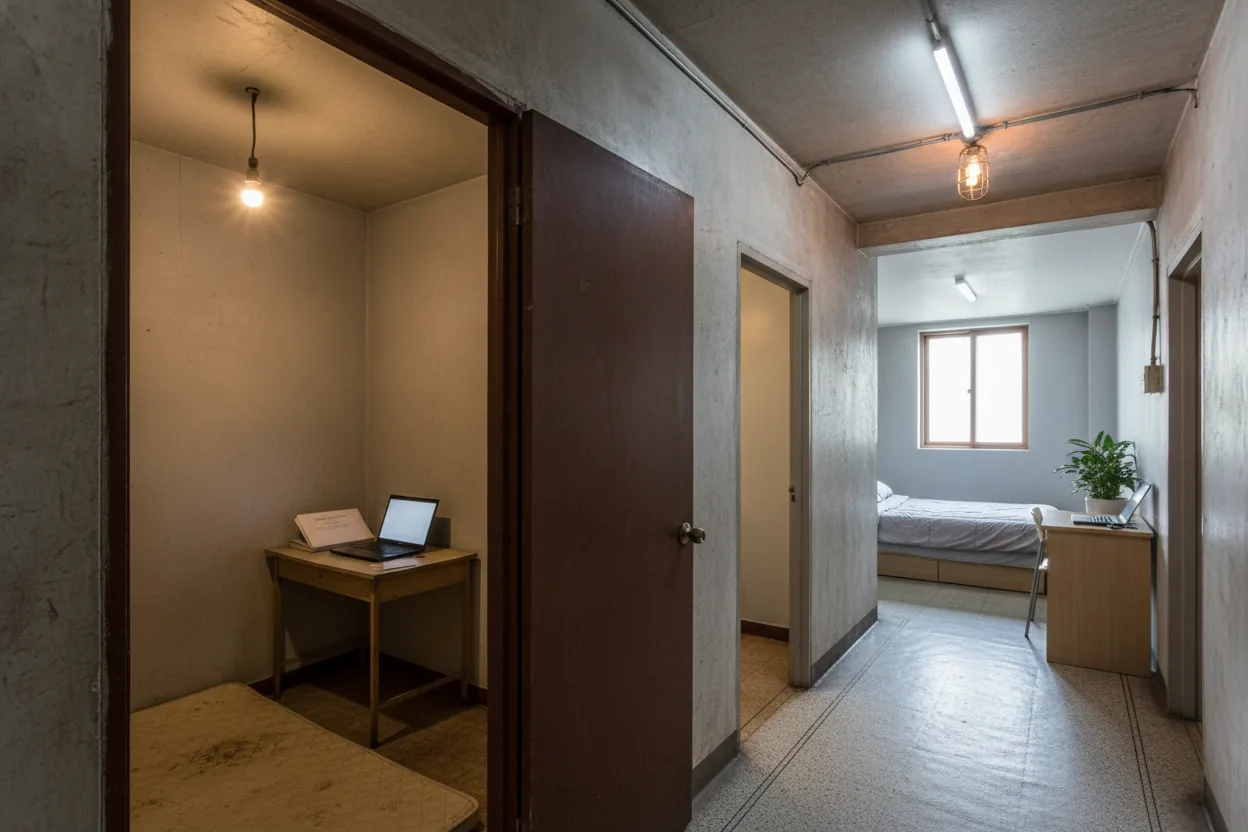
In the same Sinchon building this past August, a windowless room rented for KRW 200,000 a month while a renovated unit with an actual window, two floors up, went for KRW 800,000. Guidebooks and housing blogs tell newcomers to shop around for the best deal before a semester starts, but locals know better: the cheap rooms vanish first, snapped up weeks before anyone even glances at the expensive ones. A pane of glass shouldn't be worth four times the rent on its own. So what actually sorts who gets which room? And why are the people who most need the cheap one the least likely to land it?
That's the entire logic of student housing in Korea, compressed into one building. Supply is fixed, demand spikes twice a year, and the room itself barely matters next to timing. In 2026, someone who books in June for a September semester pays roughly half what someone who waits until late August pays. That gap has widened, not narrowed, as university neighborhoods gentrify around their own student populations. The rest of this comes down to three comparisons: what a goshiwon room actually costs depending on when you book it, how that stacks up against a university dormitory once meals get factored in, and how both compare to a private studio once maintenance fees land on top of the advertised rent.
Why Did Only Two Of Ten Goshitels Still Have Rooms In August?
Sinchon Goshitel Rooms: Price vs. Room Features, August 2026
| Room Tier | Monthly Rent | Deposit | Room Features |
|---|---|---|---|
| Lowest band | KRW 200,000 | ~KRW 100,000 | Windowless, below ground or airshaft, 6 to 8 sqm, shared bathroom |
| Mid band | ~KRW 500,000 | ~KRW 500,000 | Small window, shared or basic private bathroom |
| Highest band | KRW 800,000 | ~KRW 1,000,000 | Renovated, real window, small private bathroom, studio like |
Only 2 of 10 surveyed goshitels still had vacancies two weeks before semester start, and cheapest rooms were gone first.
Source: Goshitel listings survey near Yonsei, Ewha, and Sogang, August 2026
A look at goshitels near universities in Sinchon, the dense student quarter that feeds Yonsei, Ewha, and Sogang, in August 2026 found deposits ranging from roughly KRW 100,000 to 1,000,000, and monthly rent spanning roughly KRW 200,000 to 800,000. By the time anyone called, just a couple of weeks before the semester started, most of those buildings already looked full.
That range isn't noise. It's a sorting mechanism. The KRW 200,000 rooms are windowless, often below ground level or facing an airshaft, somewhere around six to eight square meters, with a shared bathroom down the hall. The KRW 800,000 rooms are renovated, have a window, sometimes a small private bathroom, and look close to a compact studio. A goshiwon, for anyone unfamiliar with the format, is a subdivided building of tiny private rooms with shared kitchen and bathroom facilities, originally built for exam takers studying for civil service tests and now absorbed almost entirely into the student and young worker housing market. Goshitel is the newer, slightly nicer branding for the same concept.
What this actually reveals isn't that goshiwons are cheap. It's that the cheap end of the market disappears first. Students on tight budgets are also the ones with the least flexibility to book early, since many are waiting on scholarship decisions or parental transfers that land late. The people who most need the KRW 200,000 room are structurally the ones least likely to get it.
If a room sits in that low band and is still listed two weeks before semester start, read that as a signal. It likely means something about the room, the floor, or the street noise that the market already priced in and rejected. Booking six to eight weeks ahead of a March or September semester start isn't really a tip. It's a precondition for having real options at all.
How Much Does A University Dormitory Actually Cost Per Semester?
Who Gets the Cheap Room: The Booking Sorting Mechanism
Two semester starts a year create sharp demand spikes against a fixed room stock.
Flexible, early-deciding renters secure the KRW 200,000 windowless rooms first, roughly 6 to 8 weeks ahead.
The students who most need cheap rent often cannot commit early, since funding decisions arrive late.
Only expensive or undesirable leftover rooms remain, and prices for similar bookings have widened year over year.
Source: Article analysis of Sinchon goshitel booking patterns, 2026
The goshiwon numbers above only cover rent. A university dormitory prices differently because it bundles food in, so the two aren't directly comparable until the meal cost gets added back. Korea University's published dorm rates for 2026 make that visible once lined up against the goshiwon numbers. Jinri-gwan, a men's dormitory with single rooms, runs $1,727 (KRW 2,357,340) for a semester that includes three meals a day, seven days a week, or $1,546 (KRW 2,110,940) on the two meals a day plan. Ungbi-gwan, also men's, offers doubles with a private bathroom at $1,503 for three meals or $1,322 for two. Jayu-gwan, the women's dormitory, charges in the same general range for a double, with the three-meal plan costing somewhat more than the two-meal option.
Divide those semester figures by roughly four months and the monthly cost lands somewhere between $330 and $430, meals included. That beats a basic goshiwon room on pure rent, but it includes food, which goshiwon residents have to source themselves, usually from GS25 or CU convenience store meals, campus cafeterias charging KRW 5,000 to 8,000 a meal, or occasional cooking in a shared kitchen that might have two burners for forty residents.
The real distinction isn't price. It's who gets access. Korean university dorms allocate rooms through a points system weighted toward distance from home, academic performance, and sometimes financial need, and spots run limited relative to enrollment. International and exchange students often get priority blocks or separate quotas, which is why a foreign student might find dorm life straightforward while a domestic student from greater Seoul, close enough to commute on paper, gets bumped to the waiting list and ends up in Sinchon looking at a windowless room after all.
For anyone comparing the two options, the meal plan detail matters more than it looks. A three meal plan sounds convenient, but it also locks a student into cafeteria hours and menu rotations for an entire semester regardless of how often they actually eat there. The two meal plan is cheaper for a reason: it assumes a student fills in breakfast or dinner independently, likely with a GS25 triangle kimbap or a bowl of ramyeon. Anyone weighing a dorm application should check which plan matches their actual eating habits before the points system locks them into a room they didn't fully budget for.
Does Studio Rent Near Yonsei Really Outpace Seoul National University?
Korea University Dorm Cost Per Semester: Base Rent vs. Meal Plan
Jinri-gwan (men's, single), 3 meals/day: $1,727
Jinri-gwan (men's, single), 2 meals/day: $1,546
Ungbi-gwan (men's, double), 3 meals/day: $1,503
Ungbi-gwan (men's, double), 2 meals/day: $1,322
Bar widths scaled relative to the highest total cost ($1,727). Orange segment represents the added cost of upgrading from a 2 meal to a 3 meal daily plan (roughly $181 to $189 per semester).
Source: Korea University published dormitory rates, 2026
Dormitories solve the access problem for some students and not others, which pushes the rest of the pool toward private studios. Dabang, one of the major Korean rental listing platforms, published July 2026 data on studios up to 33 square meters near ten major Seoul universities. The average came out to KRW 625,000 a month, about $458, with a KRW 10 million deposit, roughly $7,324, plus KRW 84,000 (about $62) in monthly maintenance fees. Year on year, rent rose 7.7 percent and maintenance fees rose closer to 11 percent.
Break that average apart by neighborhood and the gap tells its own story. Near Seoul National University, monthly rent tends to run somewhat lower than the citywide average for these university districts. Near Yonsei, it runs noticeably higher. Near Hankuk University of Foreign Studies, it also sits on the higher end. Three university neighborhoods, each with a different rent ceiling, and the difference tracks almost exactly with how commercially developed the surrounding area has become.
Seoul National University sits in Gwanak district, relatively far from central Seoul subway lines and without the dense cafe and retail buildup that defines Sinchon or the area near Hankuk University of Foreign Studies in Dongdaemun. Yonsei sits inside the Sinchon and Hongdae commercial corridor, where cafes, Olive Young branches, and bars have pushed up ground floor commercial rent for over a decade, and that pressure filters upward into residential pricing on the blocks behind the main street. A studio near Yonsei isn't better built than one near Seoul National University. It just sits closer to a more expensive commercial ecosystem, and the rent reflects that proximity rather than square meterage or renovation quality.
The maintenance fee jump, 11 percent in a single year, deserves its own attention. Maintenance fees in Korea are notoriously under negotiated. They cover building cleaning, elevator maintenance, and sometimes internet and water, and landlords adjust them more freely than base rent because tenants rarely push back on a line item billed separately. A KRW 84,000 average monthly maintenance fee on top of KRW 625,000 rent means the real housing cost is closer to KRW 709,000, roughly $520, a figure that rarely shows up in headline rent comparisons but lands on the actual bill every month.
Anyone searching studio listings on Dabang or Zigbang should treat the advertised rent number as a floor, not a total. The gap between advertised rent and actual monthly cost, once maintenance and sometimes a mandatory parking or security fee get added, has widened somewhat in 2026 compared to a couple of years earlier, based on the pattern across these three university areas. That gap is where a lot of first year exchange students get caught off guard, not by the deposit, which is disclosed upfront, but by the monthly arithmetic that only becomes clear after move in.
Which Housing Type Actually Fits A Student's Situation?
Put the three options next to each other and the earlier numbers resolve into a single tradeoff. A first year exchange student with KRW 10 million in savings and no patience for a points lottery gravitates toward a private studio, while a domestic freshman waiting on a scholarship decision often ends up in whichever goshiwon still has a vacancy. A goshiwon suits someone who wants zero deposit friction and total flexibility to leave with a week's notice. A dormitory suits someone who values stability and bundled food enough to accept Korea's points based allocation lottery. A studio suits someone with KRW 10 million in savings or parental backing who wants privacy and a kitchen. None of the three is objectively the right call.
Lay them side by side and the pattern holds across every category: deposit size, food access, flexibility to leave. Each type trades one of those for the other two, and no option gives a student all three at once.
That tradeoff explains the room at the start of this piece. The windowless KRW 200,000 room and the KRW 800,000 room two floors up were never really competing on glass. They were sorted by who could act in June and who was still waiting on a scholarship letter in August. The real decision for 2026 turns less on which type and more on when. Book in June for September, book in December for March, and the whole pricing structure described above starts working in a student's favor instead of against it. Wait until the last two weeks before the semester, and the only rooms left are the ones everyone else already passed on, windowless, airshaft facing, and priced like it.