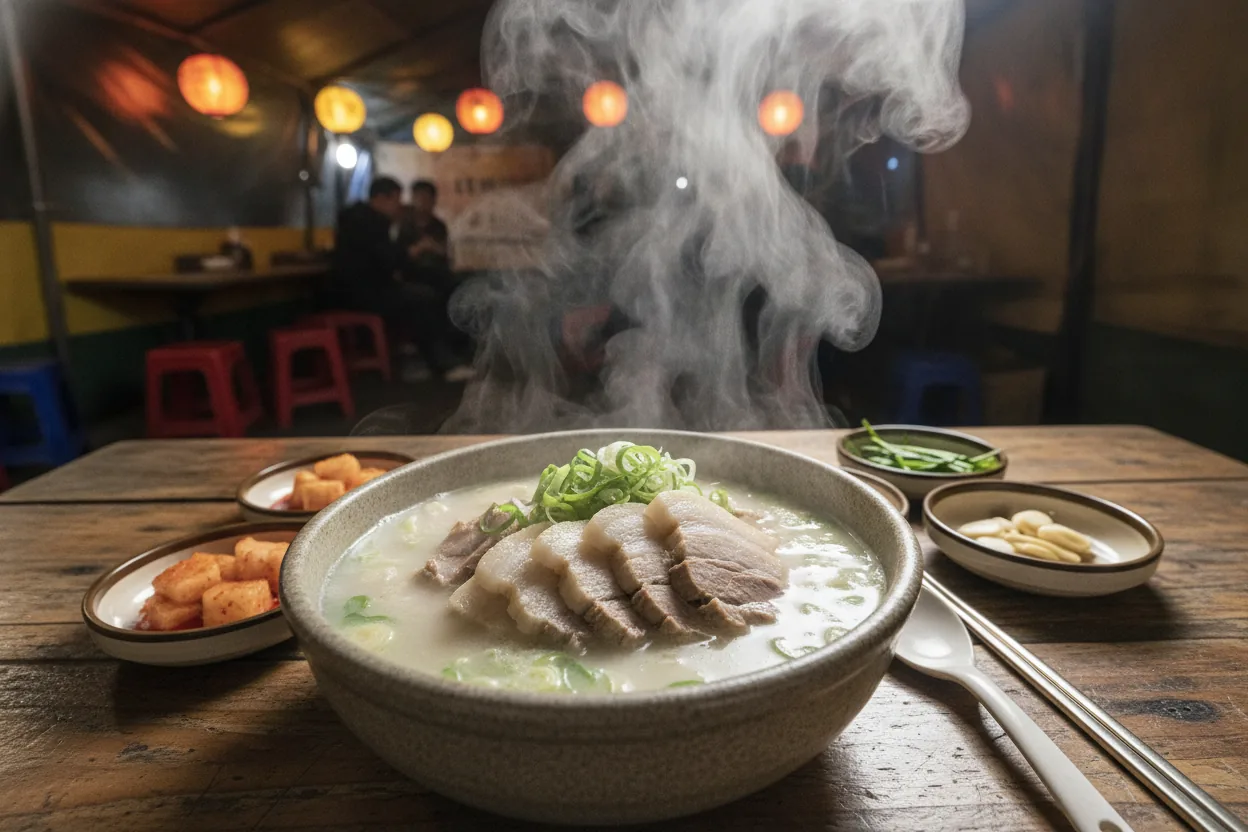
A bowl of dwaeji gukbap in Busan's Choryang-dong costs around 10,000 to 11,000 won in 2026. Walk toward Haeundae instead, and widely cited figures place that same bowl at 15,000 won or more. The broth is not better. The price difference comes down to one rule most visitors never learn before they sit down: Busan runs on specialist logic, and eating well here versus eating expensively and badly at the same time is almost entirely a question of which neighborhood you enter and whether the restaurant you pick does one thing instead of several things adequately.
Busan's food identity is unusually localized even by Korean standards. Dishes that exist everywhere in Korea taste different here, get priced differently, and come with unspoken rules about where you order them. The city has street food landmarks that survived Seoul's influence, a pork bone broth culture that predates the Korean War, and a wheat noodle tradition that most visitors confuse with cold noodles from Pyongyang. Knowing which dish belongs to which context is the whole game.
One principle runs through all of it: combined-menu restaurants in Busan are a trap for the uninformed. Not because they are dishonest, but because Busan's best dishes almost always come from restaurants that do one thing. Specialists are more entrenched here than in Seoul, and locals will tell you this without much prompting.
Ssiat Hotteok: The Street Food That Has Not Been Replaced
Busan Food Prices by Dish and Neighborhood in 2026
Busan Food Prices by Dish and Neighborhood in 2026
| Dish | Location | Price (KRW) |
|---|---|---|
| Ssiat Hotteok | BIFF Square, Nampo-dong | 1,500 to 2,000 |
| Dwaeji Gukbap | Choryang-dong (local) | 10,000 to 11,000 |
| Dwaeji Gukbap | Haeundae (tourist area) | 15,000+ |
| Dwaeji Gukbap premium | Haeundae vs Choryang | +36 to 50% more |
Source: Busan Food Guide 2026 article, observed receipts May 2026
Source: Article: Busan Food Guide 2026
BIFF Square in Nampo-dong is where ssiat hotteok became famous enough to draw a line at most hours of the day. Informal vendor patterns in mid-2026 put the price at around 1,500 to 2,000 won per piece, though that can shift. The relative stability comes partly from the vendor culture around BIFF Square being old and somewhat resistant to the fast pricing swings that hit Myeongdong hard.
What separates ssiat hotteok from the standard version you find at a GS25 or a Seoul street stall is the filling. Standard hotteok uses brown sugar and cinnamon. Ssiat hotteok adds sunflower seeds, sometimes mixed with other nuts, pressed into the dough and cooked on a flat iron until the outside develops a specific resistance: slightly crisp without being dry. The difference is as much about texture as flavor, which is why the Seoul version never quite replicates it.
The BIFF Square vendors are the reference point, but ssiat hotteok shows up at other spots around Nampo and Jagalchi. Quality is not uniform. The ones with lines are usually worth the wait, a pattern that holds more reliably in Busan street food than in Seoul, where lines sometimes track Instagram cycles more than consistent cooking.
Ssiat hotteok is the entry point to Busan food for a reason. It is cheap, it is specific to this city, and it signals immediately that Busan has its own food logic running parallel to the national one. That logic becomes more consequential when the stakes are higher, which is exactly what the next dish illustrates.
Dwaeji Gukbap and the Specialist Rule
How to Eat Well in Busan: The Specialist Rule Step by Step
How to Eat Well in Busan: The Specialist Rule Step by Step
Pick the right neighborhood first
Busan food is hyper-local. The same dish costs 36 to 50% more in a tourist zone.
Choose a specialist restaurant
One dish on the menu signals quality. Combined-menu spots are a trap for uninformed visitors.
Trust the line, not Instagram
In Busan, queues track consistent cooking more reliably than social media trends.
Eat well and pay local prices
Dwaeji Gukbap at 10,000 to 11,000 KRW with sides included, Hotteok from 1,500 KRW.
Source: Busan Food Guide 2026 article
Source: Article: Busan Food Guide 2026
Dwaeji gukbap is pork bone broth soup served with rice, and Busan is where it originated in its current form. The milky white broth comes from long boiling of pork bones. The soup typically arrives with a plate of baechu kimchi and various pork cuts in the bowl. Choryang-dong near Busan Station is one of the densest clusters of dwaeji gukbap restaurants in the city, and proximity to the station means it catches commuters and visitors in roughly equal measure.
Yeongdong restaurant in Choryang-dong is a reasonable reference point for what this dish actually costs at a non-tourist-premium establishment. A bowl in late May 2026 was in the 10,000 to 11,000 won range, based on observed receipts from that visit. That price includes the side dishes that arrive automatically. Ordering rice separately is not standard here. The rice goes into the broth, or beside it depending on preference, and that eating grammar is something first-time visitors sometimes miss entirely.
The honest complication at Yeongdong is the milmyeon. The dwaeji gukbap is solid. The milmyeon ordered on the same visit did not perform at the same level. That is not an indictment of the restaurant overall. It is a precise illustration of the specialist rule: a restaurant that does gukbap well does not automatically do milmyeon well, and ordering milmyeon at a combined-menu restaurant in Busan is a structurally different bet from ordering it at a place that has done nothing else for twenty years.
When time is limited, the instinct is to order multiple dishes at one restaurant. In Busan, that instinct costs you the quality ceiling on whatever the secondary dish is. Milmyeon is the clearest example of what that cost actually looks like.
Finding Milmyeon at the Right Address
Ssiat Hotteok vs Standard Hotteok: What Makes Busan Different
Ssiat Hotteok vs Standard Hotteok: What Makes Busan Different
| Ssiat Hotteok (Busan) | Standard Hotteok |
|---|---|
|
1,500
to 2,000 KRW per piece
Filling: brown sugar, cinnamon plus sunflower seeds and mixed nuts
Texture: slightly crisp outside, not dry
Origin: BIFF Square, Nampo-dong
City-specific recipe
|
Generic
price varies widely
Filling: brown sugar and cinnamon only
Texture: soft throughout
Found at: GS25, Seoul street stalls nationwide
Nationwide standard
|
Source: Busan Food Guide 2026 article
Source: Article: Busan Food Guide 2026
Milmyeon is a cold wheat flour noodle dish that developed in Busan among refugees during the Korean War, when buckwheat for naengmyeon was scarce and wheat from US aid supplies was available. That origin story is real and still shapes the dish. Milmyeon is softer and slightly thicker than naengmyeon, the broth is lighter, and the overall flavor profile is less assertive. It rewards familiarity because the first bowl often reads as understated to someone expecting naengmyeon intensity.
Gaegeum Milmyeon sits in Busan's local food consciousness as one of the most consistently referenced specialists, and it is the kind of place that does not advertise to outsiders. The neighborhood location and the menu focus are both signals. Research-based consensus from local sources points to Gaegeum Milmyeon as a benchmark, which means it belongs in the planning but requires the actual visit to confirm.
A bowl of milmyeon at a specialist in 2026 runs approximately 9,000 to 11,000 won based on observed pricing patterns. That range has shifted upward from where it sat in 2023 and 2024, tracking the broader Korean food inflation that has pushed almost every noodle dish past the 9,000 won floor at any restaurant worth eating at. The price is not really the point, though. A specialist milmyeon at 10,000 won is a categorically different experience from milmyeon ordered as a secondary dish at a gukbap restaurant, and a 1,000 won price difference between the two does not explain the quality gap at all.
Milmyeon is the dish in Busan that most rewards going to the right address specifically. First-timers who order it at a combined-menu spot and conclude it is overrated have not actually tried milmyeon. They tried a restaurant doing its second-best thing, which is a different meal entirely. The same dynamic extends to every other specialist category in the city, including the one that operates almost entirely after dark.
Gopchang: Neighborhoods Behind the Dish
Gopchang, grilled intestines from beef or pork, has a concentrated presence in Busan that does not get the same tourist attention as gukbap or hotteok. The Seomyeon area and parts of Busanjin-gu have clusters of gopchang restaurants that operate primarily for locals: open in the evening, built around soju and the particular social ritual of watching offal cook on a tabletop grill. The atmosphere at these places is not engineered for visitors, which is exactly why the food and pricing tend to be more reliable.
Gopchang pricing in Busan in 2026 runs roughly 12,000 to 18,000 won per portion depending on the cut and the restaurant tier, based on observed patterns rather than a verified current menu. Pork gopchang tends to sit at the lower end of that range. Beef gopchang, especially makchang, commands the higher prices. A full meal with soju at a mid-tier gopchang restaurant in Seomyeon for two people lands somewhere around 40,000 to 55,000 won total.
The cooking method matters here in a way that affects where you sit. Gopchang is typically cooked on charcoal or a gas grill set into the table, and the smoke and grease are part of the environment. Wear something you do not care about. That is practical information, not a critique. The cooking method is inseparable from why the dish tastes the way it does, and restaurants that have moved to cleaner ventilated setups tend to lose something in the char.
Busan's gopchang culture runs on regulars. The restaurants that have survived and maintained quality did so by serving the same neighborhoods for years, not by chasing food tourism cycles. You are walking into someone else's local, and the menu, the pace, and the service assumptions all reflect that. This is the specialist rule applied to atmosphere rather than just menu focus, and it is the same principle that separates a 10,000 won bowl of gukbap in Choryang-dong from a 15,000 won bowl near Haeundae. Knowing before you arrive which room you are walking into is the only preparation Busan actually requires.