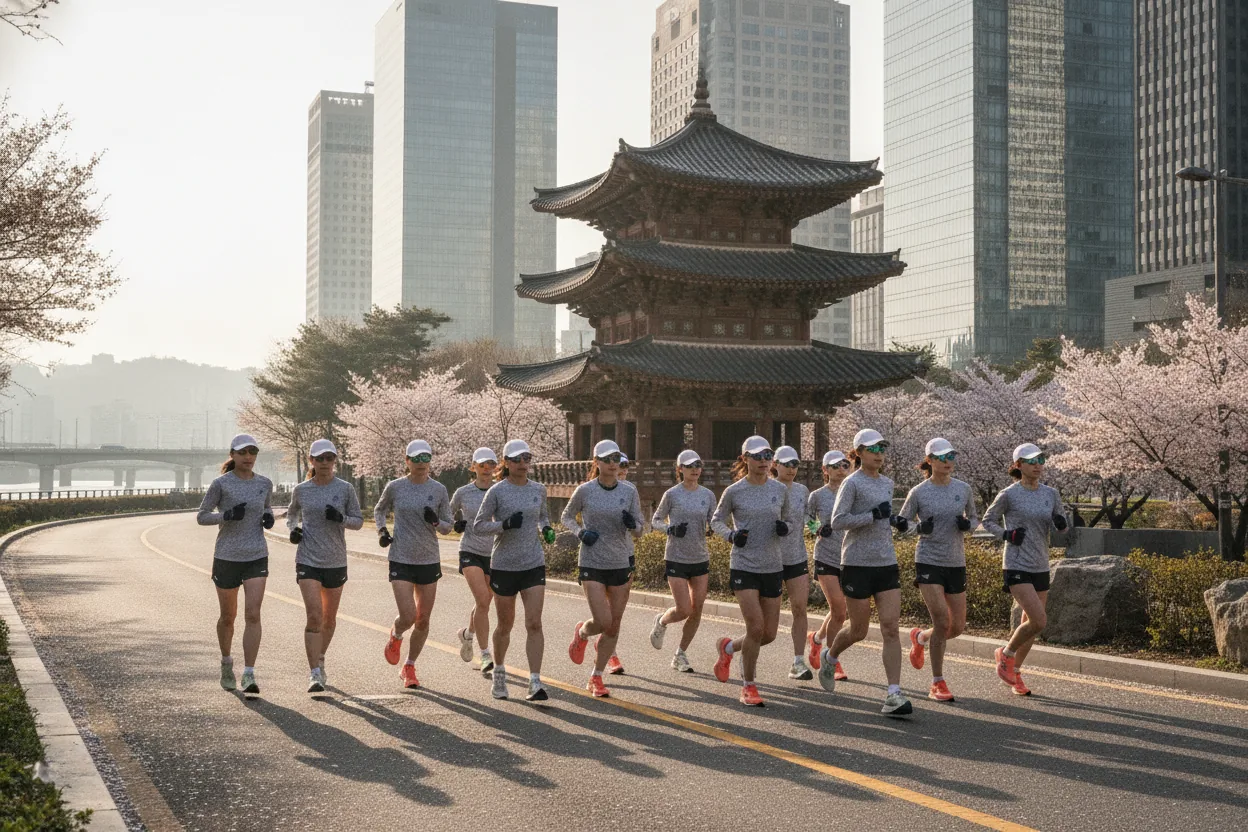
Marathon running and its deep roots in South Korean sports culture
South Korea's marathon tradition stretches back to 1931, making the Seoul Marathon the oldest continuously-held road race in Asia. That's nearly a century of competitive history. And yet a single image of a Chinese runner finishing a regional race while visibly free-bleeding has done more to spark a national conversation about women in Korean endurance sports than all of it combined. How does one viral moment from a mid-tier race with no World Athletics Label status manage to expose what a sport built on national pride has long left unexamined?
- The Seoul Marathon holds IAAF Gold Label status, placing it alongside Berlin and Tokyo in terms of official international recognition.
- Hwang Young-jo's 1992 Olympic gold medal in Barcelona remains one of the most celebrated individual achievements in Korean athletics history, the kind of result that gets taught in schools.
- The Gyeongju International Marathon, held every spring, draws over 20,000 registered runners along a course that passes UNESCO World Heritage sites.
- South Korea's running club culture has expanded significantly since 2020, with parkrun Korea chapters now operating in at least 10 cities as of 2025.
- The 42.195-kilometer full marathon distance is widely recognized in Korea under the term 풀코스, distinguishing it from the half (하프) and 10K (10킬로) categories offered at most domestic events.
Marathon participation in Korea spans all age groups, from elite athletes chasing qualifying standards to weekend runners completing their first 5K. For international readers, the key context is that running here carries cultural weight that goes well beyond fitness. It's tied to national identity, civic pride, a tradition of public endurance events nearly a hundred years old. That deep foundation is exactly what makes the current global conversation about women's endurance experiences cut so sharply in Korea. The sport's scale has long outpaced its inclusivity, and most people inside it have simply learned to look past that fact.
The global viral story about a female marathon runner driving the current search trend
Into that backdrop, a single image from a regional Chinese race has become the catalyst for a nationally specific conversation in South Korea about gender, endurance, and what it actually means to finish a race on your own terms. The current spike in Korean searches for 마라톤 connects directly to Li Meizhen, a Chinese runner who completed the 2024 Hengshui Lake Marathon while visibly free-bleeding after her period started approximately 5 miles from the finish line. Photos of Li crossing the finish line with blood on her legs spread rapidly across social media in mid-2025, then resurfaced in Korean online communities in late July 2026, touching off a fresh wave of discussion about women's endurance sports, bodily autonomy, and what athletic determination actually looks like up close. International outlets including The Times of India and My Modern Met covered the story, both framing Li's finish as an act of resilience rather than an incident.
- The Hengshui Lake Marathon is a certified road race held annually in Hengshui, Hebei Province, China, with thousands of registered participants. It is not a World Athletics Label event. Its reach here is entirely social-media-driven, which is arguably the point.
- The phrase "free bleeding marathon" generated significant cross-platform engagement across Korean online communities including DC Inside, Naver Cafe running groups, and X (formerly Twitter) Korea threads during the week of July 21, 2026.
- My Modern Met's dedicated profile on Li Meizhen described her finish as a moment that sparked global conversation about menstruation and athletic performance, a framing Korean media outlets picked up and translated directly.
- Discussion threads from South Korean women's running communities, including several Naver-based cafe groups with memberships over 50,000, drew explicit contrasts between Li's experience and the practical challenges faced by Korean female runners at domestic races.
The reason this story lands with particular force in South Korea is straightforward: Korean running culture, despite its scale and tradition, has historically been male-dominated at both the organizational and participation levels. Public conversations about women's specific physical experiences during endurance events remain rare. Li Meizhen's story functions less as a foreign curiosity and more as a direct challenge to a sport that has spent nearly a century celebrating the finish line while leaving the conditions that get women there largely unexamined. The insider runner already knows the gaps. The outsider sees only the finish-line glory. Li Meizhen's image has made that distance impossible to ignore, and the volume of Korean search traffic confirms it.