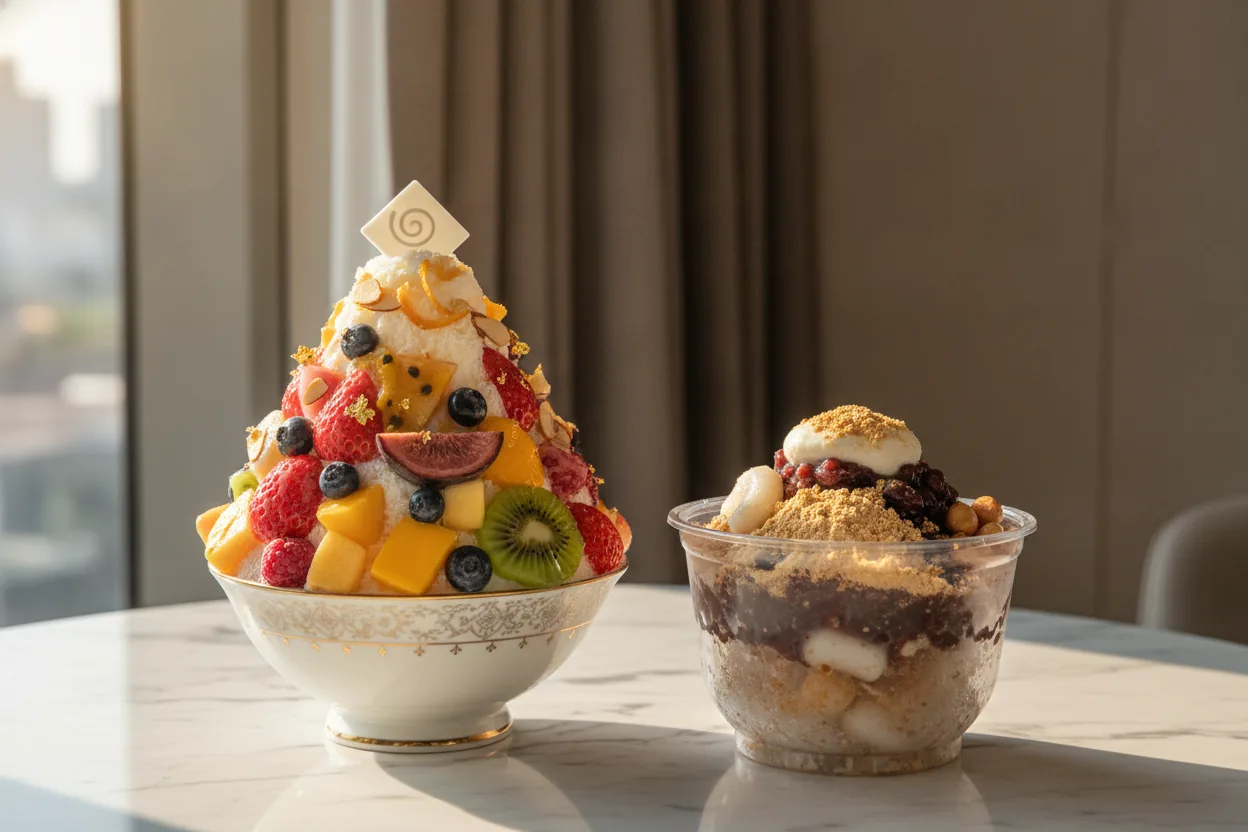
A bowl of shaved ice at a five-star Seoul hotel costs around ₩130,000 to ₩149,000 this summer. The structurally identical dessert at Sulbing runs ₩7,500 to ₩13,000 across the city. Most visitors either pay the hotel price without understanding what they actually bought, or skip it entirely without knowing what they passed on. The real question is not which tier to choose but whether you can read the architecture of each price point before you sit down and the menu arrives.
Bingsu season in Seoul runs hard from late June through August, and 2026 has pushed prices noticeably higher across all tiers compared to two years ago. The reasons are layered: premium ingredient sourcing has intensified, hotel dessert menus have become a genuine content category in their own right, and the competition for viral presentation has raised the floor on what even midrange cafes feel they need to spend on plating. Knowing where each price point actually lands, and why, is the difference between a ₩12,000 bowl that genuinely satisfies and a ₩110,000 bowl that feels like a miscalculation.
The Architecture of an Expensive Bowl
Seoul Bingsu Price Tiers at a Glance, Summer 2026
Seoul Bingsu Price Tiers at a Glance, Summer 2026
| Venue Type | Price Range | Ice Base | Key Differentiator |
|---|---|---|---|
| 5-Star Hotels Lotte, Shilla, Signiel |
₩100,000 to ₩149,000 |
Jeju fresh milk snow |
Jeju provenance, hotel lounge, 2-hr seating, premium staging |
| Specialty Cafes Seongsu, Yeonnam, Gyeongbokgung |
₩15,000 to ₩35,000 |
Craft milk or flavored |
Single-origin red bean, handmade tteok, competitive ingredients |
| Sulbing Chain Citywide locations |
₩7,500 to ₩13,000 |
Standard shaved ice |
Accessible, consistent, widely available across Seoul |
Source: Article data, Seoul Hotel and Cafe Bingsu Menus 2026
Source: Article data, Seoul Hotel and Cafe Bingsu Menus 2026
The flagship hotel bingsu in Seoul in 2026 is almost always anchored to Jeju. Jeju hallabong citrus, Jeju raw milk, Jeju green tea from Osulloc estates: the island functions as a premium provenance signal the way certain wine regions do in other contexts. When Lotte Hotel, Shilla, or Signiel positions a seasonal bingsu on its summer menu, the Jeju sourcing is not incidental. It is the structural justification for the price, and the kitchen teams know it.
What you are actually buying at the ₩100,000 tier is a specific set of components stacked together. The ice itself is milk snow, not water ice, churned from fresh dairy to a texture closer to soft powder than the granular shaved ice of a street stall. The toppings operate on a different logic: housemade rice cake, whole fruit rather than syrup, and often a centerpiece element like fresh mango sourced from a specific farm or a condensed milk sauce made on site. The bowl arrives with the kind of staging that photographs at a resolution the ₩8,000 version simply cannot match.
The setting absorbs a significant portion of that price too, and it is worth being precise about what that means. A hotel patisserie lounge in Gangnam or on the upper floors of a tower in Jung-gu offers air conditioning that functions at a level the average cafe cannot sustain during a 35-degree Seoul July, service that refills your water without being asked, and a seat you can hold for two hours without social friction. On a humid Tuesday in peak bingsu season, those are not trivial goods.
Whether that combination is worth ₩80,000 in premium over a Sulbing bowl is a personal calculation, but the components are real. The insider read is this: most visitors either overpay without understanding what they bought, or skip the hotel tier entirely without knowing what they passed on. Both are the same failure of calibration. The price gap only makes sense once you separate the material cost from the real estate cost from the experience cost, and most people never bother to do that.
Where the Middle Tier Actually Lives
What You Are Actually Paying For in a Hotel Bingsu Bowl
What You Are Actually Paying For in a Hotel Bingsu Bowl
Estimated share of a typical ₩120,000 hotel bingsu price
Source: Article analysis of hotel bingsu price components, 2026
Source: Article analysis of hotel bingsu price components, 2026
Between the hotel price point and the Sulbing floor there is a densely populated middle range that most first-time visitors walk right past. Specialty dessert cafes in Seongsu-dong, Yeonnam-dong, and the narrower streets behind Gyeongbokgung have been running bingsu menus that tend to fall somewhere in the mid-to-upper teens through the mid-thirties in thousands of won this summer, and some of them are sourcing ingredients at a level that genuinely competes with hotel quality on taste, if not on setting.
The pattern in Seongsu-dong is worth watching. The neighborhood's dessert cafe density kept climbing through 2025 and into 2026, and the competition has pushed several operators toward unusually serious ingredient work. Handmade tteok, single-origin red bean paste simmered in house, seasonal stone fruit sourced from Chungcheong province farms: these are not universal, but they appear often enough in the ₩22,000 to ₩30,000 range that the tier has developed real credibility.
Hongdae and Insadong still carry bingsu options in this range, but the tourist traffic in both neighborhoods has pushed several cafes toward volume over refinement. The gap between the best Seongsu-dong bowl at ₩28,000 and an Insadong bowl at the same price is noticeable if you are paying attention to ice texture and topping quality. That gap does not appear on a menu board or in a storefront photo, which is exactly why it catches people off guard.
Knowing the middle tier exists, and knowing how to locate its better performers, is probably the highest-leverage piece of bingsu knowledge you can carry into Seoul this summer. The hotel experience has its logic. Sulbing operates on a different set of priorities entirely. The middle tier is where the most interesting value is concentrated right now, and it rewards visitors who move off the main streets and navigate by T-money card rather than tourist map.
Sulbing's Position in the 2026 Market
How to Choose Your Seoul Bingsu Tier: A Decision Flow
How to Choose Your Seoul Bingsu Tier: A Decision Flow
no frills
plus atmosphere
setting, and content
Sulbing chain
citywide
Specialty cafe,
Seongsu or Yeonnam
5-star hotel lounge,
Jeju ingredients
Source: Article framework for bingsu price calibration, 2026
Source: Article framework for bingsu price calibration, 2026
Sulbing remains the most geographically accessible bingsu option in Seoul, with locations spread across major transit corridors, subway station food halls, and tourist districts from Myeongdong to Hongdae to the underground at COEX. The price range this summer sits at roughly ₩7,500 to ₩13,000 depending on the menu item and location, with a small premium observable at the highest-traffic tourist sites. That is an observed pricing pattern across multiple locations, not an official tier structure from the company.
The menu logic at Sulbing is standardized in a way the independent cafe tier is not. The injeolmi bingsu, the strawberry milk snow, the mango bingsu: these are consistent products across locations, which means you know what the texture and topping ratio will look like before you order. That predictability is genuinely useful when you are navigating a hot day and do not have the time or language ability to parse a handwritten Korean menu at a small independent shop.
What Sulbing cannot offer is sourcing specificity or the visual drama of the higher tiers. The red bean on a Sulbing bowl is sweet and functional. The red bean on a well-made independent cafe bowl might have been simmered with a particular water ratio and salt balance that produces a noticeably different result. Whether that difference justifies ₩15,000 to ₩20,000 in additional spend is entirely context dependent, but the difference is real.
Sulbing is also the most stable price performer across the bingsu inflation curve of the last two years. The hotel and specialty cafe tiers have moved aggressively upward. Sulbing has held its core menu pricing with only incremental movement, and that stability is its own form of information. Treat it as a baseline and you are using it correctly. Treat it as the whole picture and you are missing the tiers where Seoul's bingsu culture has done its most ambitious work.
Reading the Price Before You Sit Down
Seoul bingsu menus are almost never posted outside the establishment in a way that prepares you for the bill. Hotel patisseries in particular rely on the fact that most guests will not price check before entering. The menu arrives after you are seated, the numbers land in an environment of cool air and ambient music, and the psychological cost of leaving without ordering typically exceeds the sticker shock of the price. This is not a conspiracy. It is standard hospitality structure. Knowing it in advance changes how you approach the decision.
The practical signals to read before you commit are these:
- Lobby level placement in a five-star hotel
- A standalone dessert counter running numbered reservations
- Menu boards with QR codes rather than printed prices, which should be your clearest warning
- Bilingual menus weighted toward Japanese and Chinese alongside English
Any combination of those signals in a single venue is a reliable indicator that the bingsu menu starts at ₩30,000 and likely goes higher. None of those signals are negative indicators about quality. They are calibration tools. A standalone dessert counter with reservations in a well-regarded Gangnam building is probably producing a genuinely excellent product. The signal is telling you the price tier, not the value tier, and holding those two things separately is the core skill the 2026 Seoul bingsu market requires of anyone spending real money on shaved ice.
What the 2026 bingsu market makes visible is a broader pattern in how Seoul has segmented its food experiences over the last several years. The floor has stayed accessible. The ceiling has climbed dramatically. The most interesting action has consolidated in a middle band that is not well mapped for visitors arriving without local context. The gap between the visitor who knows that geography and the one who does not is measured in both money and quality, and it runs in both directions.
The city is not hiding any of this. The price structure is legible once you know what to look for, and the Seongsu-dong middle tier is a better starting point for most visitors than either extreme. That is the read that takes two summers in Seoul to arrive at on your own, or about four minutes to absorb before you get on the airport train.