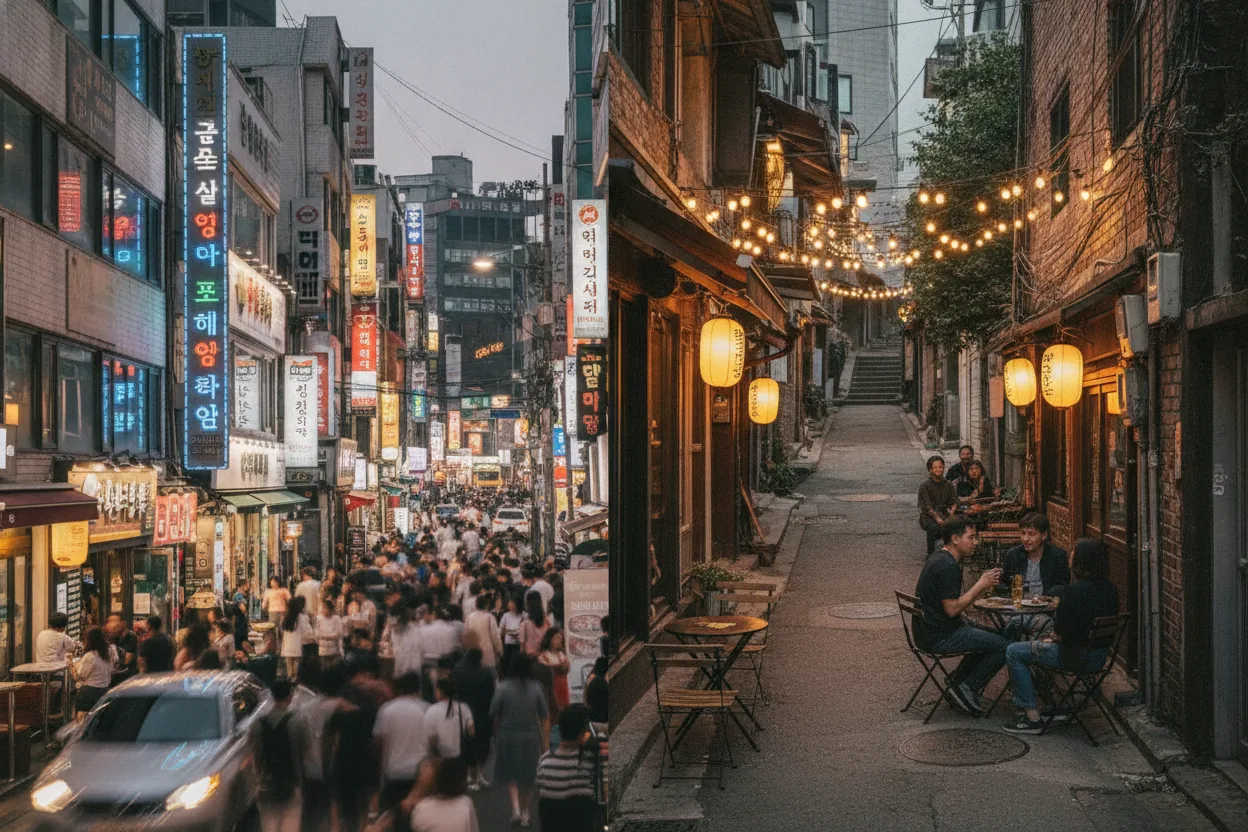
Four cuisines within fifteen minutes of Itaewon Station Exit 3, and a hillside street called Sinheung ro one block west where the beer costs the same but the room holds a tenth as many people. Most visitors treat that whole stretch as one neighborhood and spend their one night in Seoul picking a bar at random. Locals and long term residents know better. Itaewon and HBC solve completely different problems, and people who live here choose between them on purpose. So which problem do you actually have tonight: loud variety, or a quiet night? That's the question this guide answers.
Itaewon is still the most internationally mixed neighborhood in Seoul. No other district packs Nigerian, Turkish, Indian, and Mexican kitchens into a fifteen minute walk the way this one does, a legacy of the U.S. military base that shaped the area from the mid twentieth century onward. But the neighborhood that rewards a slower visit, the one where younger Koreans and long term foreign residents actually spend their Tuesday nights, sits up the hill in HBC. Below, what each neighborhood is actually good for, and how to split a visit between them without flattening both into one generic evening.
Itaewon's Food Scene And Its Military Base Roots
Itaewon vs HBC: Core Differences
| Feature | Itaewon | HBC |
|---|---|---|
| Walk from Exit 3 | 0 to 15 minutes | One block west, uphill |
| Cuisine Variety | Nigerian, Turkish, Indian, Mexican | Small independent spots, less variety |
| Beer Price | Same as HBC | Same as Itaewon |
| Room Capacity | Large, up to 300 people | About a tenth of Itaewon's rooms |
| Typical Crowd | Mixed tourists, expats, locals | Long term residents, young Koreans |
| Best Visit Day | Weekday, e.g. Tuesday | Weeknight, e.g. Wednesday |
Source: Based on article descriptions, qualitative comparison
Most first time visitors assume Itaewon works like Myeongdong or Hongdae with a foreign accent, a tourist zone dressed up for international consumption. The restaurant ownership tells a different story. Itaewon grew up around a military base, not around a shopping concept, and the cuisine map still reflects that history rather than a marketing plan.
Walk the main strip near Itaewon Station Exit 3 and within a few blocks you can eat Nigerian jollof rice, Turkish kebab, Indian thali, and Mexican tacos, often cooked by owners from those countries rather than Korean operators licensing a cuisine. That density doesn't exist anywhere else in Seoul. Not in Gangnam, not in Hongdae. A plate of Turkish kebab with rice runs mid priced for the area, though menu prices shift block by block and season by season, so check a posted menu before you sit down.
The nightlife draws a similarly mixed crowd. Koreans, long term expats, and tourists share the same bars instead of splitting into separate scenes. That mixing is rarer in Seoul than people assume. Most nightlife districts here sort by age or nationality without much overlap, and Itaewon just doesn't sort as cleanly. That's why it still pulls people back even after rents and reputations have shifted around it over the past decade.
Anyone building a Seoul itinerary around food variety should put Itaewon at the top of the list. Time the visit for a weekday: weekend evenings get dense fast, and a Tuesday dinner gives you a much clearer read on what the neighborhood feels like day to day. That density and noise are exactly what Itaewon is for. The next section covers the neighborhood built for the opposite experience.
The Residents Who Fill HBC On A Weeknight
Room Capacity: Itaewon vs HBC
Itaewon Bar
~300
people per sound system
HBC Bar
~30
a tenth of Itaewon's capacity
Same beer price, very different atmosphere: loud variety versus a quiet night.
Source: Based on article's venue size comparison
People assume Haebangchon, shortened almost universally to HBC, is just overflow seating for Itaewon, somewhere you end up when the main strip is full. The booking pattern on the ground runs the other direction. People choose HBC on purpose, specifically to avoid Itaewon's peak hour density.
HBC sits on the hillside just west of Itaewon proper, centered on a street called Sinheung ro. The businesses here skew toward small independent restaurants, craft beer bars, and cafes run by their own owners rather than chains. That shapes both the pricing and the atmosphere. A pint of craft beer in HBC costs about the same as in Itaewon, but the rooms are smaller, the crowd is thinner, and nobody's shouting over a sound system built for three hundred people.
Long term foreign residents who've already done Itaewon's main strip a hundred times make up part of a typical Wednesday crowd here. Younger Koreans who either got priced out of Itaewon's rents or just prefer a quieter standard of night out make up the rest, and that second group matters more than visitors usually realize. HBC isn't a foreigner enclave. It's one of the clearer examples in Seoul of a neighborhood where expat residents and local Koreans overlap by genuine shared preference, not just proximity.
For a traveler choosing between the two on a single evening, it comes down to volume tolerance: Itaewon for maximum cuisine variety and a louder, busier night, HBC for a long dinner and two unhurried drinks without raising your voice to be heard. Pick based on which kind of tired you want to be by midnight. HBC's other advantage has nothing to do with food or drink: it sits at the base of a hiking route most visitors never find.
The Hiking Entrance To Namsan Park Tourists Skip
How To Split A Night Between Itaewon And HBC
Step 1: Arrive Itaewon Station Exit 3
Explore mixed cuisine strip, Nigerian, Turkish, Indian, Mexican
Step 2: Eat Dinner On A Weekday
Tuesday gives a clearer read on everyday density
Step 3: Walk Uphill One Block West
Reach Sinheung ro in HBC
Step 4: Settle Into A Small Craft Beer Bar
Quiet room, same beer price, locals and residents
Source: Based on article's suggested itinerary logic
Nearly every visitor to Seoul gets to Namsan Tower by cable car from Myeongdong, and nearly every travel guide recommends exactly that route. Fewer people realize there's a direct hiking entrance to Namsan Park from the HBC side, and almost nobody uses it.
The HBC approach starts from the upper streets near Sinheung ro and climbs through residential alleys before joining the park's walking trails. It's steeper than the Myeongdong approach in places, and there's no cable car option from this side, which is exactly why it stays empty. Most tourists won't climb a hill when a gondola exists nearby, and that filtering effect is the whole advantage. Where the Myeongdong cable car line can mean a long wait during peak season, the HBC trail means a quiet uphill walk with maybe a handful of local joggers and nobody else.
The hike takes a while longer than a casual stroll, with the exact time depending heavily on pace, fitness, and which entrance point you use, so treat any specific duration as a loose guess rather than a promise. The payoff is the same N Seoul Tower observation deck everyone else paid for a cable car ticket to reach, minus the ticket, minus the line, minus the crowd posing for photos at the summit platform.
This route rarely makes it into a first time visitor's plan because it requires knowing HBC exists in the first place, and knowing the hill behind it connects to Namsan at all. Anyone staying in or near Itaewon for more than a single night should treat this hike as the default way up the mountain, and save the cable car descent for the way back down when your legs are tired and you've already earned the view once. Food, drink, and now a hike: the one variable left is what all of this actually costs.
How Itaewon And HBC Prices Compare To Seongsu dong
The outside assumption is that an internationally oriented neighborhood with this much foreign cuisine must run expensive by Seoul standards, a kind of import tax on variety. The receipts tell a more mixed story, and the gap depends heavily on which category of spending you're measuring.
Street level dining in both neighborhoods stays reasonable relative to Gangnam or Seongsu dong, where rents have climbed hard enough over the past several years to drag casual meal prices up with them. A full meal at a mid range Itaewon or HBC restaurant, a kebab plate, an Indian curry set, a Mexican taco plate, generally sits in a mid range bracket per person that's crept upward gradually rather than spiking the way Seongsu dong's cafe prices have. Coffee runs fairly standard across both neighborhoods, in line with most of central Seoul.
The gap actually opens at nightlife. Cocktails in Itaewon's more polished bars cost noticeably more than a casual HBC beer bar, and that spread is the clearest financial argument for treating the two neighborhoods as genuinely different products rather than one extended strip. A night that starts with dinner in Itaewon and ends with cocktails there costs meaningfully more than a night that starts with dinner in HBC and ends with a few rounds of craft beer on Sinheung ro.
Don't treat any of these figures as fixed. Menu prices across both neighborhoods have moved upward over the past two years in line with general inflation in Seoul's food and beverage sector, so any specific number here is best read as a realistic range, not a locked in figure. Check a posted menu before you sit down. Locals do this reflexively, and it's the habit worth building before the first order goes in. With the food, the hike, and the price gap laid out, the remaining question is how to fit both neighborhoods into an actual schedule.
A Two Day Route Through Itaewon And HBC
The common planning mistake is treating Itaewon and HBC as a single stop, allotting one evening and expecting to see both properly. The geography makes that tempting since the two neighborhoods sit a short walk apart. Each one plays out better across separate visits.
A workable structure looks like this:
- Daytime food crawl through Itaewon's restaurant strip
- Afternoon hike from HBC up to Namsan Park and the tower
- Evening dinner and drinks back down on Sinheung ro
- A separate night later, whenever you want it, for Itaewon's bars and clubs
This sequencing solves two problems at once. It uses the Namsan hike as the connective tissue between the two neighborhoods instead of treating it as a separate half day trip from Myeongdong, and it keeps Itaewon's louder nightlife scene from colliding with its daytime food scene, so neither one gets rushed. To get there by subway, take Itaewon Station on Line 6 and tap your T money card at the gate. HBC is a ten to fifteen minute uphill walk from Exit 2, or a short taxi ride if the hill doesn't appeal after a full day of walking. A KakaoTaxi from Itaewon Station to upper HBC runs cheap for the short hop, cheaper than most visitors expect for a ride that saves you a genuinely steep climb.
Visitors who try to compress both neighborhoods into a single rushed evening tend to leave with a flattened impression, Itaewon and HBC blurred into one generic foreign food street. Separate the visits by even a few hours and the distinction becomes obvious on the ground, not just on the page. Book the two outings as separate calendar entries, give each neighborhood its own slot, and you get both answers, loud variety and a quiet night, instead of a blurred compromise between them.