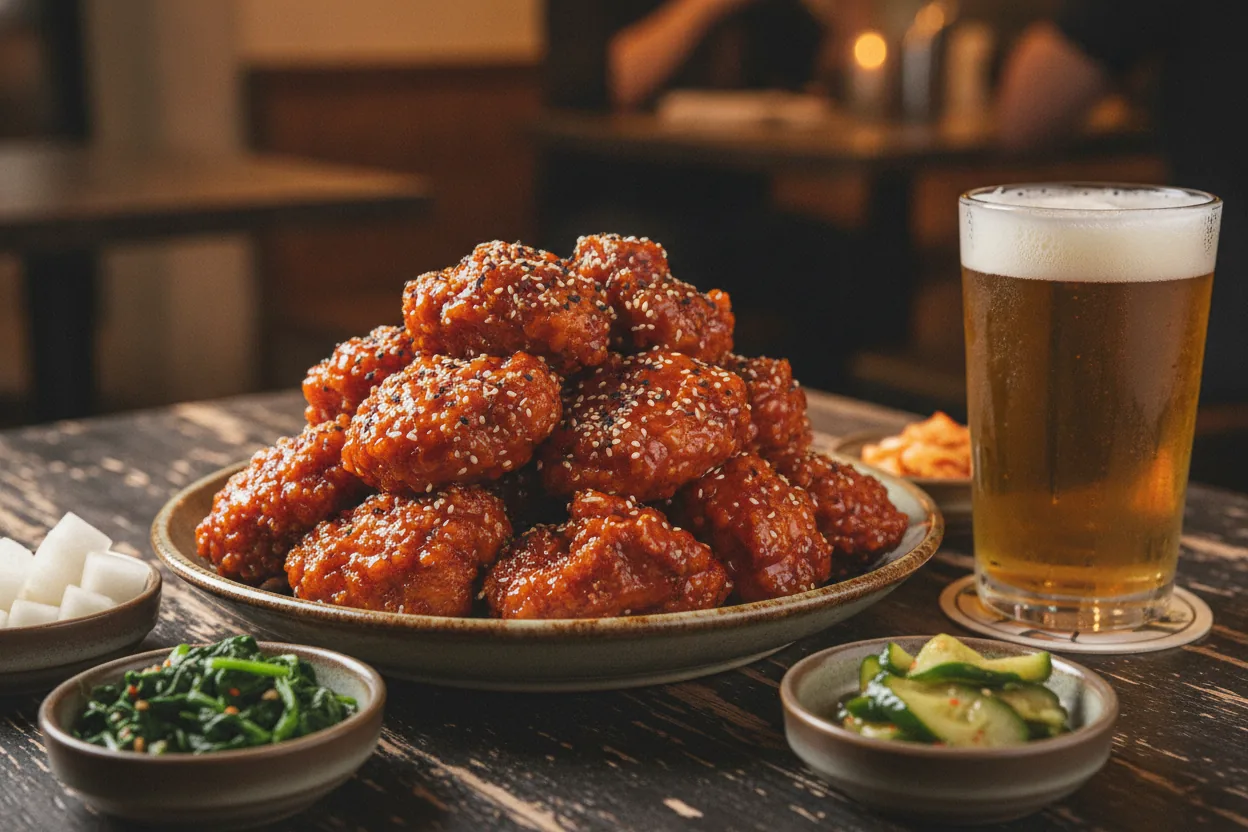
Korean Fried Chicken: A Complete Overview of the Dish
South Korea has tens of thousands of fried chicken restaurants serving a country of roughly 51 million people, yet the dish those restaurants are built around is not a variation of American fried chicken but a structurally different food engineered around motorcycle delivery, post-fry glazing, and a snack culture that has no direct American equivalent. So how did two traditions that both start with oil and a bird end up producing something so fundamentally different that comparing them by taste alone misses the point entirely?
- Korean fried chicken breaks into two core styles: plain crispy (huraideu) and sauce-glazed (yangnyeom). Yangnyeom refers to a sweet and spicy red pepper-based coating applied after frying, not before, which is the key structural difference from American preparations.
- A popular third category is the soy-garlic glaze, a savory, slightly sweet sauce coating the finished chicken. Bonchon, founded in South Korea in the early 2000s, popularized this style internationally.
- In South Korea, fried chicken is a snack or evening food, not a main meal. People eat it most commonly during afternoon hours, after work, or as a late-night delivery order, which is exactly why portion sizes and eating context feel so different from an American family-meal spread.
- The word chimaek combines chicken and maekju (beer). The pairing runs deep enough that chicken-and-beer festivals, including the annual Daegu Chimak Festival, draw over one million visitors each year.
- South Korea's estimated tens of thousands of fried chicken restaurants make it one of the most densely served foods in the country relative to population.
Korean fried chicken sits at the intersection of street food, delivery culture, and social ritual. Treating it as a snack category rather than a dinner entrée immediately reframes why its portions, coating style, and sauce philosophy are built the way they are. That reframing is what the rest of this post works through, starting with the cooking method that makes the texture possible.
Why the Cooking Method Produces a Fundamentally Different Texture and Flavor
The snack-and-delivery positioning isn't incidental to how Korean fried chicken is cooked. It's the reason the cooking method exists in its current form. The defining technical difference between Korean and American fried chicken is the double-frying method. Korean-style chicken goes into the oil once at a lower temperature to cook the meat through, comes out to rest briefly, then goes back in at a higher temperature to drive off remaining moisture in the coating. That two-stage process produces a crackly, thin crust that stays crisp longer and absorbs significantly less oil than a single-fry method, which matters enormously when the food has to survive a 30 to 40 minute motorcycle delivery to an apartment. American Southern-style fried chicken typically uses a thick flour-and-buttermilk dredge fried once, producing a dense, crunchy crust that is heavier and greasier by design.
- Korean fried chicken batter is generally made with potato starch or a rice flour blend rather than all-purpose wheat flour. The lighter molecular structure crisps faster and retains less fat during frying, a measurable difference in both texture and caloric density per serving.
- The double-fry technique is central to chains like Bonchon, whose preparation process became a point of franchise documentation. The method is specifically why the coating achieves a delicate, crackly texture rather than a thick, seasoned skin.
- Sauces like yangnyeom go on as a glaze after the second fry. The crust is already fully set before any moisture from the sauce contacts it, which preserves crispiness in a way that marinating or pre-coating with wet sauce simply cannot.
- Whole or half birds appear on menus, but individual pieces and wing sections dominate delivery orders. The wing is the premium cut in Korean fried chicken culture, the opposite of the American preference hierarchy where the breast holds that spot.
- Korean fried chicken entered global markets significantly through major communal events and growing international interest in Korean culture, with chimaek culture becoming visible outside Korea well before the Korean Wave (hallyu) brought K-drama and K-pop audiences into contact with Korean food habits.
Bonchon's expansion to the United States, opening first in Fort Lee, New Jersey in 2006, gave international audiences their first standardized exposure to the double-fried, sauce-glazed format. The brand now operates in locations across multiple countries. Since then, K-drama product placement, mukbang video culture on YouTube, and Korean diaspora communities in cities from Los Angeles to London have built local demand well ahead of any franchise supply arriving to meet it.
This brings the original question into focus. The reason two traditions that both start with oil and a bird end up so far apart isn't taste preference or regional seasoning. It's engineering. The American fast-food bucket and the Korean delivery box are solving completely different problems, and the chicken inside each reflects that directly. The double-fry, the starch-based batter, the post-fry glaze, the wing-forward cut preference: all of it answers the same design brief. A crisp, sauceable snack food that survives transit and pairs with beer. Understanding that brief is the single most useful frame any outsider can bring to Korean fried chicken culture.