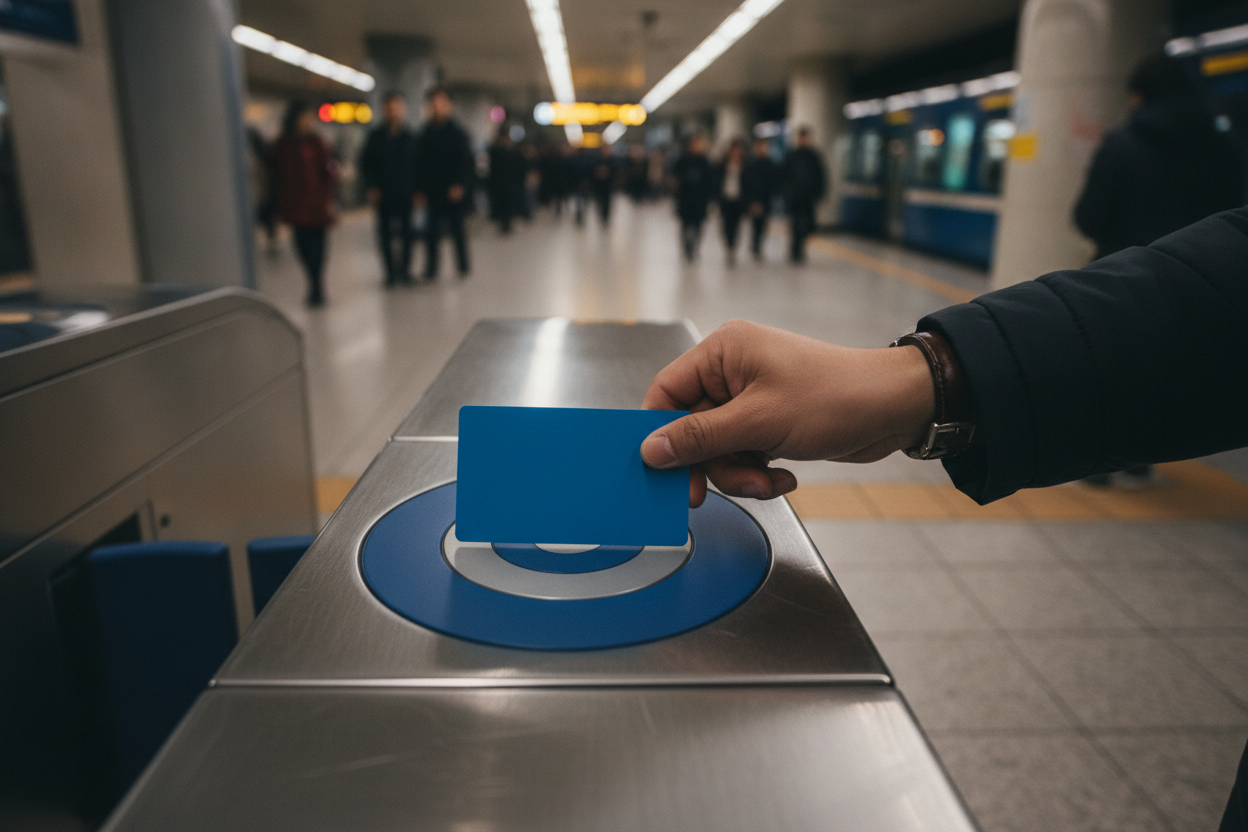
T-money: South Korea's National Transit Smart Card Overview
A single plastic card costing 3,000 won unlocks every bus, subway, taxi, airport express, and even highway toll booth across all of South Korea, yet the system was built entirely around Korean daily commuters, not the short-term foreign visitors who now depend on it heavily. That gap between who T-money was designed for and who is actually using it is exactly why picking the right card variant before you land matters far more than most travel guides admit.
- T-money works on all public transport buses nationwide, covering city buses, express buses, and rural routes across every Korean province.
- As of June 2024, the card is accepted on all six metropolitan subway networks: Seoul, Incheon, Busan, Daegu, Daejeon, and Gwangju.
- Beyond the standard metro lines, T-money covers AREX (the express train to Incheon Airport), the Shinbundang Line, U Line, EverLine, Donghae Line, and Busan-Gimhae Light Rail Transit.
- Korail ticket offices and toll booths operated by Korea Expressway Corporation also accept T-money, which makes it genuinely useful for intercity and highway travel, not just urban commuting.
- Many convenience stores, including GS25, CU, and 7-Eleven, accept T-money as a payment method for small purchases, so it functions like a prepaid debit card at the register.
The card is sold at subway station ticket machines, convenience stores, and some tourist information centers, typically for a one-time card fee of 2,500 Korean won. One card replaces the need to buy individual paper tickets for every single subway or bus journey across an entire trip. Most tourists visiting South Korea for more than a day will find T-money faster and cheaper than alternatives. The card also gives a small transfer discount when switching between buses, or between a bus and the subway, within a limited transfer window. That discount adds up quickly if you're moving around a lot.
Practical Details Foreign Visitors Need Before Using T-money in Seoul
Knowing T-money's nationwide reach is only half the picture. The other half is knowing where the system's assumptions about its users break down for foreign visitors specifically. Foreigners can buy a standard T-money card at any convenience store inside or near a subway station, no Korean ID or residency required. The card loads Korean won only, so visitors must either bring cash or use a foreign credit card at designated reload kiosks now available at major Seoul stations. As of 2026, an ongoing policy shift in South Korea is allowing some foreigners to tap international credit cards directly on transit readers, though the rollout is still partial and T-money remains the most reliable payment method for Seoul subway and bus journeys right now.
- Standard T-money cards carry a small one-time purchase fee, with reloading available at convenience store counters, subway station kiosks, or T-money's own reload machines. There is a low minimum top-up amount and a set ceiling on how much the card can hold.
- The Wow Pass, a competing card sold at airport and city kiosks, functions as both a T-money transit card and a Korean debit card. Foreigners can load funds via app using a foreign bank card, cutting out the need to handle Korean won cash entirely.
- Seoul Citypass Plus is a T-money variant designed for tourists that bundles transit access with discounts at major attractions, available at Incheon Airport arrival halls and central Seoul tourism offices.
- T-money Mpass is a one-day card combining unlimited metropolitan transport use with entry to the Seoul City Tour Bus, a solid option for visitors who want to cover significant ground in a single day without tracking individual fares.
- Mobile T-money is available as an NFC-based app on Google Play, letting compatible Android phones work as a T-money card without any physical card. iPhone compatibility is also available via the MobileTmoney app on the App Store, which supports iPhone and Apple Watch as of mid-2026.
Refunds on unused T-money balance are available at convenience stores for amounts under a certain threshold, with a small processing fee deducted. Larger balances require a visit to a T-money customer service center, which is its own kind of adventure if you're on a tight departure schedule. The refund and foreign-card processes were never designed with short-term tourists in mind, and it shows. Visitors who choose the Wow Pass for app-based reloading, or who keep their T-money balance modest toward the end of a trip, will sidestep the most common inconveniences that catch first-timers off guard. The right card, selected before boarding the AREX from Incheon, is the single decision that determines whether T-money accelerates a visit or quietly complicates it.