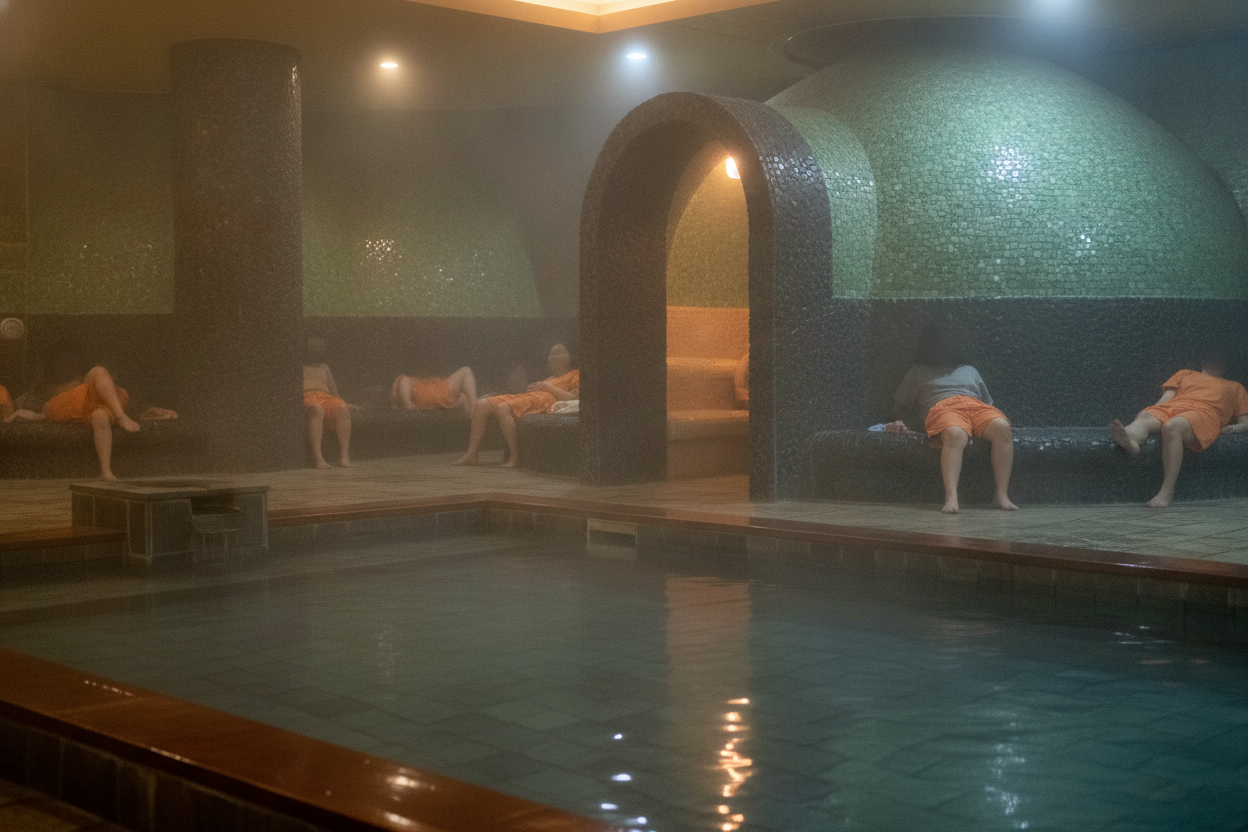
What a Jjimjilbang Actually Is: Korea's All-in-One Wellness Complex
Most international visitors to Seoul walk past 24-hour jjimjilbang complexes without ever figuring out what happens inside, or how to survive the first five minutes without committing the space's most serious etiquette violation. Which is a shame, because a full night's sleep, a multi-hour soak, and access to heated clay rooms packed with jade and charcoal walls will run you somewhere between 7 and 11 USD. The real question is what you actually do once you walk through the door.
- The word breaks down as jjimjil (steaming or heating the body) combined with bang (room), which points directly at the whole point: thermal treatment.
- Two distinct zones define every jjimjilbang. The mogyoktang is the gender-separated wet bathing area where nudity is required. Then there's the communal floor area where all genders mix, everyone wearing the provided shorts and T-shirt.
- Larger facilities, including well-known chains like Dragon Hill Spa in Yongsan-gu, layer on karaoke rooms, arcades, food courts, and cold plunge pools on top of the standard sauna lineup.
- The thermal rooms use traditional Korean heating materials: yellow clay, jade, charcoal, and salt bricks line the walls of different chambers, each held at a different temperature to produce varied effects.
- Jjimjilbangs are nothing like upscale day spas. The vibe is deliberately casual, multi-generational, and family-oriented. Grandparents and small children share the same heated floor without anyone treating that as unusual.
What makes jjimjilbang culturally significant beyond simple bathing is that communal hygiene and relaxation have been woven into Korean social life for centuries, predating modern plumbing and continuing long after it arrived. For a foreign visitor, the space offers something genuinely rare: a completely non-performative slice of everyday Korean life that tourist sites almost never deliver. Most foreigners who skip it leave Seoul having seen the surface. Those who go understand something the guidebooks cannot stage. That understanding starts with knowing how to actually move through the space.
The Step-by-Step Process Every First-Time Foreign Visitor Needs to Know
The practical sequence inside a jjimjilbang is straightforward once you know it, but almost nothing about it is intuitive if you grew up using private bathrooms in a Western country. Everything starts at the entrance desk. You pay admission (typically 10,000 to 15,000 Korean won for a standard daytime visit, with overnight fees running higher), and in return you get a wristband or receipt tied to a locker number, a small towel, and the uniform-style shorts and T-shirt that mark you as a paying guest in the communal areas.
- Step 1, shoe locker: Shoes come off and go into a small locker near the door, usually numbered to match your wristband, before you go anywhere else in the building.
- Step 2, the mogyoktang (bathing area): You enter the gender-separated wet zone, undress completely, and take a thorough shower before going anywhere near the pools. Skipping that shower is the single most serious etiquette violation in the entire space. Don't do it.
- Step 3, pool use and body scrubbing: The pools are for soaking, not cleansing. Optional Italy towel scrub services (called ttaemill) are available for an additional fee, typically 18,000 to 38,000 won, and involve a dedicated attendant exfoliating your entire body. It sounds intense. It kind of is, and it's also excellent.
- Step 4, communal floor area: Change into the provided shorts and T-shirt and head to the mixed-gender floor. Heated clay or stone floors are where most Koreans spend hours napping, watching television, or eating snacks from the in-house food stand. This is the heart of the experience.
- Step 5, thermal sauna rooms: Rotate freely through the individual sauna chambers for the rest of your visit. Each room runs at a different temperature with different wall materials, and moving between rooms and resting on the communal floor repeatedly over 2 to 5 hours is exactly how locals use the place.
Two practical realities deserve direct acknowledgment. First, nudity in the mogyoktang is non-negotiable and completely non-sexual. Koreans have bathed communally since childhood, the atmosphere is matter-of-fact, and visible self-consciousness tends to stand out far more than simply participating. Foreigners, particularly those presenting as a different race, may get curious glances in the bathing area. Those reactions come from genuine unfamiliarity, not hostility. Second, English signage is inconsistent across facilities outside major tourist-district locations like Dragon Hill Spa, so learning three words before you arrive (mogyoktang for bathing room, sauna, and yeosung/namsung for female/male) removes most of the navigation friction.
Low cost, no reservation required, no fluent Korean needed: that combination is exactly why travel communities consistently rank jjimjilbang among the highest-value stops in any Seoul itinerary. Can you manage it without embarrassing yourself? Yes. The sequence is simple, the etiquette collapses into one rule above all others (shower before the pool), and the visitor who spends an afternoon on a heated clay floor walks out knowing something about Seoul that a full week of photographing palaces and markets simply cannot provide.